In 2021, when Eric Esrailian, MD, MPH, was awarded the Benemerenti Medal from Pope Francis for his humanitarian work, he recognized other people worldwide who save lives daily – but without recognition. They’re motivated for “the right reasons. To be clear, I do not deserve this honor. It is honestly overwhelming and humbling,” he said in 2021 when news of the award reached him in Los Angeles where he holds the Lincy Foundation Chair in Clinical Gastroenterology at the University of California, Los Angeles. He also serves as chief of the Vatche and Tamar Manoukian Division of Digestive Diseases, and director of the Melvin and Bren Simon Digestive Diseases Center.
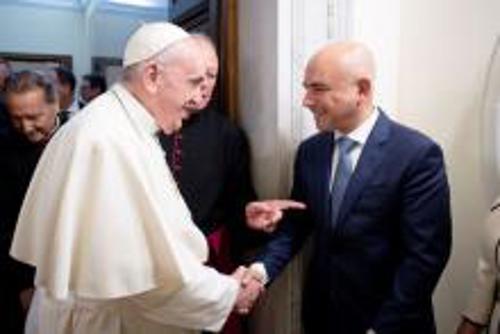
Courtesy Dr. Eric Esrailian
Pope Francis with Dr. Eric Esrailian.
Dr. Esrailian, the son of Armenian immigrants, says that humanitarian work has been ingrained in him since childhood. His great-grandparents were Armenian genocide survivors and their struggles have never left him. He’s devoted his life not only to medicine, but to documenting the history of the Armenian genocide and leading, or supporting, efforts to resolve humanitarian crises in Armenia and around the world. Earlier this year, he, with Kim Kardashian and singer/actor Cher, published op-eds that addressed a humanitarian crisis building as a result of Azerbaijan’s blockade of the Lachin corridor – which is the only road that links Armenia to the ethnic Armenian–populated sections of Nagorno-Karabakh. In September, Armenia and Azerbaijan reached a tentative agreement to end the blockade, but more needs to be done, he says. Tragedies continue to unfold, and he is redoubling his efforts to bring more attention to this humanitarian crisis, he said.
Because storytelling is an important part of raising awareness, in 2016 Dr. Esrailian and partners produced two films about stories of perseverance, endurance, and the inextinguishable fire of the human spirit. The first film was “The Promise,” a historical war drama set in the Ottoman Empire and released in 2016. In 2017, he and partners released “Intent to Destroy: Death, Denial, & Depiction,” a documentary about the Armenian genocide. The documentary received an Emmy nomination for Outstanding Historical Documentary. And, in 2020, he produced “Francesco,” a film about Pope Francis that documented his pilgrimage to Armenia in 2016.
“The Promise” had such an impact on viewers that in 2017 Dr. Esrailian and the UCLA School of Law created The Promise Institute for Human Rights as a center of human rights education, research, and advocacy. In 2019, Dr. Esrailian and UCLA followed up with The Promise Armenian Institute as a place for academic research and teaching of Armenian studies, language, and culture. “The impact from building these two institutes has been transformational, and they will be part of UCLA forever,” he said.
His philanthropic efforts connecting health, human rights, education, and the arts has had an impact worldwide. One person can make a difference, Dr. Esrailian said: “I’ve learned along the way that an individual can have more of an impact than ever imagined, but you have to dream big and never give up.”
In this interview, he tells us more about his work.
Q: Not many doctors wear hats in medicine and filmmaking. Describe your journey as a filmmaker.
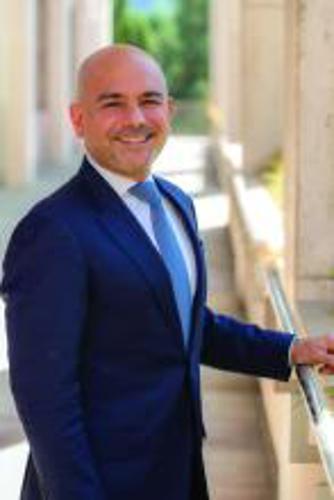
Dr. Eric Esrailian
Dr. Esrailian: I’ve always been interested in storytelling. I was an English minor at Berkeley. My late mentor, Kirk Kerkorian, a legendary philanthropist, businessman, and entrepreneur, pushed me to take storytelling and do something that would potentially help secure Armenian Genocide recognition by the United States. Because of genocide denialists and geopolitical pressure, he felt the United States government was reluctant to recognize the Armenian Genocide. He thought having some visual materials for educational and outreach efforts would be transformational, and as it turns out, they were.
If you talk to any advocacy organization that tried for years to get Armenian Genocide recognition, they’d say that both films, “The Promise” (a feature film) and “Intent to Destroy” (a documentary), and the social impact media campaign we launched around them, were influential in moving the needle with legislators in the United States who, 3 years after “The Promise” was released, recognized the genocide. This was followed by the Library of Congress in 2020 and President Biden’s executive branch in 2021.
Q: What has been your most rewarding accomplishment?
Dr. Esrailian: Giving a voice to people who don’t have a voice is something that I’m proud of. Sometimes, it’s questionable what impact it may have because we still see atrocities committed all over the world. In September, Azerbaijan completed an ethnic cleansing campaign of Armenians from a region called Artsakh, officially the Republic of Nagorno-Karabakh.
Despite having so many relationships with powerful people in government and in high-profile media, and despite our documentaries, op-eds, and interactions with influential leaders on a regular basis, it always feels like it’s not enough. Obviously, the perpetrators are still able to abuse human rights and conduct these campaigns. Nevertheless, I don’t think we should be deterred. Allowing human rights violations to occur with impunity only emboldens perpetrators even more. It takes a long time to bring people to justice through international courts, but it does happen – eventually. That’s something I’m going to continue to work on.
Q: What should be the role of physicians in supporting human rights?
Dr. Esrailian: Physicians and health care providers play an important role in human rights. If you look back throughout history, whether it’s the International Committee of the Red Cross, or Doctors Without Borders, or other organizations, physicians and health care professionals are often on the front lines, helping people. Unfortunately, physicians have also been part of human rights violations, like the Holocaust or other genocides. But I do think that in this day and age, with the reputation that physicians have, we can be policy advocates and upstanders in addition to taking care of patients. Telling our stories to the world is important so that people know what’s actually happening on the ground.
Lightning round
Do you prefer texting or talking?
Talking
How many cups of coffee do you drink each day?
Two
What was the last movie you watched?
Mission Impossible
If you weren’t a gastroenterologist, what would you be?
Entrepreneur
Who inspires you?
My family