Introduction
Substance use disorders (SUDs) represent one of the most prevalent chronic diseases in the United States and are a major driver of morbidity and mortality across a spectrum of gastrointestinal (GI) and liver diseases. SUD is defined by the Diagnostic and Statistical Manual of Mental Disorders, Fifth Edition (DSM-5) as a cluster of cognitive, behavioral and physiological symptoms in which an individual continues using a substance despite significant substance-related problems.¹ In 2024, approximately 48 million people in the United States met criteria for an SUD, yet most did not receive specialty treatment.²
As patients with SUDs may initially present with GI-related complaints, GI providers are uniquely positioned to intervene during these encounters. The purpose of this review is to equip the general gastroenterologist and hepatologist with the knowledge and tools needed to identify SUDs, initiate evidence-based treatment and connect patients to longitudinal care.
Gastrointestinal and liver manifestations of SUDs
Alcohol
Alcohol consumption is associated with a range of GI and liver-related diseases. Alcohol-associated liver disease (ALD) encompasses a broad spectrum of disease from isolated steatosis to cirrhosis.³ ALD is now the leading indication for liver transplantation in the United States, and its morbidity and mortality continue to rise.⁴ Beyond the liver, alcohol reduces lower esophageal sphincter pressure, contributing to gastroesophageal reflux and erosive esophagitis. Ethanol and its metabolites also directly injure pancreatic acinar and ductal cells, causing premature enzyme activation and inflammation that underlie both acute and chronic pancreatitis. Alcohol use further confers an elevated risk of esophageal, gastric and colorectal cancers.⁵
Opioids
Opioids are implicated in a range of GI disorders through their effects on the enteric nervous system that disrupt motility, secretory and sphincteric function, and intestinal barrier integrity.⁶ In the esophagus, opioids can induce distal esophageal spasm, type III achalasia or esophagogastric junction outflow obstruction by impairing inhibitory neurons in the myenteric plexus. In the stomach and duodenum, opioids delay gastric emptying and impair motility, which can cause nausea and vomiting, early satiety and postprandial fullness, known as opioid-induced gastroparesis.⁷ Opioids also reduce colonic peristalsis and intestinal secretions, prolong transit and lead to dyssynergic defecation, which can result in opioid-induced constipation (OIC).⁶ Narcotic bowel syndrome is an underrecognized disorder of gut-brain interaction in which abdominal pain progresses and paradoxically worsens with continued opioid use.⁸ Conversely, opioid withdrawal drives noradrenergic rebound in the enteric nervous system, leading to nausea, vomiting, abdominal cramping and diarrhea.⁹ These symptoms can mimic other acute gastrointestinal processes, so opioid withdrawal should remain on the differential when they are present.
Intravenous drug use associated with opioid use disorder (OUD) drives the majority of new hepatitis C virus (HCV) infections in the United States. Untreated HCV causes hepatic fibrosis in a significant proportion of individuals, with roughly 20% to 30% developing cirrhosis over 20 to 30 years.¹⁰
Cannabis
Cannabis use is increasingly common among patients with GI symptoms, and many patients specifically self-medicate with cannabis to treat nausea, vomiting or abdominal pain. Cannabinoids act via CB1 and CB2 receptors throughout the enteric nervous system, modulating motility, secretion, visceral pain and inflammation. With chronic, daily use, patients can develop cannabis hyperemesis syndrome (CHS), characterized by cyclical episodes of severe nausea, vomiting and abdominal pain.¹¹ Because patients often use cannabis specifically for these same symptoms, they may be reluctant to consider it as the cause, and may even increase use in response to worsening symptoms, making cessation counseling challenging in practice.
Tobacco
Tobacco use disorder independently worsens GI and hepatic outcomes. With effects mediated by oxidative stress, immune dysregulation and oncogenic pathways driven by numerous carcinogens, tobacco use is a risk factor for esophageal, gastric, pancreatic and colorectal cancers.¹² Tobacco use is also associated with an increased risk of peptic ulcer disease, Crohn's disease, acute and chronic pancreatitis, and pancreatic exocrine insufficiency. Smoking also promotes hepatic fibrosis, increases the risk of hepatocellular carcinoma and worsens post-transplant outcomes.¹³
Management of SUD in GI practice
Recognizing and diagnosing SUD
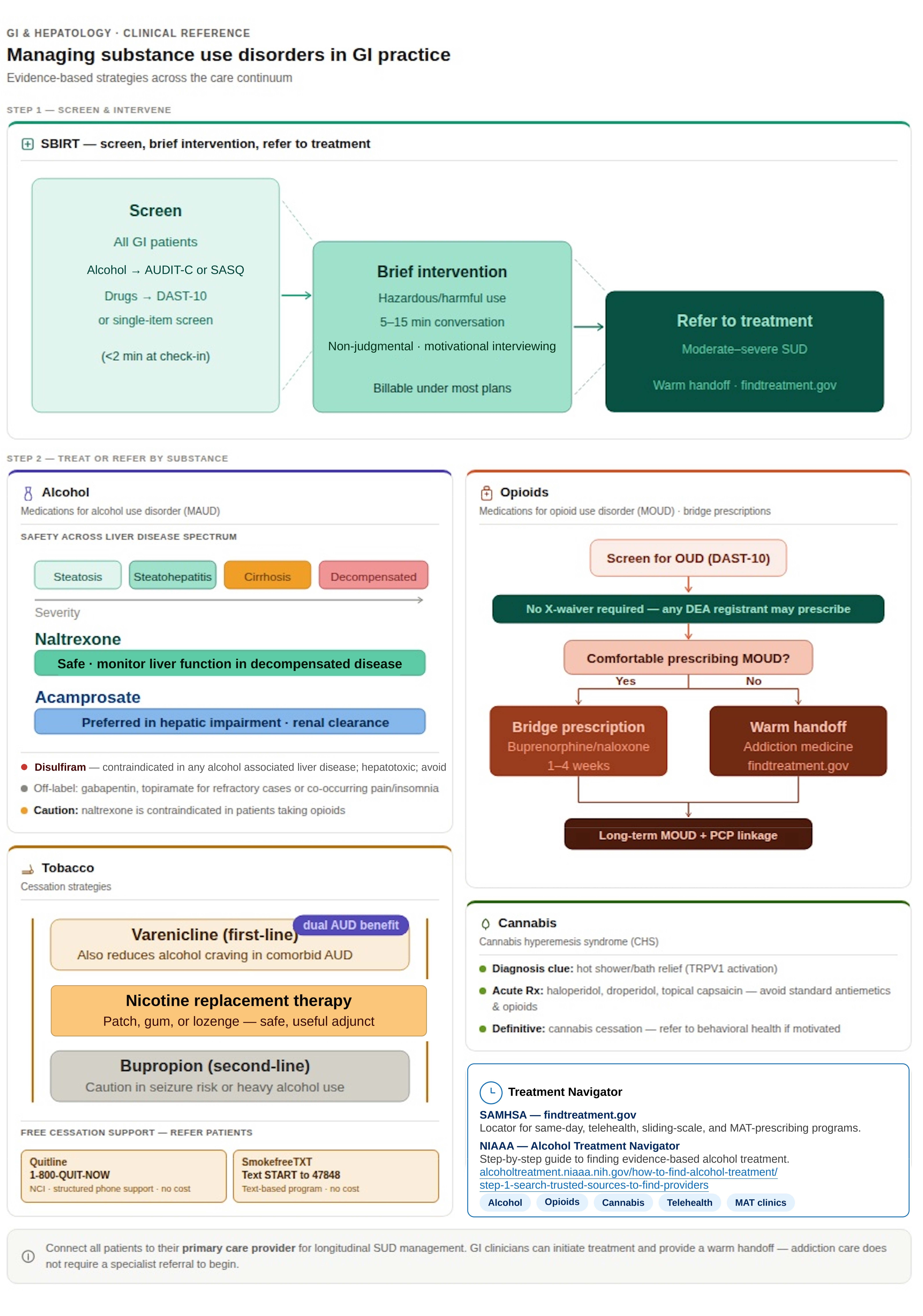
The first step in managing GI and liver-related complications of SUDs involves SUD screening and diagnosis. Validated screening tools for SUDs can be easily integrated into GI clinic workflows. For alcohol, the Single Alcohol Screening Questionnaire (SASQ) or AUDIT-C (a three-item condensed version of the Alcohol Use Disorders Identification Test) demonstrate high sensitivity and can be administered in less than one minute.¹⁴ For opioids, the Drug Abuse Screening Test (DAST-10) or single-question screens such as “How often in the past year have you used drugs other than as prescribed?” provide rapid risk stratification.¹⁵ Formal SUD diagnosis under DSM-5 criteria requires identifying at least two of 11 criteria within a 12-month period.¹
SBIRT: A framework for intervention
Screening, Brief Intervention and Referral to Treatment (SBIRT) is an evidence-based, public health approach to identify, engage and refer patients to treatment. The three-step model involves: (1) Screening using a validated tool; (2) a Brief Intervention — a focused, nonjudgmental conversation lasting five to 15 minutes that provides feedback, raises awareness of health consequences and explores motivation for change; and (3) Referral to Treatment for patients with moderate-to-severe SUD.¹⁶
As part of brief intervention in GI clinics, motivational interviewing (MI) should be incorporated to build rapport with patients and enhance motivation for behavior change. MI can be described using the “OARS” acronym: Open-ended questions; Affirmations of positive thoughts, actions or ideas; Reflections that indicate you hear and understand; and Summarizing basic reflections.¹⁶ See Table 1 for a review of these principles in a case example adapted from Deutsch-Link et al.¹⁷
For referral to treatment, the Substance Abuse and Mental Health Services Administration's findtreatment.gov is a publicly available, searchable database of local treatment facilities that clinicians can share directly with patients. Another option is performing warm handoffs to primary care providers for ongoing coordination of care.
Medications for alcohol use disorder
Despite robust evidence for efficacy, medications for alcohol use disorder (AUD), or MAUD, remain underutilized. There are three FDA-approved medications for AUD: naltrexone, acamprosate and disulfiram. However, disulfiram should be avoided in liver disease due to the risk of hepatotoxicity.
Naltrexone, available as a once-daily oral tablet or monthly intramuscular injection (Vivitrol), is a first-line agent. Though historically avoided in liver disease, multiple retrospective studies now support its safety in ALD, including in decompensated disease (Child-Pugh Class B/C).¹⁸ Of note, naltrexone is contraindicated in patients on chronic opioids or opioid agonist therapy (methadone or buprenorphine).
Acamprosate is another first-line MAUD and, due to primary renal excretion, represents an excellent option for patients with decompensated cirrhosis and preserved renal function. For patients with severe renal impairment (CrCl ≤30 mL/min), acamprosate is contraindicated. Baclofen, a GABA-B agonist with predominantly renal clearance, is the only MAUD with randomized trial data in cirrhosis, although studies have demonstrated mixed efficacy. Gabapentin and topiramate, both used off-label, offer additional options for patients who cannot tolerate first-line agents or who have co-occurring pain or sleep disturbances.¹⁷
A recent meta-analysis of randomized controlled trials in patients with AUD and cirrhosis showed that MAUD use was associated with a 32% increase in alcohol abstinence.¹⁹ We encourage GI clinicians to incorporate MAUD into the care of patients with ALD. GI clinics represent an underutilized opportunity to expand access to safe and effective treatment.
Medications for opioid use disorder
Medications for opioid use disorder (MOUD) — buprenorphine, methadone and extended-release naltrexone — are the most effective treatments for OUD and reduce overdose mortality by more than 50%. Historically, buprenorphine required a special DEA waiver (the “X-waiver”), but this was eliminated in 2023, meaning any prescriber with a standard DEA registration can now prescribe buprenorphine for OUD.²
GI providers who feel comfortable may prescribe buprenorphine as a bridge prescription — a short-term course (typically one to four weeks) to stabilize a patient in withdrawal and link them to a primary prescriber or addiction medicine program. Otherwise, the essential role is to screen for OUD, engage the patient without stigma and provide a warm handoff to addiction medicine, primary care or a bridge clinic. The findtreatment.gov website identifies OUD treatment programs by ZIP code. Of note, buprenorphine is generally considered safe in patients with compensated liver disease and can be used with appropriate monitoring in more advanced disease.
For OIC, stimulant or osmotic laxatives should be initiated early. When ineffective, peripherally acting µ-opioid receptor antagonists (PAMORAs), including oral naloxegol (Movantik) or methylnaltrexone (Relistor, available as subcutaneous or oral formulations), are evidence-based treatment options that can substantially improve symptoms.⁶
Cannabis hyperemesis syndrome
The only definitive treatment for CHS is cannabis cessation — a fact that must be communicated clearly and compassionately to patients — though several adjunctive agents can improve symptoms while patients work on abstinence. In the acute setting, haloperidol, droperidol and topical capsaicin (applied to the abdomen) have demonstrated symptom relief. Benzodiazepines and aprepitant have also shown benefit in case series and small studies. Standard antiemetics and opioids have not demonstrated significant benefit. Finally, amitriptyline, which is used in idiopathic cyclic vomiting syndrome, may be considered in patients who experience difficulty stopping cannabis.¹¹
Tobacco cessation strategies
Tobacco cessation counseling is among the highest-yield interventions available to GI clinicians and offers meaningful risk reduction. The “5 A's” framework — Ask, Advise, Assess, Assist and Arrange — is one practical approach. Even brief physician counseling (fewer than three minutes) meaningfully increases quit rates, and the combination of behavioral counseling with pharmacotherapy is substantially more effective than either modality alone.²⁰
Varenicline (Chantix), a partial agonist at the α4β2 nicotinic acetylcholine receptor, is the most effective single agent for tobacco cessation. Nicotine replacement therapy remains a first-line option and is particularly well-suited for patients with prior intolerance to varenicline.²¹ Providers should also offer a referral to the National Cancer Institute's quitline (1-800-QUIT-NOW) or the text-based SmokefreeTXT program, both of which provide structured support at no cost to the patient.
Conclusions
Ultimately, gastroenterologists and hepatologists routinely encounter patients at sentinel moments along the care trajectory — a new diagnosis of alcohol-associated hepatitis, a hospitalization for opioid-induced bowel dysfunction, an episode of cannabis hyperemesis or a complication of acute pancreatitis. These moments can serve as powerful catalysts for SUD treatment engagement. The gastroenterologist or hepatologist who recognizes this opportunity, and is equipped with the screening tools and prescribing knowledge to act on it, can fundamentally alter the course of a patient's disease. Closing the gap between SUD identification and treatment initiation requires a workforce of GI clinicians who are trained to screen for SUD, initiate a brief intervention and connect patients to evidence-based treatment.
Table 1. Motivational interviewing for gastroenterologists and hepatologists. Case example: A patient with compensated alcohol-associated cirrhosis continues to consume alcohol and expresses ambivalence/resistance after counseling about liver-related risks.
Motivational interviewing principle | Example statements | Clinical intent |
Open-ended questions | “Can you tell me what role alcohol plays in your life right now?” / “What concerns, if any, do you have about your drinking since being diagnosed with cirrhosis?” | Elicit patient perspective; invite discussion without judgment |
Affirmations of positive thoughts, actions or ideas | “You've been dealing with a lot medically, and it's clear you've been doing your best to manage everything.” / “It sounds like you've made changes before when things have felt urgent.” | Reinforce strengths; build rapport and trust |
Reflections that indicate you hear and understand | “It sounds like alcohol helps you cope with stress, even though you worry about the impact on your liver.” / “I'm hearing you feel pressured to stop alcohol, but you're not sure you're ready.” | Demonstrate understanding and reduce defensiveness |
Summarizing basic reflections | “Let me make sure I'm understanding: Alcohol helps you relax and feel normal, but you're also worried about worsening your liver disease and your overall health.” | Consolidate ambivalence and transition to change talk |
Express empathy | “Given all that you are dealing with and the stress of your diagnosis, it makes sense that trying to stop using alcohol feels overwhelming.” | Normalize ambivalence and maintain therapeutic alliance |
Rolling with resistance | “I hear that stopping alcohol completely feels really hard right now. Would it be okay if we explore what feels hardest about stopping?” | Acknowledge resistance and shift from resistance to exploration (with permission) |
Elicit change talk | “How does your drinking fit with what you want your health to look like in a year?” / “On a scale of 1 to 10, how important is it to you to protect your liver? I'm hearing a 7 — and why not a lower number?” | Encourage patient-generated motivation |
Link behavior to liver disease | “Would it be okay if I shared how alcohol affects cirrhosis, and then hear your thoughts?” | Provide education with permission |
Collaborative planning | “What would feel like a reasonable next step for you?” / “Would you be open to talking with someone who specializes in alcohol use while we continue managing your liver disease?” | Maintain patient autonomy and integrate addiction care |
Source: self-created, adapted from Deutsch-Link et al.¹⁷
References
American Psychiatric Association. Diagnostic and Statistical Manual of Mental Disorders. DSM-5-TR. American Psychiatric Association Publishing; 2022. doi:10.1176/appi.books.9780890425787
SAMHSA Releases Annual National Survey on Drug Use and Health. SAMHSA. Accessed May 5, 2026. https://www.samhsa.gov/newsroom/press-announcements/20250728/samhsa-releases-annual-national-survey-on-drug-use-and-health
Bataller R, Arab JP, Shah VH. Alcohol-Associated Hepatitis. Hardin CC, ed. N Engl J Med. 2022;387(26):2436-2448. doi:10.1056/NEJMra2207599
Wong RJ, Singal AK. Trends in Liver Disease Etiology Among Adults Awaiting Liver Transplantation in the United States, 2014-2019. JAMA Netw Open. 2020;3(2):e1920294. doi:10.1001/jamanetworkopen.2019.20294
Meza V, Arnold J, Díaz LA, et al. Alcohol Consumption: Medical Implications, the Liver and Beyond. Alcohol Alcohol. 2022;57(3):283-291. doi:10.1093/alcalc/agac013
Lacy BE, Cangemi DJ. Opioids and the Gastrointestinal Tract: The Role of Peripherally Active µ-Opioid Receptor Antagonists in Modulating Intestinal Permeability. Am J Gastroenterol. 2024;119(10):1970-1978. doi:10.14309/ajg.0000000000002887
Patel D, Callaway J, Vaezi M. Opioid-Induced Foregut Dysfunction. Am J Gastroenterol. 2019;114(11):1716-1725. doi:10.14309/ajg.0000000000000354
Fukudo S, Aziz Q, Drossman DA, et al. Centrally Mediated Disorders of Gastrointestinal Pain. Gastroenterology. 2026;170(6):1283-1302. doi:10.1053/j.gastro.2025.12.038
Burma NE, Kwok CH, Trang T. Therapies and mechanisms of opioid withdrawal. Pain Manag. 2017;7(6):455-459. doi:10.2217/pmt-2017-0028
Lingala S, Ghany MG. Natural History of Hepatitis C. Gastroenterol Clin North Am. 2015;44(4):717-734. doi:10.1016/j.gtc.2015.07.003
Rubio-Tapia A, McCallum R, Camilleri M. AGA Clinical Practice Update on Diagnosis and Management of Cannabinoid Hyperemesis Syndrome: Commentary. Gastroenterology. 2024;166(5):930-934.e1. doi:10.1053/j.gastro.2024.01.040
Li LF, Chan RLY, Lu L, et al. Cigarette smoking and gastrointestinal diseases: the causal relationship and underlying molecular mechanisms (review). Int J Mol Med. 2014;34(2):372-380. doi:10.3892/ijmm.2014.1786
El-Azab G, Elkhouly E, Abouyoussef R, Nagdy H. Smoking and liver diseases: an updated review of pathogenesis, progression, and therapeutic implications. Clin Exp Med. 2026;26(1):51. doi:10.1007/s10238-025-01922-6
O'Connor EA, Perdue LA, Senger CA, et al. Screening and Behavioral Counseling Interventions to Reduce Unhealthy Alcohol Use in Adolescents and Adults: Updated Evidence Report and Systematic Review for the US Preventive Services Task Force. JAMA. 2018;320(18):1910-1928. doi:10.1001/jama.2018.12086
Smith PC, Schmidt SM, Allensworth-Davies D, Saitz R. A single-question screening test for drug use in primary care. Arch Intern Med. 2010;170(13):1155-1160. doi:10.1001/archinternmed.2010.140
Lundahl B, Droubay BA, Burke B, et al. Motivational interviewing adherence tools: A scoping review investigating content validity. Patient Educ Couns. 2019;102(12):2145-2155. doi:10.1016/j.pec.2019.07.003
Deutsch-Link S, Byers IS, Gu H, Arab JP. Addiction in Gastrointestinal and Liver Disorders. Am J Gastroenterol. Published online January 21, 2026. doi:10.14309/ajg.0000000000003925
Thompson R, Taddei T, Kaplan D, Rabiee A. Safety of naltrexone in patients with cirrhosis. JHEP Rep Innov Hepatol. 2024;6(7):101095. doi:10.1016/j.jhepr.2024.101095
Gratacós-Ginès J, Bruguera P, Pérez-Guasch M, et al. Medications for alcohol use disorder promote abstinence in alcohol-associated cirrhosis: Results from a systematic review and meta-analysis. Hepatology. 2024;79(2):368-379. doi:10.1097/HEP.0000000000000570
Clinical Practice Guideline Treating Tobacco Use and Dependence 2008 Update Panel, Liaisons, and Staff. A clinical practice guideline for treating tobacco use and dependence: 2008 update. A U.S. Public Health Service report. Am J Prev Med. 2008;35(2):158-176. doi:10.1016/j.amepre.2008.04.009
Nides M, Oncken C, Gonzales D, et al. Smoking cessation with varenicline, a selective alpha4beta2 nicotinic receptor partial agonist: results from a 7-week, randomized, placebo- and bupropion-controlled trial with 1-year follow-up. Arch Intern Med. 2006;166(15):1561-1568. doi:10.1001/archinte.166.15.1561