Introduction
Millions of patients consume social media content about health care daily. Nearly 80% of Americans search social media for health information.1 Whether accurate or not, social media serves as a major source of information influencing health decisions. As health professionals, it is our responsibility to understand, educate, and provide evidence-based information for patients where they are actively seeking information. Most health information created online is by individuals without professional expertise.2 As clinicians engage in social media, they must ensure patient privacy, professionalism, transparency, and information integrity. Prior guidance for gastroenterologists has addressed these issues,3 but newer information-sharing platforms, such as TikTok, Instagram, and YouTube, necessitate updated information that reflects their unique characteristics. Rather than discouraging clinicians, this article aims to provide a timely legal and ethical framework for clinicians to implement before engaging in social media content creation.
Patient privacy
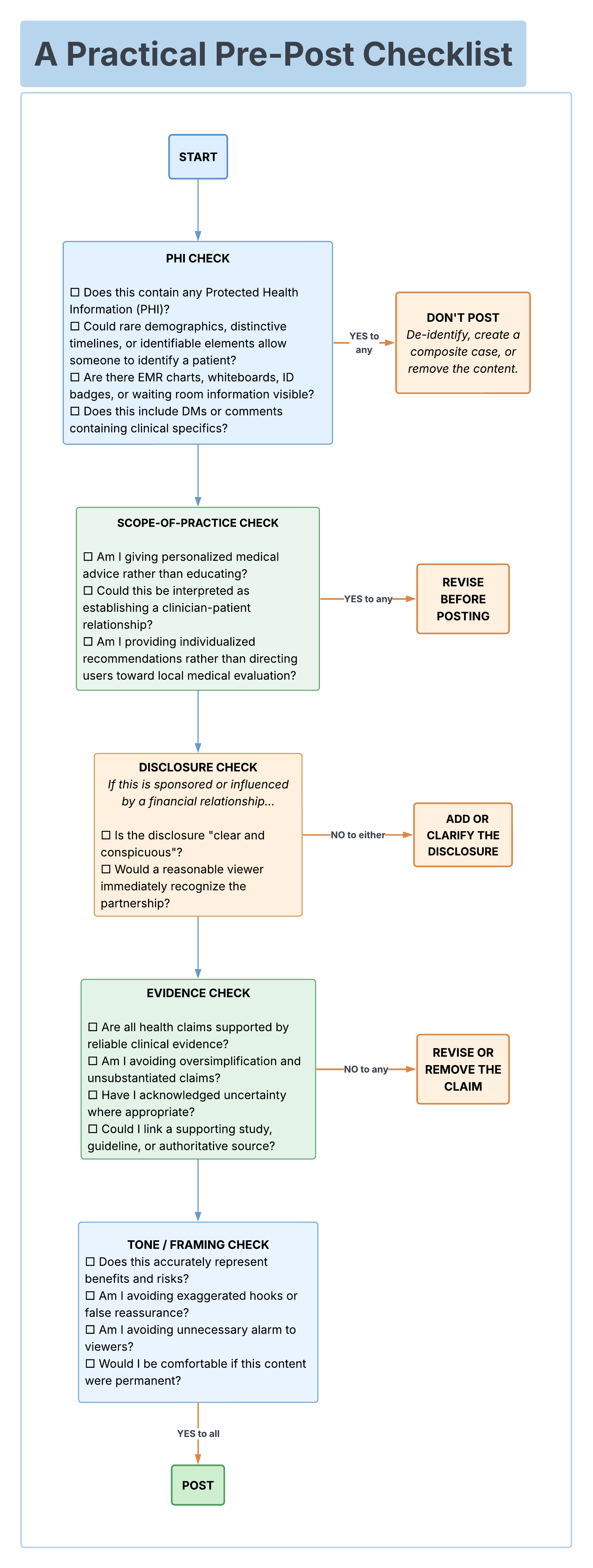
Although the Health Insurance Portability and Accountability Act (HIPAA) predates social media, the U.S. Department of Health and Human Services has repeatedly affirmed its protection of patient privacy. The revised Privacy Rule, a subsection of HIPAA, indicates all individually identifiable health information known as protected health information (PHI) must be protected, including online.4 Exposure of PHI on social media is a serious violation of these regulations. The most common pitfalls fall into four distinct categories.
In medical education, composite cases are useful for teaching, but if too specific, rare demographics and distinctive timelines can identify a patient despite the omission of names.
Videos taken in a clinical setting can inadvertently capture PHI or individuals such as patients without their consent.
Social media direct messages between clinicians and users can become a liability once clinical specifics are disclosed. Despite the seemingly private conversation space, the exchange becomes a documented record, lacks the security to protect PHI, and introduces medicolegal risk.
Comment sections on social media posts often include self-disclosed PHI. Clinicians should be careful not to confirm or expand on such comments.
To avoid potential HIPAA violations, clinicians should employ practical guardrails. For case composites, consider following the “two-patient rule” to reduce the risk of identification. Some clinicians on social media include de-identified patient images for teaching purposes on social media, but this practice should be exercised with caution and ensure patient consent. A safer practice clinicians should consider is to limit images to what is already publicly available. Finally, clinicians can employ automated messaging on social media platforms to direct users toward individualized medical evaluation instead of general online advice. The American Medical Association’s social media use guidelines emphasize that any content published on the internet is permanent and thus should be approached as an ongoing professional responsibility to protect patient privacy.5
Clinician-patient relationship
There exists a legal gray zone between providing information online and giving medical advice. At what point does a clinician providing information online evolve into medical advice? Unfortunately, there is no uniform answer. Although the general idea is that personalized medical care should not be discussed online, there is much state-by-state variability in what constitutes establishing a clinician-patient relationship. While some states require explicit consent, others are more context-dependent and driven by what a reasonable patient deems important.6 The closest analogy to navigating these boundaries is telemedicine. A clinician is typically required to hold licensure in the patient’s state for any synchronous clinical exchange. However, social media content reaches a national audience of 50 states simultaneously. Standardized rules do not yet exist for social media education. Whether licensure requirements should extend to social platforms remains an active debate, especially if a patient in another state is harmed based on information from social media.7
Another sensitive area of clinician-patient relationships includes online reviews or complaints. While it may be tempting to respond, a patient posting their own medical information does not waive their HIPAA rights. If a clinician confirms these details in a response, this exchange becomes evidence in litigation and a potential HIPAA violation. Disclaimers such as “not medical advice” may help but are not dispositive. Instead, clinicians are advised to direct followers to seek individualized medical care and avoid personalized comments. Malpractice policies do not commonly cover social media activity by default. Limited liability companies may offer some protection, but regardless, clinicians should consult their employer’s specific policies before posting. Some companies explicitly forbid employees from posting on social media, while others claim copyright or ownership of any content created by clinicians under their employment.
Brand partnerships
Clinicians are among the most trusted voices on social media and brands are eager to partner with clinicians to create promotional content. Producing sponsored content in exchange for financial compensation can be polarizing and is heavily scrutinized by regulatory agencies such as the Federal Trade Commission (FTC). Additionally, clinicians on social media risk loss of trust among followers by engaging in financial relationships in exchange for sponsored content. Some clinicians explicitly choose not to engage in external partnerships or mention specific brands in their non-sponsored (organic) content.
Nevertheless, many prominent clinicians on social media do engage in brand partnerships and tend to follow similar practices. First, exercise high selectivity regarding companies or products to endorse, as any content sponsored or unsponsored reflects professional judgment and integrity. Second, adhere to FTC guidelines to ensure transparency and accuracy.8 Clinicians are required to disclose any relationship that might affect how the audience weighs the endorsement. Moreover, the disclosure must be “clear and conspicuous,” a standard the FTC now defines as difficult to miss and, on social media, effectively unavoidable.
Moreover, liability through external partnerships is personal and extends in multiple directions. Clinicians should not assume that a brand or agency partner will manage disclosures on their behalf. Violations include civil penalties, and recent enforcement activity has focused specifically on health professionals promoting products without adequate disclosure. Compliance with the FTC is necessary but not sufficient, as Food and Drug Administration guidelines, the Physician Payments Sunshine Act, state medical board regulations, specialty-society guidance, or employer-specific regulations may impose overlapping obligations.
Finally, brand partnerships should be managed with the same formality as any other business arrangement. This entails a legal contract rather than relying on informal correspondence. A well-drafted agreement should address the deliverables of the partnership, the compensation structure, the duration, and any exclusivity provisions that might restrict the clinician from working with competing brands. Attention should be paid to intellectual property and content ownership, as many standard agreements assign ownership or broad usage licenses to the sponsoring company. Failure to do so potentially allows brands to repurpose a clinician’s likeness, name, or statements in future advertising. Protections that preserve editorial control and limit how a brand may use their identity are not merely legal formalities but protect a clinician’s professional reputation.
Misinformation and algorithms
Social media algorithms reward engagement, such as user retention and shares rather than content verifiability.9 A cross-sectional analysis of gastroenterology content on TikTok identified health misinformation as common and evidence-based treatments as underrepresented.10 The medical ethics principle to “do no harm” extends beyond the clinic and into social media. Content creators should be careful to avoid oversimplification. Hooks can backfire if they sacrifice clinical nuance for bold claims such as a single food that can “cure bloating.” These claims overstate a treatment’s benefit and generate false reassurance. Similarly, overemphasizing rare complications can produce undue alarm and erode trust. The optimal presentation of medical information is grounded in evidence-based care and transparent about multifaceted outcomes. By referencing studies in the caption or acknowledging uncertainty in an emerging field, clinicians will build trust and reduce liability.11
Social media rewards brevity and engagement, while medicine values nuance and uncertainty. One of the greatest ethical challenges for clinician creators is translating complex evidence into accessible language without oversimplifying the science. Responsible clinician creators should strive to make information understandable while acknowledging uncertainty when it exists. Artificial intelligence (AI) has become increasingly integrated into content creation. While AI may assist with drafting captions, organizing information, or editing language, clinicians remain responsible for the accuracy, completeness, and clinical appropriateness of any information published.
Conclusion
Social media requires the same professional standards as any other clinician-patient relationship, just at greater visibility, scale, and speed. Online health information for patients in these spaces can be troubled by misinformation, whether by patients themselves or uncredentialed individuals. Clinicians are encouraged to engage appropriately and should feel prepared to navigate legal and ethical implications as outlined in this article. Content creation represents additional work, and clinicians should establish practices that prevent consistent digital engagement from contributing to burnout. As the reach and influence of digital platforms continue to grow, clinicians must pursue ongoing education in engaging responsibly across social media — including peer-reviewed publications, conferences, and other educational forums — to ensure that medical information reaching the public is accurate, ethical, and evidence-based.
References
Liu X, Susarla A, Padman R. Promoting health literacy with human-in-the-loop video understandability classification of YouTube videos: development and evaluation study. J Med Internet Res. 2025;27:e56080. doi:10.2196/56080
Kbaier D, Kane A, McJury M, Kenny I. Prevalence of health misinformation on social media—challenges and mitigation before, during, and beyond the COVID-19 pandemic: scoping literature review. J Med Internet Res. 2024;26:e38786. doi:10.2196/38786
Bilal M, Taleban S, Riegler J, Surawicz C, Feld A. The do's and don'ts of social media: a guide for gastroenterologists. Am J Gastroenterol. 2019;114(3):375-376. doi:10.1038/s41395-018-0369-0
US Department of Health and Human Services. Summary of the HIPAA privacy rule. Accessed August 4, 2026. https://www.hhs.gov/sites/default/files/privacysummary.pdf
American Medical Association. Opinion 2.3.2: professionalism in the use of social media. AMA Code of Medical Ethics. 2017. Accessed August 4, 2026. https://policysearch.ama-assn.org/policyfinder/detail/E-2.3.2%20?uri=%2FAMADoc%2FEthics.xml-E-2.3.2.xml
Spatz ES, Krumholz HM, Moulton BW. The new era of informed consent: getting to a reasonable-patient standard through shared decision making. JAMA. 2016;315(19):2063-2064. doi:10.1001/jama.2016.3070
American Medical Association Advocacy Resource Center. Issue brief: telehealth licensure. 2023. Accessed August 4, 2026. https://www.ama-assn.org/system/files/issue-brief-telehealth-licensure.pdf
Guides concerning the use of endorsements and testimonials in advertising, 16 CFR §255. Accessed August 4, 2026. https://www.ecfr.gov/current/title-16/chapter-I/subchapter-B/part-255
Bipartisan Policy Center. Algorithm Tradeoffs in Content Moderation. Bipartisan Policy Center; 2023. Accessed August 4, 2026. https://bipartisanpolicy.org/wp-content/uploads/2023/10/BPC_Tech-Algorithm-Tradeoffs_R01.pdf
Duggal S, Mahapatra S, Garrison K, Robles A. Assessing gastrointestinal awareness on TikTok: a content analysis of colorectal cancer, IBS, and IBD narratives. Am J Gastroenterol. 2025;120(8):1870-1873. doi:10.14309/ajg.0000000000003539
Kang E, Lee H, Choi J, Ju H. The quality of evidence of and engagement with video medical claims. JAMA Netw Open. 2026;9(1):e2552106. doi:10.1001/jamanetworkopen.2025.52106