Higher baseline liver stiffness and increases over time were independently associated with death or liver transplantation among patients with compensated primary sclerosing cholangitis (PSC) in a prospective international cohort, according to a study published in Gastroenterology. Five-year transplant-free survival ranged from 93.9% among patients with baseline measurements below 10 kPa to 46.0% among those with measurements of at least 15 kPa.
Predicting the pace of PSC progression with reliable, simple tools remains an unmet need, wrote Olivier Chazouillères, MD, of the Reference Center for Inflammatory Biliary Diseases and Autoimmune Hepatitis at Saint-Antoine Hospital, Assistance Publique – Hôpitaux de Paris, and Inserm UMR_S938 at Sorbonne University in Paris, and colleagues. No medical therapy of proven efficacy exists for PSC, the researchers noted, and liver transplantation remains the only lifesaving option.
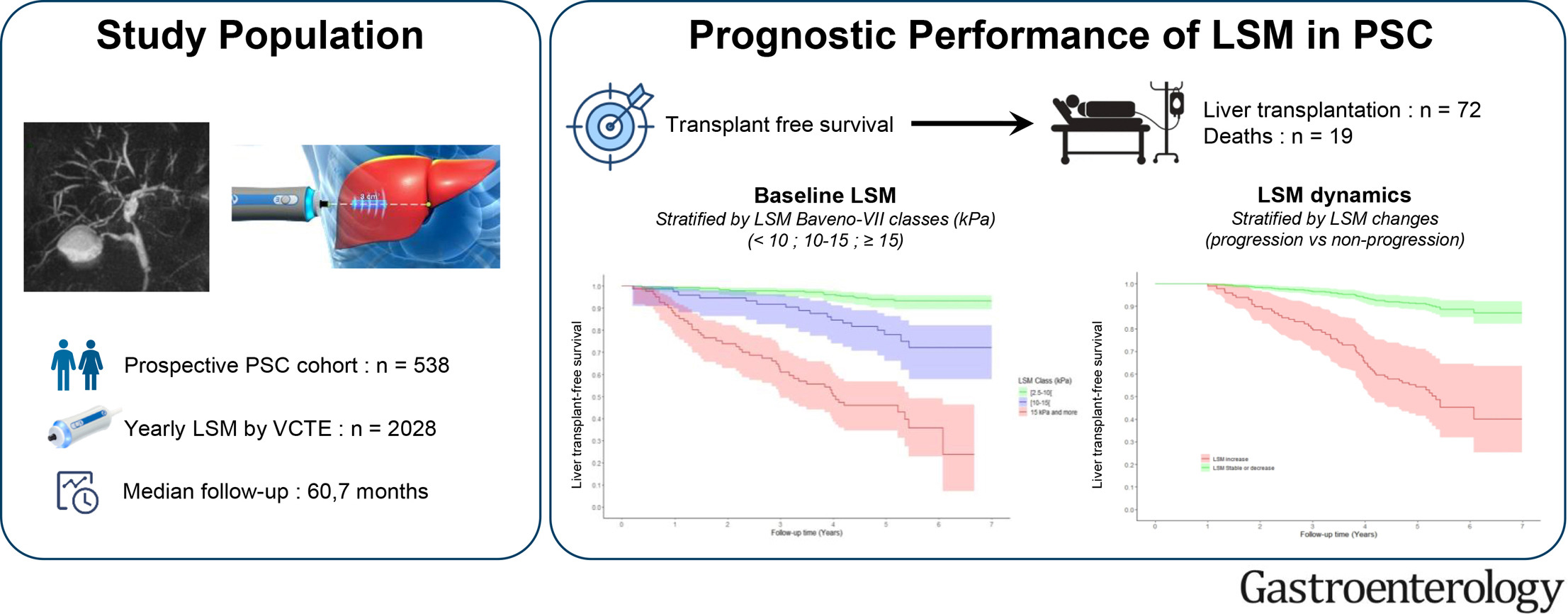
Study design
The FICUS cohort, conducted under the auspices of the International PSC Study Group, enrolled adults with PSC at 13 hepatology departments in 11 countries across Europe, North America, and the Middle East between May 2013 and June 2016. Of 617 patients registered, 538 were eligible for analysis after exclusions for inclusion criteria, changed diagnosis, duplication, absence of a valid measurement, or missing follow-up. At entry, patients were younger than 75 years and had compensated PSC without evidence of malignancy.
Median age was 42 years, two-thirds of patients were men, 71% had associated inflammatory bowel disease, and 76% were treated with ursodeoxycholic acid. Median duration since PSC diagnosis was five years, and median baseline liver stiffness was 7.6 kPa. Median follow-up was 60.7 months.
Liver stiffness was measured approximately annually with vibration-controlled transient elastography (VCTE; FibroScan), and unreliable measurements were excluded. Measurements were grouped using the Baveno-VII thresholds developed for compensated advanced chronic liver disease — below 10 kPa, 10 to less than 15 kPa, and 15 kPa or higher — which the researchers said had not previously been applied in PSC.
The primary outcome was transplant-free survival. The secondary outcome was survival free of liver complications, including ascites, variceal bleeding, hepatic encephalopathy, hepatocellular carcinoma, biliary cancer, serum bilirubin above 100 µmol/L (about 5.8 mg/dL) for at least three months, listing for transplantation, and transplantation. Researchers estimated survival with Kaplan-Meier methods and quantified associations using multivariable Cox models with liver stiffness entered as a time-dependent covariate. Stiffness trajectory was evaluated with joint modeling, and missing baseline data were addressed with multiple imputation.
Baseline stiffness and five-year survival
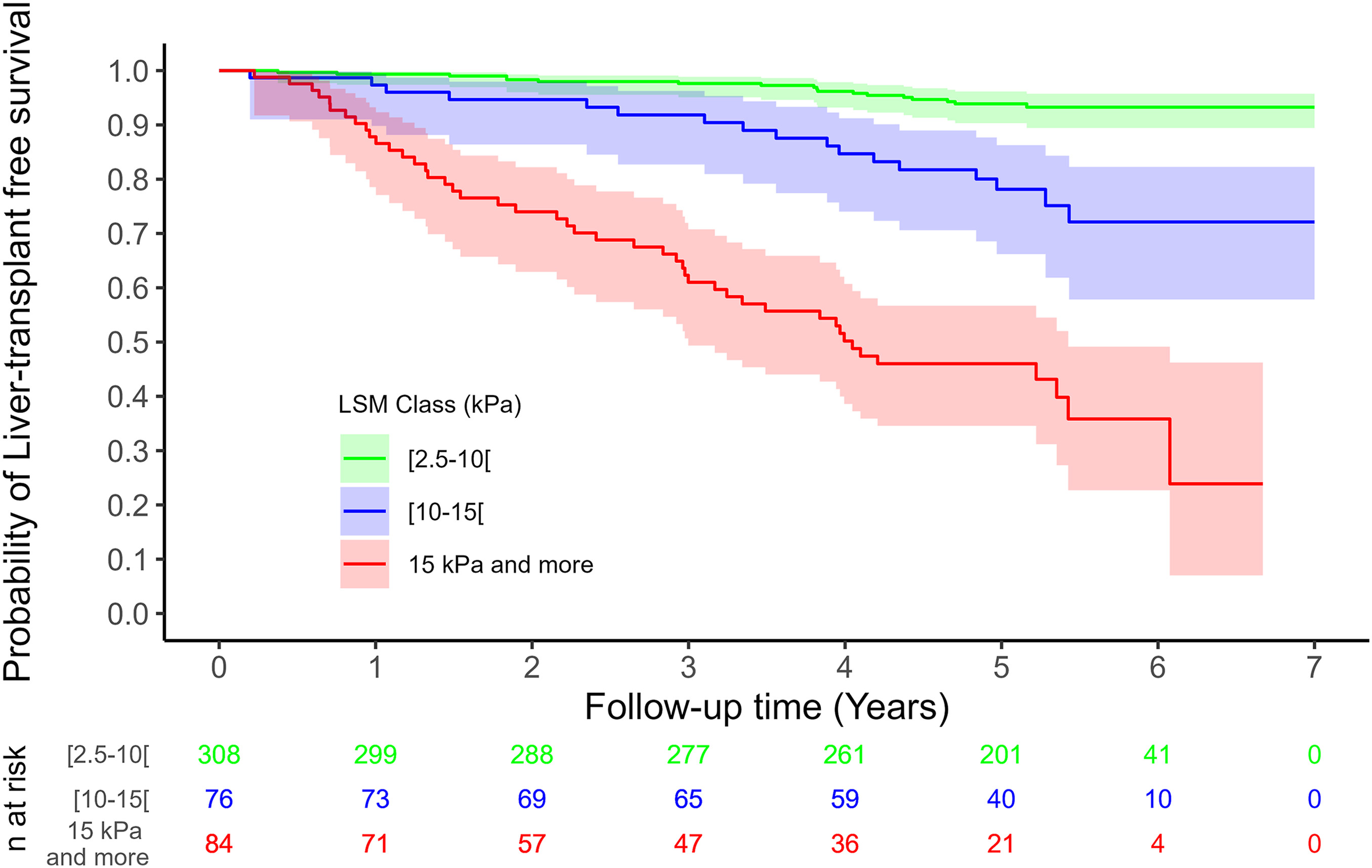
During follow-up, 19 patients died and 72 underwent liver transplantation. Among 468 patients with a reliable baseline measurement, five-year transplant-free survival was 93.9% for those below 10 kPa, 78.1% for those at 10 to less than 15 kPa, and 46.0% for those at 15 kPa or higher. Results were similar when the first reliable measurement was used as the landmark.
In a multivariable model excluding the Mayo and Amsterdam-Oxford risk scores, the adjusted hazard ratio for transplantation or death was 3.35 in the 10 to less than 15 kPa group (P = .007) and 5.82 in the 15 kPa or higher group (P < .001), compared with the lowest category. Ursodeoxycholic acid treatment was not a significant prognostic factor in either univariable or multivariable analysis.
Added value over established risk scores
Liver stiffness retained prognostic value when analyzed alongside the two established PSC risk scores. Adding stiffness class to either model significantly improved prognostic performance by likelihood ratio test (P = .002 for the Mayo score and P < .001 for the Amsterdam-Oxford score).
Adjusted for the Mayo score, patients at 15 kPa or higher had a hazard ratio of 4.18 for transplantation or death (P < .001), while the intermediate group did not reach statistical significance (hazard ratio, 2.34; P = .056). Adjusted for the Amsterdam-Oxford score, hazard ratios were 2.71 for the intermediate group (P = .024) and 6.30 for the highest group (P < .001).
Liver complications and biliary cancer
Five-year survival free of liver complications was 78.5%, with events in 117 patients over a median 5.0 years. Baveno-VII classes stratified this outcome as well, with adjusted hazard ratios of 2.69 for the intermediate group (P = .02) and 6.48 for the highest group (P < .001).
Liver stiffness did not identify patients who went on to develop biliary cancer. Among 17 patients diagnosed with cholangiocarcinoma, median baseline liver stiffness was 10.5 kPa, and eight had baseline measurements below 10 kPa.
Stiffness trajectory and outcomes
Among 416 patients with at least two reliable measurements, stiffness moved between Baveno-VII categories in both directions. Of the 354 patients who started below 15 kPa, 19% progressed to a higher category — 15% of the 286 starting below 10 kPa and 35% of the 68 starting between 10 and 15 kPa. Movement also ran the other way: among the 130 patients who started at 10 kPa or higher, 25% regressed to a lower category, including 18% of the 62 starting at 15 kPa or higher and 32% of the 68 in the intermediate band, who are counted in both groups.
In an adjusted joint model that included 400 patients with complete data, each 1-kPa-per-year increase in liver stiffness was associated with an 18% higher hazard of transplantation or death (P = .019).
Forty-one patients were classified as progressors on the basis of a significantly positive individual slope. Estimated five-year transplant-free survival was 54.3% among progressors, compared with 91.2% among the 375 nonprogressors, whose slopes were stable or decreasing. In multivariable analysis restricted to 318 patients with complete data, progressors had an adjusted hazard ratio of 3.12 for transplantation or death (P = .001).
The strength of the association varied by starting stiffness. For each 1-kPa-per-year increase, the adjusted hazard ratio was 1.24 among patients starting below 10 kPa, 1.66 among those at 10 to less than 15 kPa, and 1.75 among those at 15 kPa or higher. The researchers emphasized that the overall 18% figure represents an average across patients with complete data rather than a uniform effect.
Not every measure of change carried prognostic weight. When stiffness trajectories were classified simply as decreasing, stable, or increasing, outcomes did not differ significantly — a result the researchers reported without accompanying data.
Limitations
The researchers noted several limitations. Participating sites were specialized centers, and because most patients had baseline stiffness below 10 kPa — a group unlikely to be considered for transplantation — the analysis could overestimate prognostic accuracy. There was no independent validation cohort. Transplantation indications may differ among countries, though a competing-risk analysis adjusted for country showed no change in results, which the researchers said suggested comparable access to transplantation across the participating sites.
VCTE also carries intrinsic variability related to factors including absence of fasting, supine positioning, uneven distribution of lesions within the liver, and inflammatory or cholestatic flares. Of 2,262 measurements obtained, 234, or 10.3%, were unreliable or failed. Comparisons with other noninvasive fibrosis markers were limited to platelet count and the FIB-4 index, and the researchers said liver stiffness should be compared with a broader panel of serum markers, including the Enhanced Liver Fibrosis test, in future studies.
The researchers concluded that the findings support liver stiffness as “a risk stratification tool and potential surrogate endpoint” in future PSC clinical trials. They pointed to the Food and Drug Administration’s acceptance of a letter of intent on liver stiffness as a reasonably likely surrogate endpoint in metabolic dysfunction-associated steatohepatitis as evidence of growing regulatory recognition, and said they hoped their findings would help extend that recognition to rare liver diseases.
The study was funded by the Microbiote foundation. Study co-author Christophe Corpechot reported receiving lecture fees from Echosens, which manufactures FibroScan. Co-author Palak Trivedi reported institutional salary support from the National Institute for Health and Care Research Birmingham Biomedical Research Centre. The remaining authors reported no conflicts related to the study.