Editor's note: This research summary has been updated from its original version with new information and expert commentary.
Translumbosacral neuromodulation therapy (TNT) cut weekly fecal incontinence episodes by at least half in 66% to 81% of patients after six weeks, compared with 32% of those receiving sham treatment.
The phase 3, multicenter, double-blind, sham-controlled trial evaluated TNT, a noninvasive treatment that delivers repetitive magnetic stimulation to the lumbar and sacral plexus nerves that regulate anorectal function. The study, published in Gastroenterology, was conducted at two US academic centers from 2019 through 2024.
“There are very few treatment options for fecal incontinence, a devastating problem that plagues the lives of millions of Americans and affects over 9% of the population,” first author Satish S.C. Rao, MD, PhD, the Harold Harrison Distinguished University Chair in Gastroenterology at Augusta University, Augusta, Georgia, told GI & Hepatology News. “Of those available, there is limited scientific evidence that they work or are proven in large scientific trials. Here we have not only demonstrated significant clinical improvement using the best and universally accepted responder definition (a 50% reduction in fecal incontinence episodes) but concurrently have demonstrated improvement in fecal incontinence severity and quality of life.”
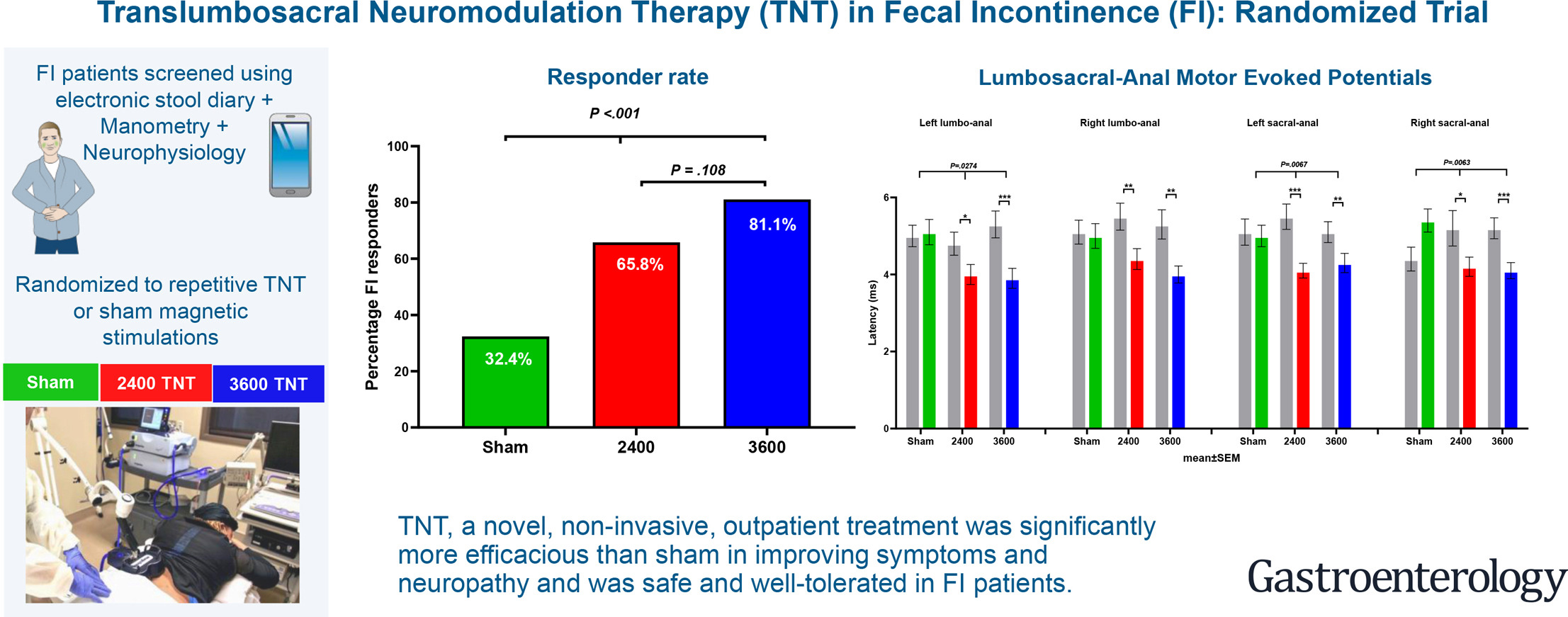
Dr. Rao and colleagues randomly assigned 109 adults whose fecal incontinence had not improved with conservative treatment to receive 2,400 magnetic pulses, 3,600 pulses, or sham magnetic pulses treatment. The pulses were delivered to four sites in the lower back once a week for six weeks. Patients and researchers assessing the results did not know which treatment was given, but the researcher administering it did.
The main outcome was the proportion of patients who had at least half as many fecal incontinence episodes as they did before treatment. Researchers also measured how many patients had at least a 75% reduction, days without incontinence, symptom severity, quality of life, anorectal function, and nerve function. All randomized patients were included in the analysis.
Among patients receiving 2,400 magnetic pulses, 66% had at least half as many fecal incontinence episodes after treatment, compared with 81% of those receiving 3,600 pulses and 32% receiving sham treatment. Patients receiving 2,400 pulses had nearly four times the odds of responding as those receiving sham, while those receiving 3,600 pulses had more than eight times the odds. The two active doses did not differ significantly.
Fecal Incontinence Severity Index scores improved by 8.6 points with 2,400 pulses and 5.6 points with 3,600 pulses, compared with 1.4 points with sham treatment. Patients receiving TNT also reported improvements in all four areas of quality of life measured, although the differences between the treatment groups were not significant.
The treatment also appeared to improve nerve and muscle function. Nearly 90% of patients had nerve damage in the lower back and sacral region at the start of the study. After TNT, nerve signals traveled significantly faster in most pathways involved in bowel control compared with sham treatment, indicating improvements in neuropathy. Patients receiving TNT also showed stronger anal squeeze pressures, indicating improvements in muscle control.
No serious side effects were linked to the treatment. Two patients in each group reported temporary back pain, while tingling or numbness and urinary urgency were each reported by one patient receiving TNT. Three patients were hospitalized for serious events that investigators determined were unrelated to treatment. Overall, 94% of patients completed their assigned treatments.
The authors noted that it remains unclear how long the benefits last and whether 3,600 pulses are more effective than 2,400. Limitations included relatively few men, a treatment administrator who knew which therapy patients received, and possible low-level magnetic stimulation from the sham treatment.

Colleen Parker, MD, FRCPC, a staff gastroenterologist at University Health Network, Toronto, who was asked to comment on the study, said she was impressed by the response rate among patients who received active treatment. "The particular strength of this study is that not only does it demonstrate improvement clinically but also demonstrates physiologic changes in patients that respond," Dr. Parker said. "The therapy appears to be well tolerated with no serious adverse events, which further adds to the potential appeal of this therapy to both patients and clinicians."
Despite the encouraging results, "further work is needed to determine the durability of this therapy," she added. "The appropriate dose of the stimulation needs to be determined, [as well as] how often and how long sessions need to be to offer clinical benefit, and how long the benefit can last. This does appear to be a promising therapy for patients with a condition that is often difficult to treat. It will be interesting to see how this can be generalized and brought to the clinic."
The National Institutes of Health supported the study. Dr. Rao holds a patent for TNT; the remaining authors reported no conflicts of interest. Dr. Parker reported having no disclosures.

Expert Insight
GI & Hepatology News asked Dr. Rao to put the findings into clinical context.
Where might noninvasive TNT fit in the treatment algorithm for patients with fecal incontinence refractory to conservative therapy?
Dr. Rao: TNT can be administered alongside biofeedback therapy or after biofeedback therapy and certainly before considering invasive procedures such as a dextranomer injection or surgery or sacral nerve stimulation (SNS) implantation. This is an outpatient procedure that takes about an hour, is non-invasive, and well tolerated with very minimal side effects.
Do the improvements in lumbosacral nerve conduction and anal sphincter function suggest that TNT is modifying the underlying pathophysiology of fecal incontinence?
Dr. Rao: Absolutely. This is the best evidence we have so far in the literature for neuromodulation. Drugs and SNS are considered as neuromodulator therapies but there is little evidence for improvement in lumbar and sacral plexus function or anorectal neuropathy. Here we found significant improvement and in fact normalization of neuropathy in a majority of patients who received active TNT treatment, whereas those who received sham therapy showed no significant change. Additionally, we showed improvement in muscle strength through anorectal manometry, suggesting that the improved nerve conduction likely improved anal sphincter function. These findings provide the clearest data yet for a neuromodulatory treatment that is modifying the disease and thereby improving symptoms, likely through neuroplasticity.
What additional evidence is needed before TNT could be incorporated into routine clinical practice?
Dr. Rao: This multicenter, sham-controlled study showed conclusively that TNT is efficacious and safe. However, confirmatory studies from other centers will help to corroborate these findings in the future. Also, we are performing additional studies to examine the long-term outcome of TNT and look at other objective metrics of improvement including gut and brain interactions, stool microbiome, salivary gene markers, and to examine the predictive factors for clinical response.