Among patients with cirrhosis who survived a variceal hemorrhage and were not candidates for preemptive transjugular intrahepatic portosystemic shunt (TIPS), a history of ascites or hepatic encephalopathy before the bleed was associated with markedly higher mortality despite guideline-recommended secondary prophylaxis, according to an individual participant data meta-analysis published in Clinical Gastroenterology and Hepatology.
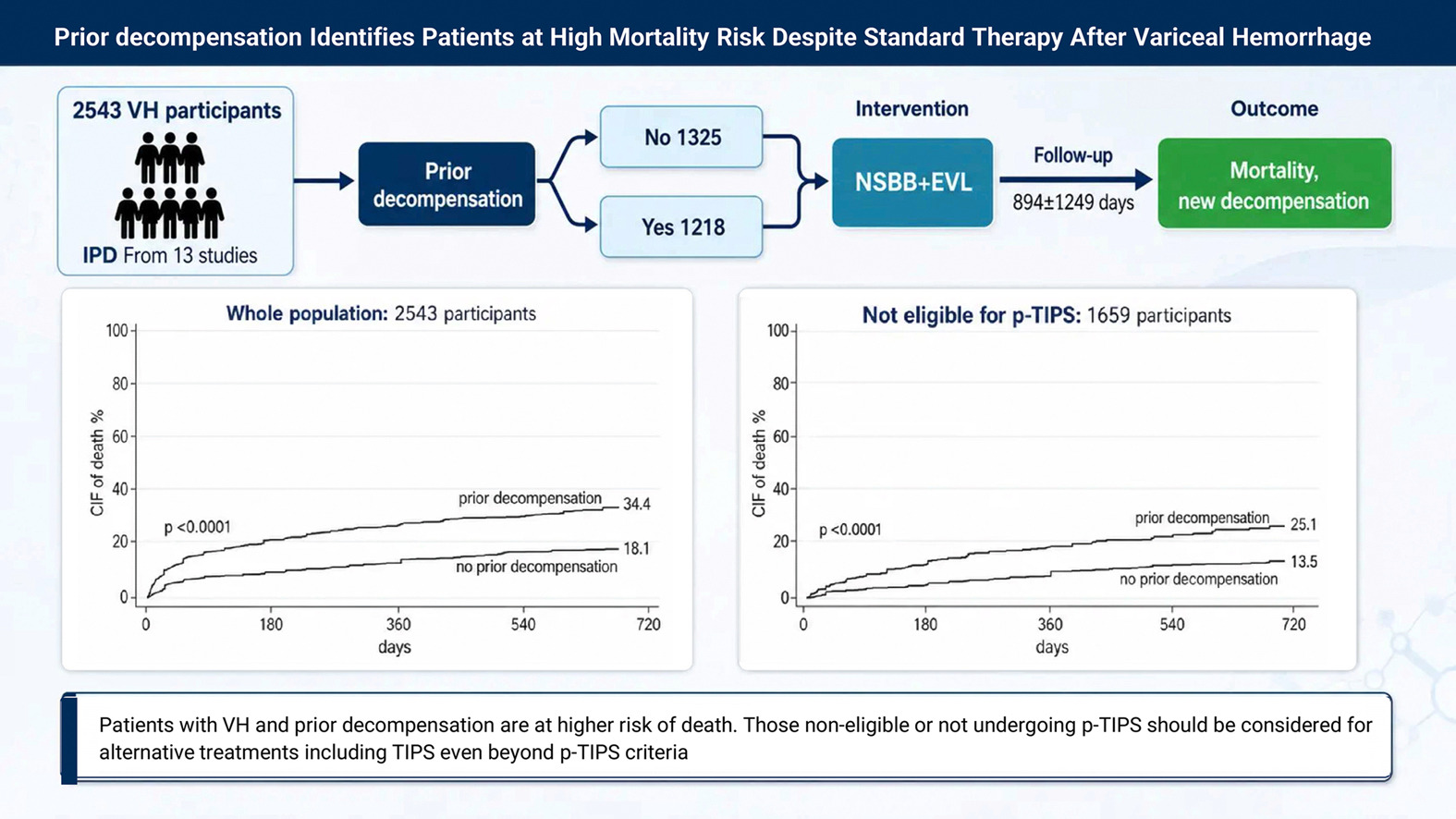
Two-year cumulative incidence of death was 25.1% among the 606 patients with prior decompensation, compared with 13.5% among the 1,053 without. After adjustment for liver disease severity and other prognostic factors, prior decompensation was associated with a 43% higher risk of death.
However, the signal was not uniform. Prior ascites was independently associated with a 79% higher adjusted risk of death, and prior hepatic encephalopathy with a 71% higher risk. Prior variceal hemorrhage alone was not associated with higher mortality after adjustment. In patients with both ascites and a prior bleed, the adjusted estimate pointed toward higher mortality but did not reach statistical significance.
Current guidelines recommend nonselective beta-blockers (NSBBs) plus endoscopic variceal ligation (EVL) for all patients who do not receive TIPS during admission, without stratifying by decompensation history. That recommendation, the investigators wrote, “does not take into account whether patients with VH had a prior decompensating event.”
The study was led by co-first authors Laura Turco of the Internal Medicine Unit for the Treatment of Severe Organ Failure, IRCCS Azienda Ospedaliero-Universitaria di Bologna, Italy, and Vincenzo La Mura of Fondazione IRCCS Ca' Granda Ospedale Maggiore Policlinico and Università degli Studi di Milano. Gennaro D'Amico of Azienda Ospedaliera Ospedali Riuniti Villa Sofia-Cervello, Palermo, Italy, and Guadalupe Garcia-Tsao of Yale School of Medicine and VA Connecticut Healthcare System, New Haven, share senior and corresponding authorship.
The investigators searched PubMed, Embase, and the Cochrane Central Register of Controlled Trials for studies published from January 2000 through December 2024 that enrolled patients with cirrhosis started on NSBBs plus EVL after variceal hemorrhage, with follow-up beyond six weeks. The protocol was registered with PROSPERO.
Of 3,199 records screened, 13 studies published between 2009 and 2024 — five randomized trials and eight observational studies — contributed patient-level data on 3,600 patients. Because most eligible studies were preemptive TIPS trials, the analysis was restricted to patients who would not have qualified for preemptive TIPS under Baveno VII and American Association for the Study of Liver Diseases criteria: Child-Pugh class A, class B with a score of 7, or class B with a score of 8-9 without active bleeding at endoscopy.
Excluded were 394 patients who received preemptive TIPS, 520 who received regimens other than NSBBs plus EVL, 67 who died or underwent transplantation within five days, 70 with a Child-Pugh score above 13, and six with missing decompensation data. A further 884 patients who met preemptive TIPS criteria but did not receive it were reserved for separate analyses. That left 1,659 patients, 805 in Child-Pugh class A and 853 in class B.
Prior decompensation was defined as overt ascites of grade 2 or higher, overt hepatic encephalopathy, portal hypertensive hemorrhage, or jaundice preceding the index bleed. The primary outcome was all-cause mortality; the secondary outcome was any new or worsening decompensating event. Time zero was day five after the index bleed. Mean follow-up was 1,044 days, or 4,742 patient-years, though it was substantially shorter in the prior-decompensation group at 697 days vs. 1,244 days.
The mortality association held in both Child-Pugh class A and class B disease. It persisted when patients with hepatocellular carcinoma were excluded, when MELD replaced the Child-Pugh score, and after multiple imputation for missing covariates. A separate two-stage meta-analysis pooling study-level estimates from the eight studies that permitted direct comparison produced a similar result, a 37% higher adjusted risk of death, with low heterogeneity across studies. In the same models, hepatocellular carcinoma carried a larger hazard than prior decompensation, roughly doubling the risk of death.
Twelve studies with 1,158 patients contributed data on further decompensation. A total of 731 patients, or 63%, had a new or worsening event: 74.7% of those with prior decompensation vs. 59.2% of those without. Two-year cumulative incidence was 69% vs. 46%, and after adjustment, prior decompensation roughly doubled the risk.
Here again the pattern tracked ascites and encephalopathy. Two-year cumulative incidence reached 80% among patients with prior hepatic encephalopathy and 80% among those with prior ascites alone, and 71% in patients with ascites plus a prior bleed. Patients whose only prior event was variceal hemorrhage had a two-year incidence of 40%, slightly lower than the 46% seen in patients with no prior decompensation at all, and no significant increase in adjusted risk.
Ascites was the most common first recurrent event, in 378 of 1,158 patients, or 32.6%, followed by rebleeding in 21.7%, hepatic encephalopathy in 5.8%, and jaundice in 0.8%. Two-year cumulative rebleeding incidence was 28.2% in patients with prior decompensation vs. 21.2% in those without.
The investigators positioned the findings as a case for widening TIPS consideration beyond current criteria. TIPS is currently recommended after failure of secondary prophylaxis; the authors wrote that it “could be considered in patients who experience VH even without failure of preventive therapy” if ascites preceded the bleed. They also framed the cohort as a rational basis for randomized trials of TIPS placed later in the admission or shortly after discharge, when the procedure would be semi-elective.
For patients with prior hepatic encephalopathy, the authors were explicit that the same conclusion does not follow, writing that “alternative therapies should not include TIPS in these patients, if not in selected patients.”
The included studies varied in quality; five were randomized trials, and one observational study was rated at high risk of bias, with six rated unclear. Risk of bias was entered as a covariate in the multivariable models. Missing covariate data reduced the complete-case sample by 12%, though results were confirmed by multiple imputation. Heterogeneity in the pooled analysis of further decompensation was moderate, which the authors attributed to inconsistent definitions of worsening decompensation across studies. Reliable information on alcohol abstinence, prior treatment of decompensation, and previous NSBB use was unavailable in some studies, and few patients underwent liver transplantation during follow-up, a pattern the authors linked to the two-year observation window.
The authors declared no conflicts of interest. The study received no financial support.