Many patients with moderately to severely active ulcerative colitis who lost response after stopping upadacitinib or while taking a lower maintenance dose recaptured clinical and endoscopic remission after restarting treatment or escalating the dose, according to long-term results from the phase three U-ACTIVATE open-label extension study. Half of patients withdrawn to placebo during maintenance met protocol-defined loss-of-response criteria, and roughly 45% of those who restarted upadacitinib required escalation to the higher dose by week 144.
The analysis, published in Gastro Hep Advances, was conducted by Remo Panaccione, MD, FRCPC, of the Division of Gastroenterology and Hepatology at the University of Calgary, Alberta, Canada, and colleagues. The investigators evaluated two common clinical scenarios: restarting treatment after discontinuation and increasing the maintenance dose from 15 mg to 30 mg after loss of response.
U-ACTIVATE is an ongoing 288-week extension study running at 307 centers across 43 countries. Patients who responded to eight weeks of upadacitinib 45 mg induction in the U-ACHIEVE and U-ACCOMPLISH trials were rerandomized in the 52-week U-ACHIEVE maintenance study to upadacitinib 15 mg, upadacitinib 30 mg, or withdrawal to placebo. Patients rerandomized to maintenance 30 mg were not included in this analysis.
Patients who lost response on placebo during maintenance could enter the extension and restart upadacitinib 15 mg, escalating to 30 mg if they met prespecified inadequate-response criteria between weeks 2 and 36. Patients who lost response on maintenance 15 mg entered the extension and continued 15 mg, escalating to 30 mg only after meeting loss-of-response criteria twice at least two weeks apart during the first four weeks.
Outcomes were assessed at weeks 48, 96, and 144. Clinical remission per adapted Mayo score — a composite endpoint — required a stool frequency subscore of 1 or lower and not greater than baseline, a rectal bleeding subscore of 0, and an endoscopy subscore of 1 or lower without friability. Endoscopic improvement was defined as an endoscopy subscore of 1 or lower and endoscopic remission as a subscore of 0. Endoscopies were performed every 48 weeks and read by a central reader blinded to clinical data and treatment.
The study prespecified no primary endpoint and performed only descriptive statistics, with no hypothesis testing between groups. Results were reported as observed, without imputation for missing data, so patients without an evaluation at a scheduled visit were excluded from that time point. Because the analysis was descriptive and the dose-escalation groups were small, the findings should not be read as a head-to-head comparison of retreatment strategies.
Withdrawal and loss of response
Among 223 patients withdrawn to placebo during maintenance, 112, or 50.2%, met loss-of-response criteria, compared with 54 of 225 patients, or 24.0%, who continued taking upadacitinib 15 mg.
Of those 112 patients, 110 entered the extension and restarted upadacitinib 15 mg. The proportion requiring escalation grew over the course of follow-up: 32 patients had escalated to 30 mg by week 48, 39 by week 96, and 47 by week 144, while 57 remained on 15 mg. Median time to escalation was 99 days (95% CI, 68-218). Six patients who were escalated and then returned to 15 mg were excluded from the analysis.
Separately, 43 of the 54 patients who lost response on maintenance 15 mg entered the extension and escalated to 30 mg. Four were later de-escalated and excluded, leaving 39 patients in that group.
Recapture after restarting treatment
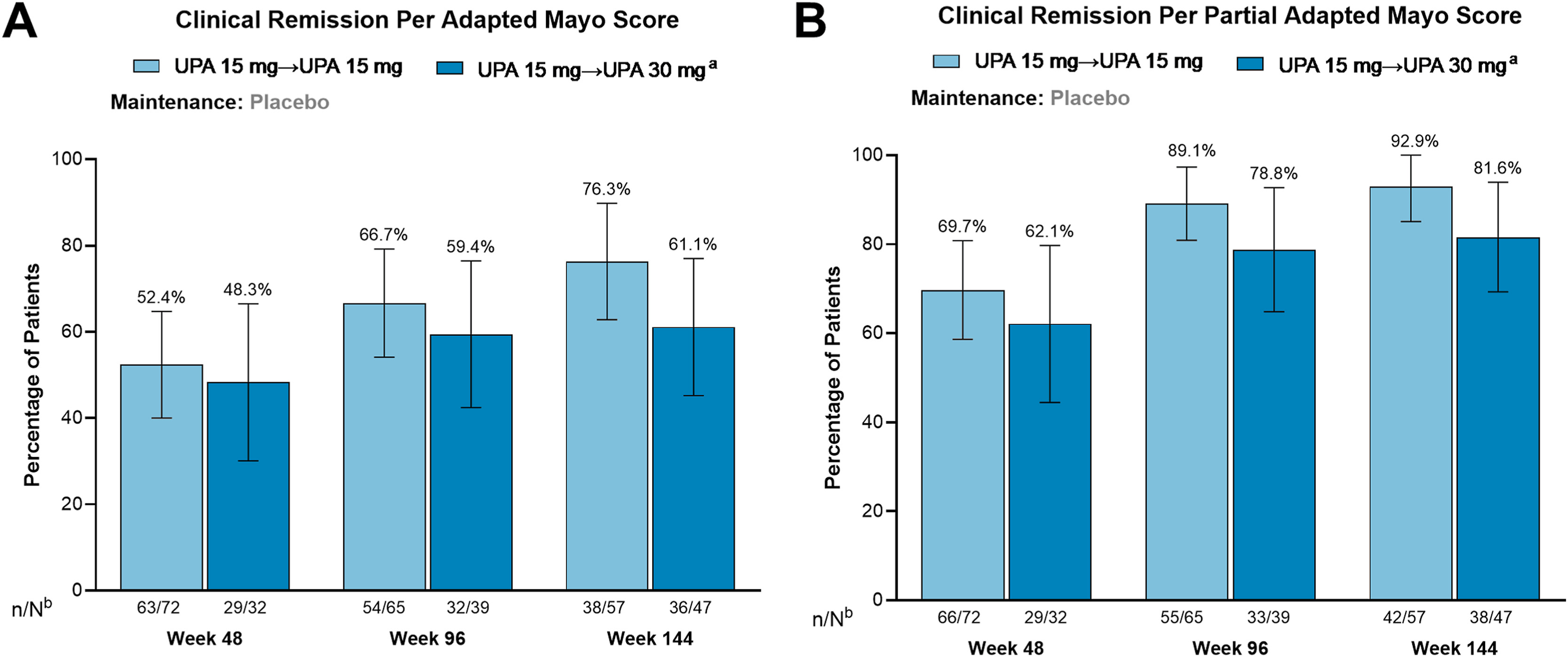
Among patients who restarted upadacitinib and remained on 15 mg, 52.4% were in clinical remission at week 48 (33 of 63 patients with available data), 66.7% at week 96 (36 of 54), and 76.3% at week 144 (29 of 38). Among those escalated to 30 mg, clinical remission was reported in 48.3% at week 48 (14 of 29), 59.4% at week 96 (19 of 32), and 61.1% at week 144 (22 of 36). Because evaluable patients declined at each visit, the percentages are not drawn from identical populations across time points.
Endoscopic outcomes were mixed. Among patients who remained on 15 mg, endoscopic improvement was reported in 64.1%, 70.9%, and 79.5% of patients at weeks 48, 96, and 144, while endoscopic remission was 31.3%, 40.0%, and 33.3% — declining at the final time point. Among patients escalated to 30 mg, endoscopic improvement fell across follow-up, from 76.7% at week 48 to 71.9% at week 96 and 69.2% at week 144, while endoscopic remission rose from 30.0% to 56.3% and 56.4%.
Dose escalation after loss of response on maintenance
Among the 39 patients who lost response on maintenance upadacitinib 15 mg and escalated to 30 mg, clinical remission was reported in 37.5% at week 48, 48.1% at week 96, and 43.5% at week 144. Endoscopic improvement was 50.0%, 57.1%, and 55.6%. Endoscopic remission was 28.1% at week 48, fell to 25.0% at week 96, and reached 40.7% at week 144.
Baseline characteristics
Patients who lost response on placebo were more likely than those who did not to have had an inadequate response, loss of response, or intolerance to at least one biologic (57.1% vs. 46.8%), prior exposure to anti-tumor necrosis factor (anti-TNF) therapy (54.5% vs. 41.4%), or corticosteroid use at baseline (42.0% vs. 33.3%). A similar pattern appeared among patients who required dose escalation by week 144. These comparisons were descriptive and not statistically tested.
What the authors concluded
The authors wrote that the results reinforce the risk of interrupting upadacitinib treatment, and that an induction-only strategy can lead to loss of efficacy. They noted that clinical and endoscopic efficacy were largely, but not entirely, recaptured in both populations, and that a subset of patients did not achieve clinical remission even after retreatment and escalation. Future studies are needed to identify clinical and pharmacodynamic biomarkers predicting who will recapture response, they wrote, which may help clinicians make informed decisions about discontinuing and restarting therapy in inflammatory bowel disease (IBD).
Limitations
The investigators acknowledged several limitations. The dose-escalation groups were relatively small, and the analyses were descriptive rather than designed to compare treatment strategies. The study did not evaluate reinduction with upadacitinib 45 mg or patients who lost response after stepping down from 45 mg to 30 mg. Safety was not assessed in this analysis, although an earlier interim analysis of the extension reported that upadacitinib was well tolerated over 96 weeks.
The study was funded by AbbVie, which was involved in the study design, conduct, data analysis, interpretation, and manuscript review. Dr. Panaccione and several coauthors reported consulting fees, research funding, or other financial relationships with AbbVie and other pharmaceutical companies. Other coauthors are AbbVie employees and may own company stock or stock options.

Expert Insight
GI & Hepatology News asked Mark Mattar, MD, director of the IBD Center at MedStar Georgetown University Hospital and professor of medicine at Georgetown University School of Medicine, Washington, D.C., to weigh in on the study results.
Why is this study important?
Dr. Mattar: Upadacitinib has become a foundational oral small molecule option for our patients with moderate to severe ulcerative colitis. When therapy is interrupted or we have a secondary loss of response, this can be challenging. The importance of adherence to medications in chronic illness like ulcerative colitis is evidenced by this study. We haven't had much evidence that we can recapture these patients until now.
The U-ACTIVATE open-label extension study provides clinically relevant data showing that both retreatment and dose escalation can restore clinical and endoscopic disease remission in some of these patients. It also highlights the risk of treatment interruption: 50% of patients withdrawn to placebo lost response, compared with 24% of patients maintained on upadacitinib 15 mg. These findings reinforce that maintenance dosing without holidays keeps this population out of trouble and without relapse.
How might the findings influence clinical practice?
Dr. Mattar: These findings influence several aspects of clinical practice. Providers should generally avoid unnecessary interruption of upadacitinib in patients who are responding, because approximately half of patients withdrawn from therapy lost response.
When interruption is unavoidable due to infection, surgery, insurance barriers, or costs, we are now more confident that restarting upadacitinib can recapture efficacy in many patients.
For patients who lose response while receiving upadacitinib 15 mg maintenance therapy, escalation to 30 mg may be considered before abandoning the mechanism of action. At week 144, 43% achieved adapted Mayo clinical remission, 55% achieved endoscopic improvement, and 41% achieved endoscopic remission after escalation. These results provide evidence supporting dose optimization as a reasonable rescue strategy, while recognizing that not every patient will recapture response.
What are the next research priorities?
Dr. Mattar: The optimal retreatment strategy remains unclear. The consequences of different lengths of treatment interruption also remain unclear. The study restarted patients at 15 mg and did not evaluate formal reinduction with 45 mg, which is sometimes considered in clinical practice. It did not specifically evaluate patients who lost response after stepping down from 45 mg to 30 mg.
Safety was not assessed in this particular analysis. Additional data are needed regarding the safety of prolonged 30 mg treatment, repeated interruption and retreatment, and dose escalation in higher-risk patients.
This study does not bring us closer to precision medicine in IBD. Biomarkers that predict successful recapture of the right patients would be of much utility. Patients with prior biologic failure, prior anti-TNF exposure, and baseline corticosteroid use appeared more likely to lose response or require escalation, but these observations require validation.
Is there anything else you would like to say about this work?
Dr. Mattar: Although this is a reassuring study, I would emphasize against elective discontinuation and nonadherence to these advanced therapies. Although many patients regained disease control, recapture was incomplete, and a substantial proportion required escalation to 30 mg. Some patients did not regain remission despite prolonged treatment. We are encouraged to maintain and optimize effective therapy whenever possible, but recognize that retreatment or dose escalation may preserve upadacitinib treatment options when loss of response occurs. Objective reassessment, including symptoms, biomarkers, and endoscopy or intestinal ultrasound when appropriate, remains important before attributing symptoms to inflammatory loss of response and escalating treatment.
Dr. Mattar reported having no relevant disclosures.