Patients with Crohn’s disease (CD) had 28% higher all-cause mortality than matched controls across 1984-2019, while mortality among patients with ulcerative colitis (UC) was similar to controls, according to a population-based matched cohort study published in the Journal of Crohn’s and Colitis.
Across the full study period, CD was associated with higher all-cause mortality compared with matched controls (hazard ratio [HR], 1.28; 95% confidence interval [CI], 1.19-1.37), whereas UC mortality did not differ significantly from controls (HR, 1.03; 95% CI, 0.97-1.10). Inflammatory bowel disease (IBD) overall was associated with a modest increase in all-cause mortality (HR, 1.13; 95% CI, 1.08-1.18), driven primarily by CD.
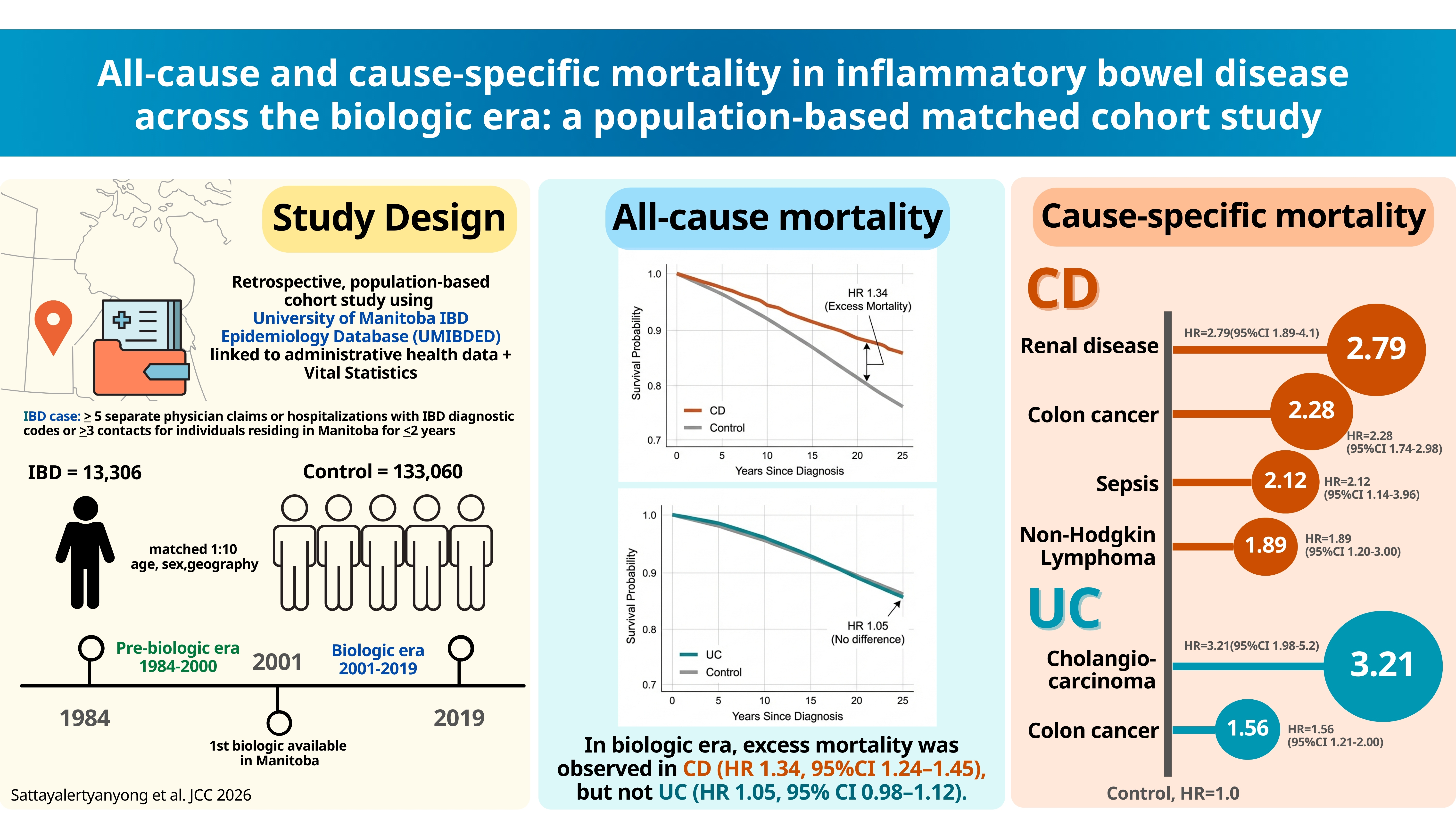
Mortality differences emerged during the biologic era
In era-stratified analyses, all-cause mortality did not differ between patients with IBD and matched controls during the pre-biologic era. During the biologic era, however, excess mortality emerged for IBD overall and was driven by CD, while mortality among patients with UC remained similar to matched controls. Age-standardized mortality rates declined over time in both patients and matched controls but remained consistently higher for CD in later calendar periods.
Diagnosis-era sensitivity analyses suggested the mortality difference was most apparent among patients diagnosed before 2001 who survived into the biologic era. No clear excess mortality was observed among patients newly diagnosed with CD after 2001, although the authors noted relatively few deaths in that subgroup.
Sex-stratified Kaplan–Meier curves showed time-dependent divergence in CD, with separation from matched controls emerging after approximately 10 years in females, while male CD and UC in both sexes remained largely comparable to matched controls.
Cause-specific mortality varied by disease subtype
Compared with matched controls, patients with CD had higher mortality from any malignancy (HR, 1.24; 95% CI, 1.11-1.39), colorectal cancer (HR, 2.28; 95% CI, 1.74-2.98), non-Hodgkin lymphoma (HR, 1.89; 95% CI, 1.20-3.00), renal disease (HR, 2.79; 95% CI, 1.89-4.11), chronic obstructive pulmonary disease (HR, 1.40; 95% CI, 1.04-1.88), and sepsis (HR, 2.12; 95% CI, 1.14-3.96). Cardiovascular disease mortality was lower among patients with CD than among matched controls.
Among patients with UC, mortality from any malignancy was not significantly increased. However, UC was associated with higher mortality from colorectal cancer (HR, 1.56; 95% CI, 1.21-2.00), cholangiocarcinoma (HR, 3.21; 95% CI, 1.98-5.22), and chronic obstructive pulmonary disease (HR, 1.38; 95% CI, 1.08-1.76). Renal disease and sepsis mortality did not differ significantly from matched controls, while cardiovascular disease and lung cancer mortality were lower.
The authors wrote that the excess mortality in this cohort was more closely linked to selected malignancies, infection, and respiratory disease than to cardiovascular disease.
Study limitations
The authors noted that administrative data did not include information on CD phenotype, disease activity, inflammatory burden, baseline severity, smoking history, frailty or several comorbidities that may influence competing causes of death, raising the possibility of residual confounding.
In addition, calendar era did not capture individual biologic exposure, and biologic exposure analyses were subject to confounding by indication and should not be interpreted as causal biologic treatment effects.
The authors also noted that the administrative data lacked information on CD phenotype and disease location. As a result, patients with isolated small-bowel CD were analyzed alongside those with Crohn’s colitis, which may have affected estimates of colorectal cancer mortality risk in the CD group.
Clinical implications
“In the modern era of IBD treatment, IBD-related mortality has fallen substantially, but important risks remain,” said study author Onuma Sattayalertyanyong, MD, of Mahidol University in Bangkok, and the University of Manitoba in Winnipeg, Canada. “In Crohn’s disease, overall mortality remains higher than in controls, with the greatest excess mortality from renal disease, colorectal cancer, sepsis and lymphoma, whereas in ulcerative colitis, overall mortality is similar to controls despite elevated mortality from cholangiocarcinoma and colorectal cancer.”

Dr. Sattayalertyanyong also noted that the study’s findings support a more proactive approach to long-term IBD care, with an emphasis on prevention, early detection and surveillance tailored to individual risk. “This includes appropriate colorectal cancer surveillance, particularly in patients with Crohn’s colitis, minimizing prolonged corticosteroid exposure, vaccination and infection prevention, regular renal function monitoring and smoking cessation,” she said.
Dr. Sattayalertyanyong further explained that patients with longstanding CD, particularly women, may warrant closer long-term follow-up and more individualized assessment of factors contributing to excess mortality. “In ulcerative colitis, overall mortality was similar to controls, but continued colorectal cancer surveillance and attention to cholangiocarcinoma risk, particularly in patients with primary sclerosing cholangitis, remain important.”
Cautions, next steps for research
An important next step, according to Dr. Sattayalertyanyong, is to understand the late-emerging mortality gap in women with CD, particularly as this signal was observed in both biologic-exposed and biologic-unexposed patients. “Future studies should identify the clinical and biological factors driving this risk and determine whether targeted prevention and surveillance can improve long-term outcomes,” she said.
Dr. Sattayalertyanyong received research fellowship funding support from the International Organization for the Study of IBD (IOIBD). IOIBD had no role in the study design, data analysis, manuscript preparation or decision to submit. Charles N. Bernstein, MD, FRCPC, reported advisory roles, research funding, educational grants, and speaker activities with multiple pharmaceutical companies. The remaining authors reported no disclosures.
Graphical abstract summarizing the study design and key mortality findings: excess all-cause mortality was observed in Crohn’s disease but not ulcerative colitis, with distinct cause-specific mortality risks across both inflammatory bowel disease subtypes.