Upadacitinib was associated with higher rates of remission without steroids than tofacitinib or ustekinumab at 16 and 52 weeks in patients with moderate-to-severe ulcerative colitis (UC). The real-world, multicenter TRIDENT-UC study included patients in whom at least one previous advanced therapy had failed.
“Treatment sequencing after failure of an advanced therapy remains a major challenge in ulcerative colitis,” co-first and corresponding author Joana Camões Neves, MD, of the Department of Gastroenterology at Unidade Local de Saúde Braga, Portugal, told GI & Hepatology News. “TRIDENT-UC provides real-world comparative data that complement current AGA guidance and may help clinicians make more informed treatment decisions in this increasingly common clinical scenario. The next step will be to validate these findings in larger prospective cohorts and to better understand which individual patient characteristics can help us select the right therapy for the right patient.”
The retrospective study, published in Clinical Gastroenterology and Hepatology, included 312 adults with moderate-to-severe UC treated at nine centers in Portugal. All had experienced failure of at least one advanced therapy. Of the participants, 103 received upadacitinib, 74 received tofacitinib, and 135 received ustekinumab.
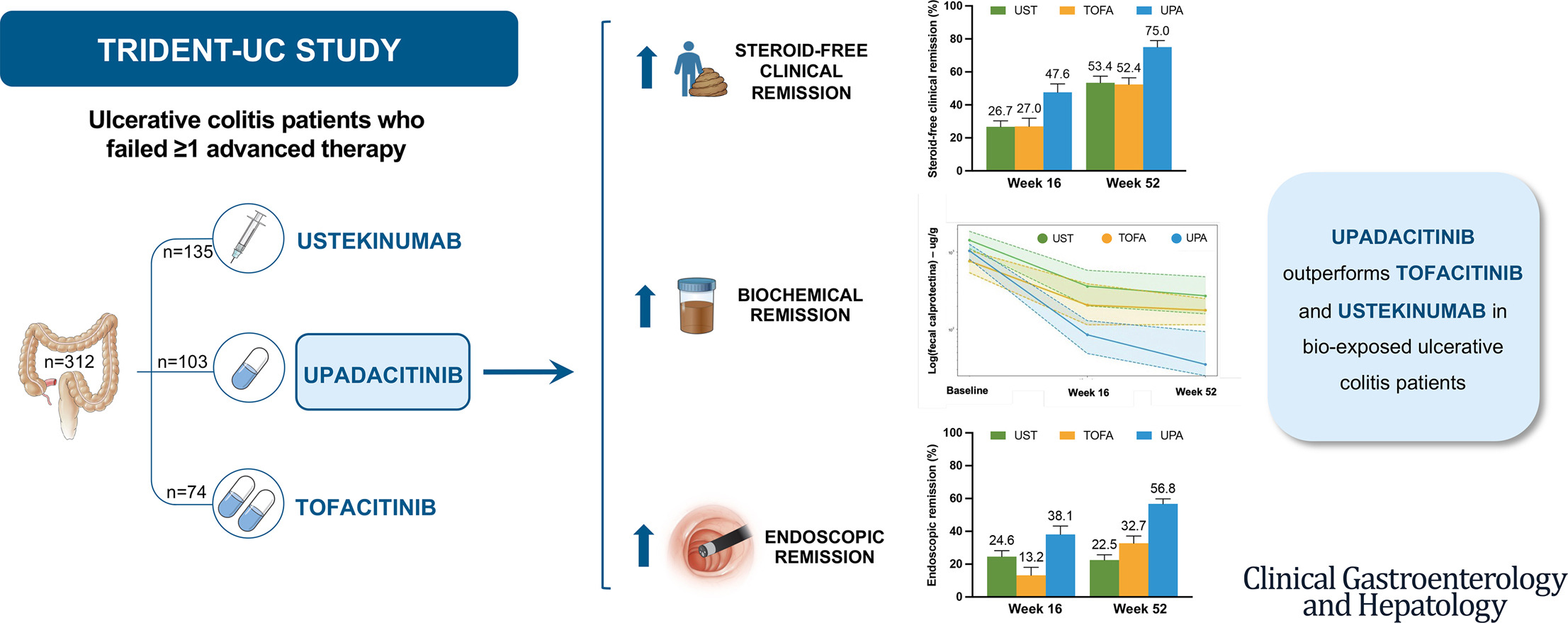
Researchers looked primarily at how many patients achieved clinical remission without steroids at weeks 16 and 52. Steroid-free clinical remission was defined as a Patient-Reported Outcome-2 score of 0 while off corticosteroids for at least 30 days at week 16 and 90 days at week 52. They also assessed biochemical remission, defined as a fecal calprotectin level of 250 µg/g or less, and endoscopic remission, defined as a Mayo endoscopic subscore of 0.
At week 16, 48% of patients taking upadacitinib were in remission without steroids, compared with 27% of those taking either tofacitinib or ustekinumab. Among patients with evaluable data at week 52, the rates were 75%, 52%, and 53%, respectively.
After Dr. Camões Neves and colleagues adjusted for differences between the patient groups, upadacitinib was associated with higher odds of steroid-free remission than tofacitinib at week 16 (OR, 2.56; 95% CI, 1.16-5.64) and week 52 (OR, 3.14; 95% CI, 1.22-8.12). The corresponding odds ratios vs. ustekinumab were 3.71 (95% CI, 1.88-7.29) and 4.68 (95% CI, 1.96-11.18). There was no significant difference between tofacitinib and ustekinumab.
Biochemical remission showed a similar pattern in the observed rates. At week 16, 64% of patients taking upadacitinib achieved biochemical remission, compared with 47% taking tofacitinib and 41% taking ustekinumab. At week 52, the rates were 73%, 48%, and 43%, respectively.
After adjustment, upadacitinib was associated with higher odds of biochemical remission than both tofacitinib and ustekinumab at week 16. At week 52, the adjusted analysis showed higher odds with upadacitinib vs. ustekinumab, but not a statistically significant advantage vs. tofacitinib.
Upadacitinib also showed the largest reduction in fecal calprotectin, a marker of intestinal inflammation, over time. Biochemical results were available for 84% of patients at week 16 and 64% at week 52.
Endoscopic remission was also more common with upadacitinib. At week 16, 38% of patients taking upadacitinib achieved endoscopic remission, compared with 13% taking tofacitinib and 25% taking ustekinumab. At week 52, the rates were 57%, 33%, and 23%, respectively.
After researchers adjusted for differences between the patient groups, upadacitinib was associated with higher odds of endoscopic remission than either of the other treatments at both time points. Endoscopy results were available for 58% of patients at week 16 and 55% at week 52.
The results were similar among 146 patients who received one of the three drugs as their second advanced therapy. At week 16, 52% of patients taking upadacitinib achieved remission without steroids, compared with 15% taking tofacitinib and 35% taking ustekinumab.
After adjustment, upadacitinib was associated with higher odds of steroid-free remission than either of the other drugs, with an OR of 6.30 vs. tofacitinib (95% CI, 1.85-21.52) and 3.04 vs. ustekinumab (95% CI, 1.31-7.08). Upadacitinib also had the highest observed rates of biochemical remission (70%) and endoscopic remission (45%). In adjusted analysis, upadacitinib was associated with higher odds of biochemical remission than ustekinumab; endoscopic remission in this subgroup was analyzed descriptively.
Serious adverse events were uncommon, occurring in 1.9% of patients taking upadacitinib, 2.7% taking tofacitinib, and 1.5% taking ustekinumab, with no significant difference among the groups. No major cardiovascular events were reported.
Nonserious skin-related adverse events were more common with upadacitinib. Acne occurred in 11% of patients taking the drug. It cleared after the dose was reduced in five patients, while six were evaluated by a dermatologist.
The authors said the findings may help physicians choose which treatment to use after a previous advanced therapy has failed, especially when the goal is remission without steroids and reduced signs of inflammation. However, treatment decisions should still be tailored to each patient based on effectiveness, safety, patient preferences, and which therapies are available.
The study had several limitations. Because it looked back at previously collected data, there may have been differences between the treatment groups that researchers could not fully account for, even after statistical adjustment. Upadacitinib also became available later than the other drugs, which may have influenced the results and contributed to less complete follow-up.
More follow-up data were missing at week 52, especially for biochemical and endoscopic outcomes. The authors characterized the week-52 biochemical and endoscopic findings as exploratory and said they should therefore be interpreted with greater caution.
The authors reported no external funding and no relevant financial, professional, or personal conflicts of interest.

Expert Insight
Dr. Camões Neves discussed the findings with GI & Hepatology News.
Based on these findings, should upadacitinib now be preferred over tofacitinib or ustekinumab after failure of a first advanced therapy in ulcerative colitis?
Dr. Camões Neves: Above all, treatment choice should be individualized to each patient. In terms of effectiveness, our study suggests that upadacitinib should be strongly considered after failure of a first advanced therapy, and these data should inform our therapeutic decisions. However, treatment selection should remain a shared decision-making process, taking into account expected effectiveness, safety profile, patient comorbidities and preferences, as well as local availability.
Which bio-experienced patients are most likely to benefit from upadacitinib, and are there clinical features that would still lead you to choose ustekinumab or tofacitinib instead?
Dr. Camões Neves: Upadacitinib is a highly effective advanced therapy, and I believe it should be strongly considered in patients who have failed a first advanced therapy, particularly in those with more extensive or severe disease. From a treat-to-target perspective, we are aiming for increasingly ambitious outcomes, and upadacitinib has shown a rapid onset of action and high effectiveness, making it an attractive option when early and deep disease control is a priority.
Of course, treatment choice should always be individualized to the patient in front of us, and there may be situations in which another therapeutic option is preferred. For example, in an older patient with significant cardiovascular or thromboembolic risk factors, or in a young woman planning pregnancy in the near future, ustekinumab may be favored over a JAK inhibitor.
How should clinicians balance upadacitinib’s greater effectiveness against its safety profile when choosing therapy?
Dr. Camões Neves: That balance is central to treatment selection. In our cohort, we did not observe significant differences in serious adverse events between treatment groups, and importantly, no major adverse cardiovascular events were observed. However, clinicians should carefully assess each patient’s individual risk profile — including age, cardiovascular and thromboembolic risk, smoking history, malignancy risk, and infection risk — and weigh these factors against the expected benefits of treatment. Ultimately, the decision should balance effectiveness and safety on an individual patient basis.