When Hashem El-Serag, MD, MPH, AGAF, became the 114th president of the AGA in 2019, he could not have known that the back half of his term would be accompanied by a global pandemic. He led the organization through the first uncertain months of COVID-19 — and the experience, he says now, sharpened a conviction that would direct the years to come. “The pandemic reinforced for me how important data, adaptability, and collaboration are in medicine,” he says. “I became increasingly interested in how health systems can continuously learn and improve in real time.”
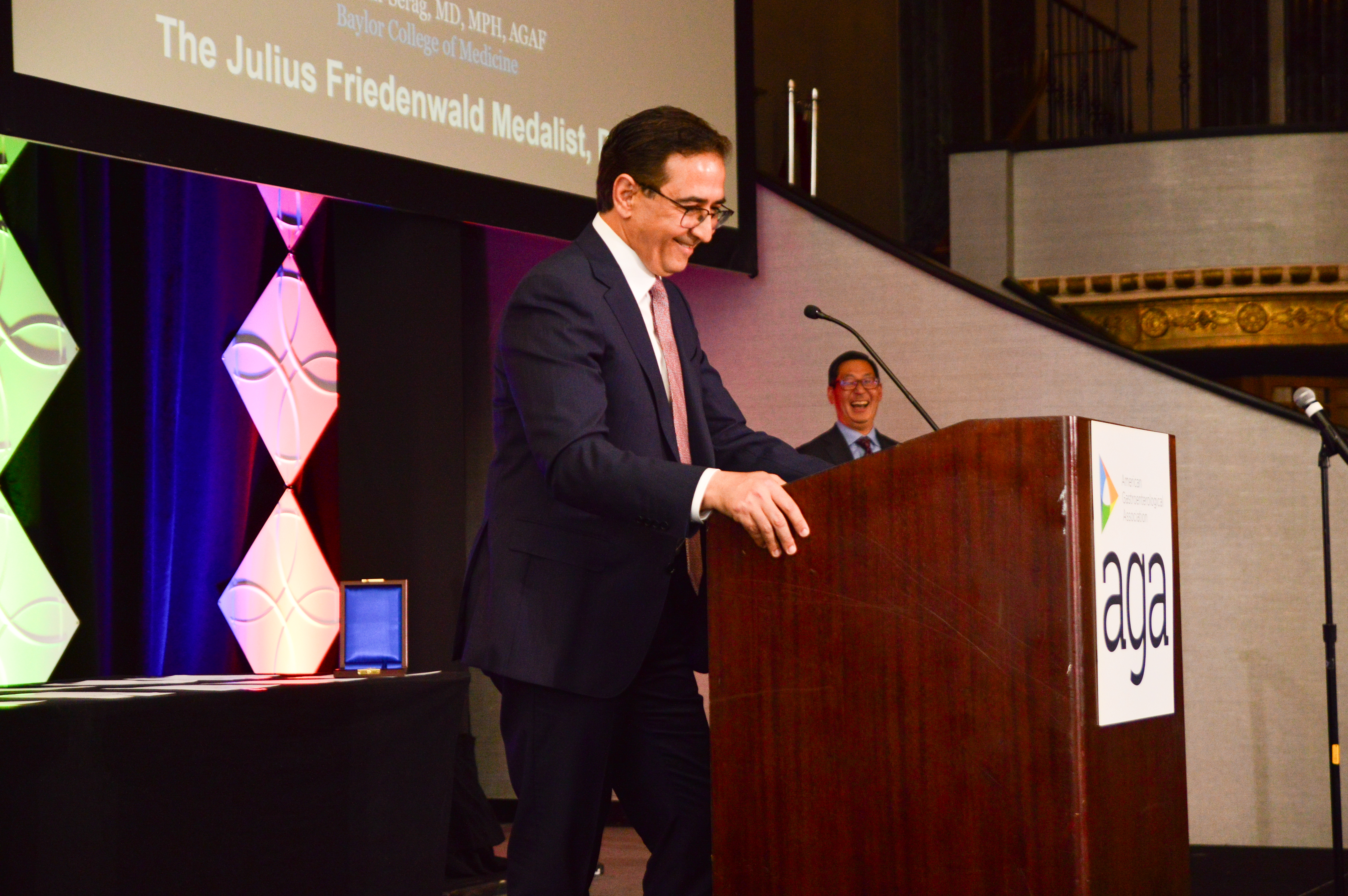
Now, AGA has awarded Dr. El-Serag its highest honor: the 2026 Julius Friedenwald Medal, recognizing a lifetime of contributions to gastroenterology. For the many members who knew him as a past president, journal editor, and one of the field's most prolific liver-cancer researchers, the medal is an occasion to catch up and find that Dr. El-Serag has spent the interval building something many might not expect.
Building something unexpected
He remains the Margaret M. and Albert B. Alkek Chair of the Department of Medicine at Baylor College of Medicine, a post he has held since 2017 and one few gastroenterologists ever occupy. He has published more than 680 papers over his career. But in 2023, he took on a new title — Vice President for the Learning Health System at Baylor — and launched an initiative built around the idea that every patient encounter should make care better for the next patient.
“A learning health system creates infrastructure where clinical care, data, research, and quality improvement are integrated rather than separated,” he explains. For a practicing gastroenterologist or hepatologist, he says, that means smarter decision support, more personalized care, and faster translation of evidence into practice, not to mention the ever-increasing ability to harness data, analytics, and AI to make discoveries in the course of everyday care.
The turn surprises even him. When asked what he did not see coming, Dr. El-Serag points to how far his work has traveled from where it began. “Probably how much my work has expanded beyond traditional epidemiology into digital medicine, AI, and health system transformation,” he says. “I still think like an epidemiologist and clinician, but now I spend much more time thinking about how to translate insights into everyday clinical care.”
Toward precision prevention
That instinct of translation over discovery alone runs through his science, too, which has evolved over the years. For decades, Dr. El-Serag's name was synonymous with the epidemiology of hepatocellular carcinoma.
“MASLD is now becoming the dominant driver of liver cancer,” he says, describing a field pivoting away from viral hepatitis, a low-prevalence but high-risk condition, toward metabolic disease, which is enormously common but carries lower individual risk. That change means much of his current work, he says, focuses on precision prevention: “identifying who is truly at highest risk, detecting cancer earlier, and understanding why some patients progress while others do not.”
He is quick to note where the field is already succeeding. Colorectal cancer screening and polyp removal have prevented countless cancers; better recognition and treatment of H. pylori has shown that gastric cancer can be headed off when its cause is understood and targeted; and curative hepatitis C therapies have already bent the curve of liver cancer. What excites him most now is the growing ability to tell, in advance, who is genuinely at risk.
“Advances in biomarkers, genomics, AI, and risk stratification are moving us toward more precise prevention and earlier detection,” he says, predicting that the coming decade will trade one-size-fits-all screening for approaches that find high-risk patients early and intervene before cancer takes hold.
Seen from his current vantage, even his earliest work points toward what he is doing today. “Early in my career, we were trying to answer some very basic questions: Who gets liver cancer? Why are rates increasing? Which patients are at highest risk?” he recalls. That work matured into tools to predict risk and detect disease sooner. “Today, whether through precision prevention, digital medicine, or learning health systems, I'm still pursuing the same goal,” he says. “The difference is that I'm now focused not only on generating knowledge, but on building the systems that can reliably translate that knowledge into better care for every patient.”
A matter of stewardship
If there is a constant beyond the science, it is the people he has trained. Dr. El-Serag has mentored a generation of investigators. His Baylor colleague Fasiha Kanwal, MD, has credited him with the time and attention he devoted to her own career, saying “It was because of his encouragement that I (successfully) applied for the editorship of Clinical GastroenterologyandHepatology.”
Dr. El-Serag counts his mentees’ successes as a source of pride. “What makes me proudest is seeing former trainees become independent leaders with their own ideas and voices,” he says. His philosophy has matured over the years into something closer to stewardship. “Mentorship is less about directing people and more about creating opportunities, building confidence, and helping people navigate setbacks while staying true to themselves.”
Ask him to name the single thread tying it all together, and he returns, characteristically, to the patient. “The thread has been a commitment to asking clinically meaningful questions that can improve patients' lives and finding the right tools to answer them.” It is also the advice he offers anyone hoping to build a career like his: stay curious, be persistent, collaborate widely, choose problems that truly matter to patients, and keep pace with technology. “Careers are rarely linear,” he says, “but meaningful work compounds over time.”
It is a fitting note for a Julius Friedenwald Medalist who, by every indication, is not finished contributing meaningful work to the field.
Lightning Round
Tell us about a mentor and what you learned from them.
My father. He taught me that education and hard work open doors, but character determines what you do once you walk through them.
Best piece of advice you’ve given or received?
“Be useful.” If you focus on helping others succeed, good things tend to follow.
What advice would you give to your younger self?
Take more risks. Most opportunities come disguised as uncertainty. Trust that your background is a strength, not a limitation.
Favorite quote or words to live by?
A Palestinian saying “The olive tree grows slowly, but it lives for generations.”
It reminds me that the most meaningful work, whether raising a family, building institutions, or advancing science takes time and outlasts us.
What would you be if you weren’t a GI?
A historian or perhaps a diplomat. I've always been fascinated by how ideas and institutions shape societies.