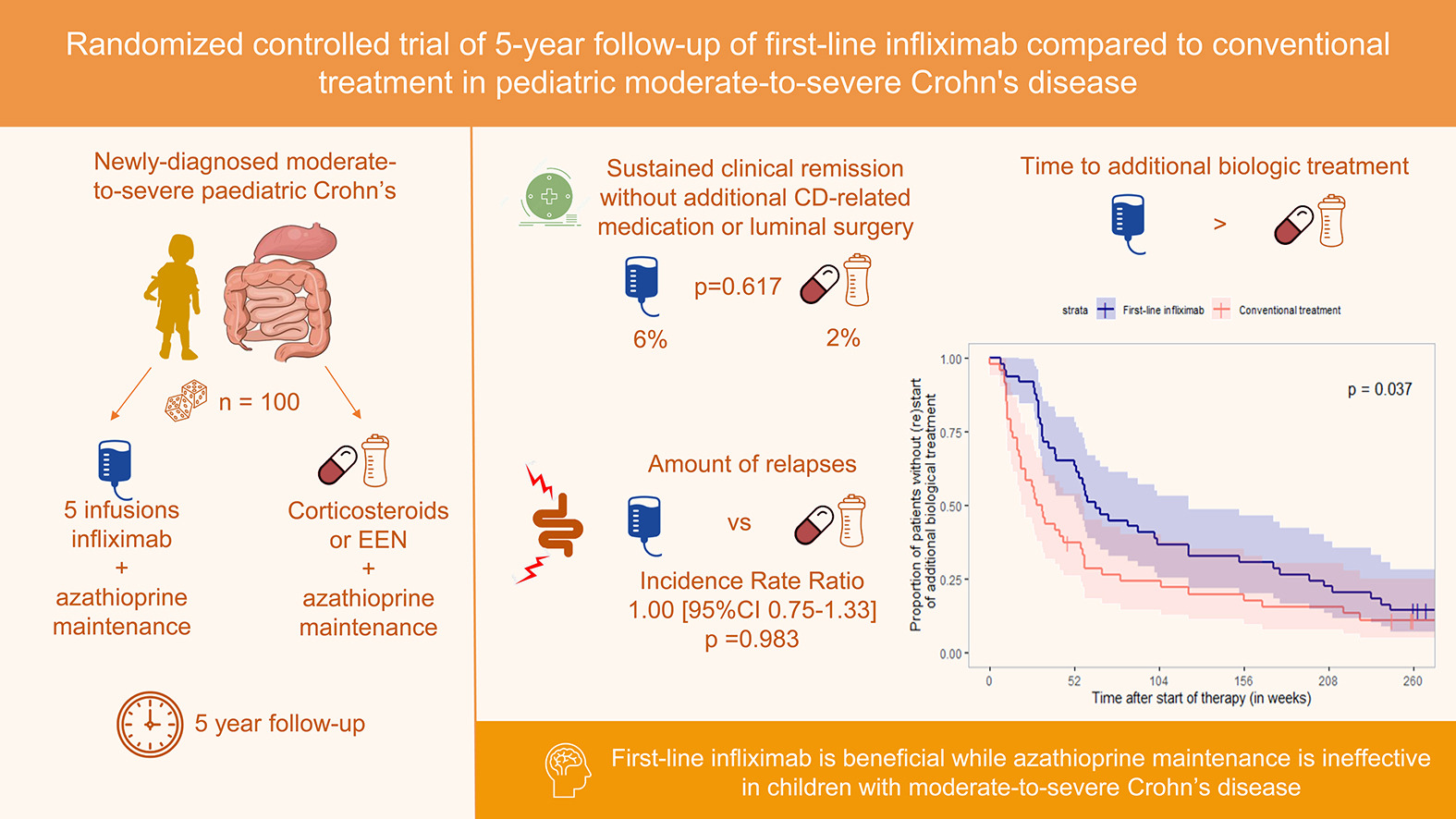
Children with newly diagnosed moderate to severe Crohn’s disease who started infliximab immediately after diagnosis did not achieve higher rates of sustained five-year remission than those who received conventional induction therapy. However, early infliximab delayed the need for additional biologic therapy, which the authors suggestprovides longer-lasting disease control as an initial treatment, even though nearly all patients ultimately required ongoing maintenance therapy.
The findings come from the five-year follow-up of the multicenter, open-label TISKids randomized trial, published in Clinical Gastroenterology and Hepatology. Initial results showed that starting infliximab at diagnosis increased the likelihood of remission without treatment escalation after one year. The latest analysis examined whether that early advantage was maintained over five years.

“This study clearly demonstrates that starting infliximab from diagnosis in pediatric moderate-to-severe Crohn's disease is a very effective treatment strategy,” corresponding author Lissy de Ridder, MD, PhD, of the department of pediatric gastroenterology at Erasmus Medical Center-Sophia Children’s Hospital, Rotterdam, the Netherlands, told GI & Hepatology News. “This study also demonstrates that azathioprine maintenance treatment as standalone therapy does not control the disease. Virtually all patients on azathioprine maintenance flare and need to switch to more intensive treatment.”
Dr. de Ridder and colleagues enrolled 100 children aged 3 to 17 years with newly diagnosed, untreated moderate to severe Crohn's disease at 12 centers in the Netherlands, Finland, and Croatia. Patients were randomly assigned to receive either infliximab induction therapy with five infusions over 22 weeks or conventional induction therapy with exclusive enteral nutrition or prednisolone. Both groups then received azathioprine for maintenance. Six patients did not complete the five-year follow-up, leaving 94 patients in the primary analysis.
The primary endpoint was sustained clinical remission over five years without additional Crohn’s disease treatment. This was defined as remaining in remission at yearly assessments without relapses or the need for additional biologic therapy, systemic corticosteroids, or intestinal surgery.
Only four patients achieved the primary endpoint. Sustained remission without additional treatment occurred in three of 48 patients (6%) who received infliximab and one of 46 patients (2%) who received conventional therapy. Overall, 13% of patients remained in sustained clinical remission during follow-up, while 91% eventually needed additional Crohn’s disease treatment. Treatment escalation was required in 88% of patients initially assigned to infliximab and 96% of those assigned to conventional therapy.
The main long-term benefit of early infliximab was delaying the need for additional biologic therapy. Patients who received infliximab as first-line treatment went a median of 65 weeks before starting or restarting a biologic, compared with 31 weeks for those who received conventional induction therapy. Most of this benefit occurred during the first year, after which the treatment groups followed similar patterns, suggesting the early advantage diminished over time.
Among patients initially treated with infliximab, 12 continued treatment beyond the planned five infusions because their disease was not adequately controlled. Of the 29 patients who stopped infliximab and switched to azathioprine alone, 26 eventually restarted infliximab after a median of about 49 weeks. Four of those patients later stopped infliximab again because they developed antibodies to the drug or experienced allergic reactions.
Most secondary outcomes were similar between the treatment groups. Patients experienced an average of about two relapses over five years regardless of their initial treatment. Rates of disease progression, growth delay, ileocecal resection, sustained fecal calprotectin remission, serious adverse events, and quality of life were also similar between the groups.
One finding showed a trend toward benefit with early infliximab, although it did not reach statistical significance. No patients who received first-line infliximab developed new perianal disease during follow-up, compared with 9% of those who received conventional therapy. The investigators cautioned that the trial was not powered to detect differences in this outcome.
The investigators also evaluated a previously identified blood protein signature that classified patients as having either a higher- or lower-inflammatory profile at diagnosis. These profiles did not predict sustained five-year remission because nearly all patients eventually required additional treatment. However, among patients with the lower-inflammatory profile, those who received first-line infliximab went substantially longer before needing additional biologic therapy than those who received conventional treatment. The findings suggest that immune profiling at diagnosis could eventually help identify patients most likely to benefit from early biologic therapy.
For clinicians, the findings suggest that the main challenge was not starting infliximab early but stopping it after the planned five infusions. Nearly all patients eventually required ongoing biologic therapy despite maintenance with azathioprine, indicating that thiopurine monotherapy is insufficient for most children with newly diagnosed moderate to severe Crohn's disease. Although early infliximab did not improve long-term remission rates, it delayed the need for additional biologic therapy without increasing serious adverse events.
“Gastroenterologists taking care of patients with Crohn’s disease should have a low threshold to start biological therapy such as infliximab, especially in cases of moderate-to-severe disease activity, preferably following diagnosis,” Dr. de Ridder said.
The investigators acknowledged several limitations, including that the protocol required discontinuing infliximab after five infusions, which no longer reflects standard practice. Patients also received a fixed dose of 5 mg/kg without proactive therapeutic drug monitoring, whereas current practice often includes dose optimization and shorter dosing intervals. In addition, the study excluded patients with mild disease, was powered for one-year rather than five-year outcomes, did not include endoscopic assessments at five years, and did not routinely collect infliximab trough levels or adverse events that did not require hospitalization.
According to Dr. de Ridder, few investigator-initiated interventional studies have been conducted in pediatric patients with IBD, making this trial uncommon. “This trial clearly demonstrates the need for these studies as highly relevant clinical questions are addressed within these studies,” she said. “Thus, the yield of such studies is high and should be supported and facilitated by funders, regulators, [and] the academic community.”
The study was funded by ZonMw (The Netherlands Organization for Health Research and Development), Crocokids, and an investigator-sponsored research award from Pfizer. Dr. de Ridder and several coauthors reported research funding, consulting fees, or honoraria from pharmaceutical companies including Pfizer, AbbVie, Celltrion, Janssen, Takeda, Ferring, MSD, Medtronic, Alvotech, Danone, Laborie, Biocodex, and others.