A structured singing program produced a higher response rate than diaphragmatic breathing in patients with supragastric belching (SGB), according to a randomized trial published in Clinical Gastroenterology and Hepatology.
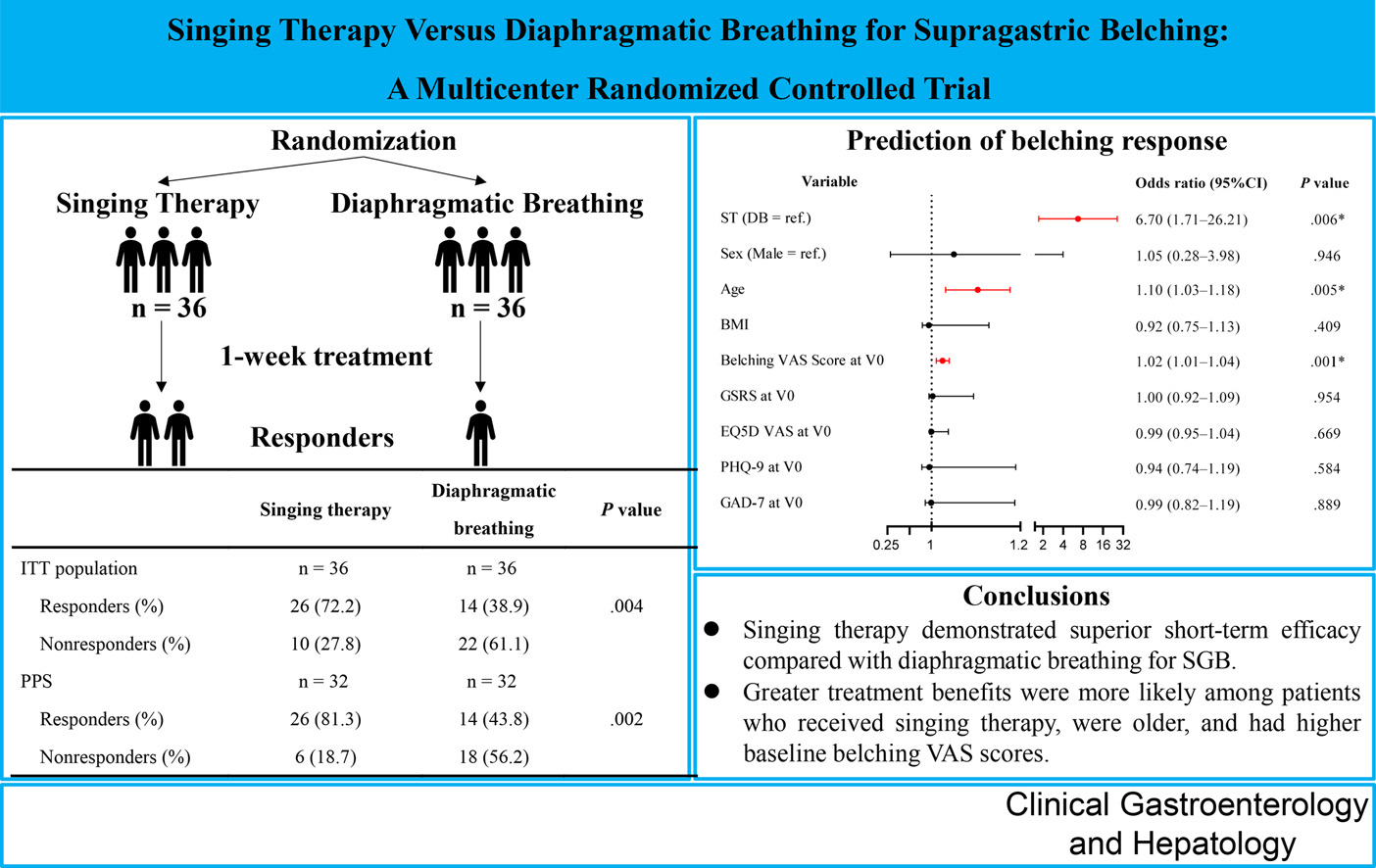
After one week, 72% of patients assigned to singing therapy achieved at least a 50% reduction in belching symptom scores, compared with 39% of those assigned to diaphragmatic breathing, the guideline-recommended first-line behavioral treatment. The separation persisted at one month, when 50% of the singing group still met the response definition, compared with 31% of the breathing group.
“Singing is an enjoyable and familiar activity, which may make patients more willing to practice consistently,” said author Tao Bai, MD, PhD, of the department of gastroenterology at Tianyou Hospital, Wuhan, China, who spoke with GI & Hepatology News. “The intervention is brief, nonpharmacological, and potentially easy to adapt across different cultures.”
In SGB, a behavioral disorder, air rapidly moves into and out of the esophagus without reaching the stomach. Some patients find diaphragmatic breathing exercises repetitive and difficult to continue over time. Because singing also uses controlled diaphragmatic breathing and may be more engaging, the researchers examined whether it could provide greater symptom relief.
For the multicenter trial, investigators screened 92 patients with SGB, diagnosed according to the Rome IV criteria, at two tertiary gastroenterology centers in China between October 2024 and April 2025. Researchers randomly assigned 72 patients in a 1-to-1 ratio to either structured singing therapy or diaphragmatic breathing for one week. Four patients in each group withdrew during the intervention, leaving 32 per group who completed treatment and 30 per group who completed the one-month follow-up. Baseline demographic characteristics, symptom severity, gastrointestinal symptom scores, quality-of-life measures, and anxiety and depression scores were similar between the groups.
The primary endpoint was treatment response, defined as at least a 50% reduction in belching symptom scores on a visual analog scale. Secondary endpoints included health-related quality of life, gastrointestinal symptom severity, anxiety, depression, and treatment acceptability. Outcomes were assessed at baseline, immediately after the one-week intervention, and again one month later.
The per-protocol analysis showed the same trend, with response rates of 81% vs. 44%. Belching symptoms improved in both groups, but patients in the singing group experienced greater reductions in symptom severity immediately after treatment, and the benefit was maintained at follow-up.
Quality of life also improved more with singing therapy. EuroQol Visual Analog Scale scores increased significantly more than with diaphragmatic breathing immediately after treatment. Although scores declined somewhat in both groups by one month, they remained higher than at baseline. Improvements in gastrointestinal symptom severity, anxiety, and depression were otherwise similar between the groups. Although depression scores differed at one month, the investigators concluded the difference was unlikely to be clinically meaningful because patients with severe anxiety or depression had been excluded from the trial.
Patients who responded to treatment also rated the intervention as more acceptable than those who did not respond. Higher treatment acceptability was associated with greater improvement in belching symptoms, and patients assigned to singing therapy rated the treatment as more acceptable than those assigned to diaphragmatic breathing.
Multivariable analysis identified three independent predictors of treatment response. Patients assigned to singing therapy were nearly seven times more likely to achieve a treatment response than those assigned to diaphragmatic breathing. Older age and greater belching severity at baseline also predicted a better response. By contrast, sex, body mass index, gastrointestinal symptom severity, quality-of-life scores, anxiety, and depression were not associated with treatment response.
The singing intervention consisted of five-minute sessions performed three times a day for one week, with additional sessions during episodes of belching. Participants sang one of four standardized Chinese folk songs while focusing on diaphragmatic breathing, sustained vocalization, and abdominal movement using visual and tactile feedback. Patients in the diaphragmatic breathing group received individualized instruction from a gastroenterologist and practiced five-minute breathing exercises three times a day, with additional sessions as needed when symptoms occurred.
The investigators acknowledged several limitations. The study included only Chinese patients and used culturally familiar songs, which may limit the generalizability of the findings. Follow-up was limited to one month, blinding was not possible because of the behavioral interventions, and treatment adherence was based on patient self-report. In addition, the visual analog scale used to assess belching symptoms has not been formally validated, and the diagnosis of SGB was based on clinical history and observation rather than high-resolution esophageal manometry or pH impedance testing.
The Shandong Provincial Natural Science Foundation and the National Key R&D Program of the Ministry of Science and Technology of China funded the study. The authors reported no conflicts of interest.

Expert Insight
GI & Hepatology News asked Dr. Bai to elaborate on the study findings.
Current guidelines recommend diaphragmatic breathing as first-line behavioral therapy for SGB. Based on your findings, where do you see structured singing therapy fitting into the treatment algorithm, and which patients are the best candidates?
Dr. Bai: We believe that structured singing therapy has the potential to become a first-line treatment option for SGB. However, further studies from different cultural backgrounds are needed before this can be formally recommended. At present, singing therapy can be considered an alternative or complementary behavioral intervention, alongside diaphragmatic breathing, thereby providing clinicians and patients with an additional treatment choice.
For patients who find conventional breathing exercises monotonous, have difficulty maintaining regular practice, or prefer a more engaging intervention, we believe singing therapy may be the preferred option. Our findings also suggest that older patients and those with more severe baseline symptoms may be particularly suitable candidates, although these factors should guide rather than restrict treatment selection.
Singing therapy appeared particularly effective in older patients and those with more severe baseline symptoms. What mechanisms do you think explain these subgroup findings, and how should clinicians interpret them in everyday practice?
Dr. Bai: Several explanations are possible. Singing requires coordinated diaphragmatic, abdominal, respiratory, and glottal control, which may provide more effective respiratory retraining for older patients with age-related changes in respiratory function. Older people may be more likely to regularly engage in loud singing exercises in a timely manner.
Patients with more severe symptoms may have greater room for improvement and stronger motivation to practice. However, these findings came from an exploratory predictor analysis rather than a prespecified subgroup comparison. Clinicians should therefore regard age and baseline severity as factors that may help identify promising candidates, not as strict criteria for offering treatment.
Your diagnosis was based on Rome IV clinical criteria rather than pH-impedance monitoring or high-resolution manometry. How confident are you that these results will generalize to patients with physiologically confirmed SGB, and is that the next study you would like to conduct?
Dr. Bai: We used detailed clinical criteria and characteristic behavioral features to identify patients with SGB, so we believe the findings are clinically relevant. Without pH-impedance monitoring or high-resolution manometry, some diagnostic misclassification cannot be excluded. However, we believe this will not significantly impact the outcome.
We are preparing to conduct a follow-up study to investigate whether patients could benefit more from extending the treatment course. Besides, we also want to follow up for a longer period.