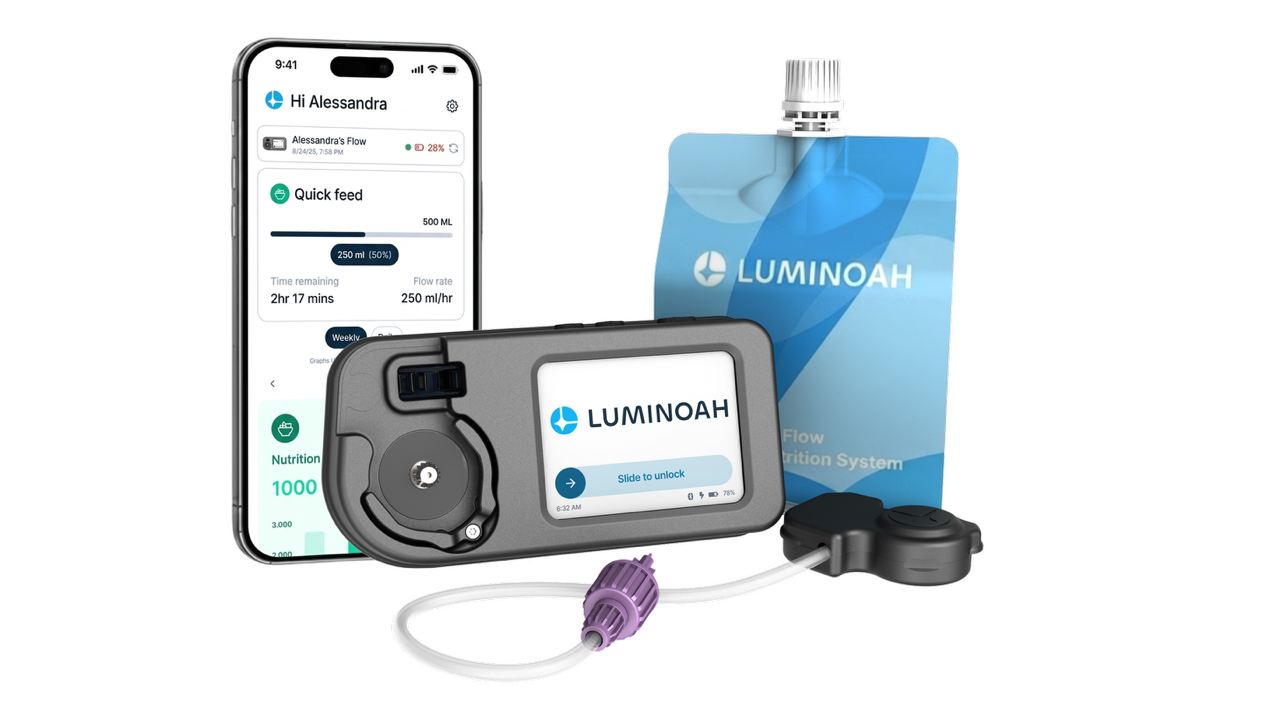
When Noah Piper was diagnosed with cancer at age three in 2019, his family came home from the hospital with tube-feeding equipment that hadn't meaningfully changed in decades — an IV pole, handwritten feeding logs, and tubing that a restless toddler could yank loose in seconds. That experience led Neal Piper to found Luminoah, whose connected feeding system, Luminoah Flow, recently received FDA clearance and won the AGA Incubator Showcase at Digestive Disease Week 2026. The Charlottesville-based company was one of 11 startups selected for the inaugural program.
Luminoah Flow is a portable, connected enteral nutrition system designed to give tube-fed patients greater mobility and flexibility during feeding. The device combines a compact wearable pump with digital monitoring capabilities, helping support more convenient nutrition delivery both in clinical settings and at home. GI & Hepatology News spoke with Piper about what the old technology got wrong, how the company designed around real life, and what he hopes changes for the patients, caregivers, and clinicians who depend on enteral nutrition every day.
Luminoah grew out of your family's experience with Noah's tube feeding. Can you take me back to the moment when this stopped being just a family problem and started becoming a company?
Piper: Noah was diagnosed with cancer in August 2019. When we came home from the hospital with the standard tube feeding equipment available today, we immediately realized something needed to change. Noah was an active three-year-old, but overnight he became tethered to an IV pole for feeds. We were handwriting feeding logs because there was no connected data system. One day, he tripped over his tubing and pulled out his gastrostomy button. It was painful and heartbreaking, but it also exposed how outdated the technology was.
As I began speaking with other families, gastroenterologists, clinical nutritionists, and health care providers, it became clear that these were not just our challenges. They were shared by millions of people who rely on enteral nutrition every day.
In March 2020, we founded Luminoah. The name combines “luminosity” and Noah, reflecting our goal of creating a brighter future for enteral tube feeding. What started as a family problem became a mission to transform a category of care that has seen very little meaningful innovation in decades.
What did the available tube-feeding equipment make harder for Noah, your family, or other caregivers than it needed to be?
Piper: The technology often forced families to adapt their lives around the equipment instead of the equipment adapting to their lives. Patients were connected to large feeding systems that limited mobility and independence. Caregivers relied on handwritten logs and manual tracking. Clinicians had little visibility into what was actually happening between appointments.
What we heard repeatedly from families was that tube feeding introduced unnecessary burdens during an already difficult time. Patients deserve technology that supports freedom, simplicity, and confidence rather than creating additional obstacles.
The name Luminoah combines “luminosity” and Noah. What does that name mean to you now, especially after FDA clearance and the AGA Incubator win?
Piper: Here is the story behind Luminoah's name. The meaning has only grown stronger over time.
When we created Luminoah, our vision was to create a brighter future for people who rely on enteral nutrition. Today, after achieving FDA clearance and winning the AGA Incubator Showcase, that vision feels more tangible than ever.
For us, Luminoah represents hope, innovation, and the opportunity to improve the lives of millions of people living with cancer, gastrointestinal disorders, neurological conditions, and other chronic illnesses. A brighter future was the vision that inspired us to start the company, and today we are beginning to make that vision a reality.
When you were designing Luminoah Flow, what were the non-negotiables for patients and caregivers?
Piper: Our guiding principle was simple: patients should be able to live their lives while receiving nutrition therapy. We wanted to create a system that was small, portable, intuitive, and designed around real life. A child receiving tube feeding should be able to play with friends. An adult should be able to go to work, travel, or spend time with family without feeling defined by their therapy. We also wanted to eliminate the stigma often associated with tube feeding. Patients deserve technology that is discreet, empowering, and designed to fit seamlessly into everyday life. Every design decision came back to one question: Does this help people live more freely and independently?
Luminoah Flow emphasizes portability, connected data, and ease of use. How did you balance the emotional needs of families with the clinical needs of providers?
Piper: Everything starts with our mission to improve the lives of people who depend on enteral nutrition. For patients and caregivers, portability and simplicity help restore independence, confidence, and quality of life. For clinicians, connected data provides visibility into nutrition delivery that has historically been unavailable.
We believe the future of enteral nutrition is connected. For the first time, patients, caregivers, and providers can have visibility into what is delivered rather than relying on handwritten logs and memory. By combining a better patient experience with meaningful clinical insights, we can help improve both quality of life and outcomes.
How did working with gastroenterologists, clinical leaders, mentors, and industry experts through the AGA Incubator shape your thinking about Luminoah Flow or the company's next steps?
Piper: The AGA Incubator came at a pivotal moment in our growth as we worked toward FDA clearance and commercialization. The experience gave us access to an exceptional network of clinicians, health care leaders, strategic partners, and fellow founders who challenged our thinking and helped strengthen our vision. Most importantly, it reinforced the tremendous opportunity to modernize enteral nutrition. The relationships and insights we gained continue to influence our strategy as we move toward broader adoption and commercialization.
What did winning the AGA Incubator Showcase at DDW 2026 mean to you and the team at this stage of the company's growth?
Piper: Winning the AGA Incubator Showcase at DDW 2026 was an incredibly meaningful moment for our team. We presented just one week after receiving FDA clearance, making it a powerful milestone in our journey. What made the recognition especially meaningful was the caliber of innovators participating. We were surrounded by companies working to transform the future of gastroenterology, and it was humbling to be recognized among them.
For me personally, it was a full circle moment. Just months earlier, our family celebrated Noah's five-year anniversary of being cancer free. Looking back at where this journey began and then standing on the DDW stage was incredibly emotional. Winning the showcase reinforced our belief that the future of enteral nutrition can be different. For a category that has seen little innovation in decades, that recognition validated both the problem we are solving and the brighter future we are working to create for patients and families.
As Luminoah moves toward commercial rollout, what difference do you most hope Flow makes for patients, caregivers, and clinicians?
Piper: Our hope is that we fundamentally improve how people live while receiving enteral nutrition.
For patients, that means greater freedom, independence, and dignity. A child should be able to attend school, play with friends, and participate fully in life while receiving nutrition therapy. An older adult should be able to spend time with family and remain engaged in the activities they enjoy. For caregivers, we want to reduce complexity and burden so they can spend less time managing therapy and more time focused on the people they care about. For clinicians, we want to provide meaningful visibility into nutrition delivery through connected data and insights that have never been available before.
Ultimately, our goal is simple: to create a brighter future for enteral nutrition by helping patients, caregivers, and providers focus less on managing therapy and more on living life.