Following their double win at the AGA Shark Tank at the AGA Tech Summit and at the Digestive Disease Week® (DDW) Shark Tank, we sat down with Spencer Matonis, PhD — materials scientist, entrepreneur, and co-founder of Edulis Therapeutics — to discuss their platform for endoscopically-delivered, bioresorbable drug depots targeting chronic GI conditions with focal disease presentations
The problem
Stricturing gastrointestinal diseases, including Crohn’s disease, represent some of the most challenging clinical conditions faced by gastroenterologists. Despite advances in biologic therapy, the vast majority of patients with fibrostenotic disease will inevitably progress toward the need for an intervention: endoscopic balloon dilation, stricturoplasty, or bowel resection. Specific pharmacological options for luminal fibrosis are few and far between. Local corticosteroid delivery offers some temporary utility, but durable, locally-targeted anti-fibrotic or anti-inflammatory delivery at the stricture site has no established standard of care.
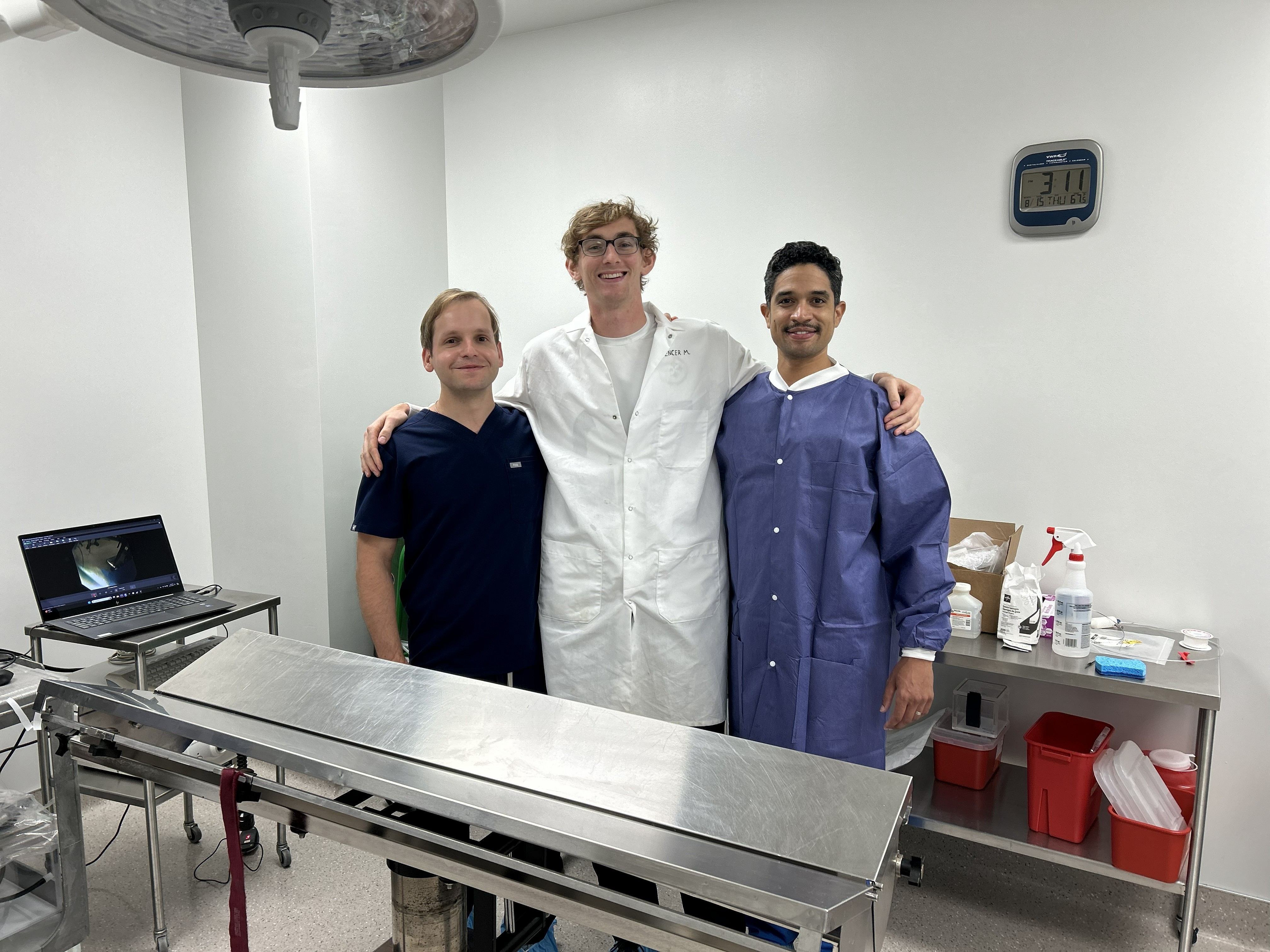
Dr. Matonis and his clinical co-founders, Vladimir Lamm, MD, and JP Genere, MD, identified this gap through systematic customer discovery across patients, physicians, hospital systems, and payers. As Dr. Matonis put it:
“IBD patients are heavily underserved in this space. We see growing prevalence, high surgical dependence, high spending, and a dramatic lack of innovation on the startup side. We saw a lot of room for opportunity.”
Crucially, they identified a structural underutilization: GI patients with refractory disease are scoped at high frequency, yet the endoscope had not been leveraged as a delivery platform for sustained local pharmacotherapy. “Pharma and therapeutic companies hadn’t begun to leverage the scope for smarter drug administration,” Dr. Matonis said. “We thought that was a major missed opportunity.”
The solution
Edulis is developing a fully bioresorbable drug depot system, which would be delivered endoscopically at the time of a routine examination. The implant is designed to elute drug locally at the target site over an extended-release window — concentrating therapeutic effect where it is needed, while avoiding the systemic exposure and immunosuppressive burden associated with steroids or parenteral biologics.
Procedurally, the goal is to make depot delivery as routine as a mucosal biopsy or polypectomy — brief, performable by a general gastroenterologist, with no retrieval required given full bioresorbability. “We really want a set-it-and-forget-it model,” Dr. Matonis said. “Instead of patients leaving with pictures and a prescription, they can leave with an autonomous management solution, purpose-built for the most stubborn of symptoms.”
As a proof of concept for depot delivery in focal, chronic inflammatory disease, Matonis points to commercial analogs in the field of ophthalmology: intravitreal or intracameral sustained-release implants such as Ozurdex (dexamethasone), Iluvien (fluocinolone acetonide), and Durysta (bimatoprost). “We’re hoping to be something akin to the drug-eluting stent of the GI world — bringing a new category of product to a space that has relied on systemic delivery for far too long,” Dr. Matonis said.
The platform is payload-agnostic by design, but the lead indication is stricturing Crohn’s disease, where local steroid or anti-fibrotic delivery at the stricture site could plausibly delay or prevent progression to surgical intervention.
Current progress
Preclinical development has advanced through porcine model testing in both the upper and lower GI tract. After a redesign of the delivery tool itself, early feasibility work followed by three-month toxicology and retention studies appears promising. “No foreign body reaction, no signs of infection. Everything looks good so far,” Dr. Matonis said.
In vitro PK characterization has confirmed drug survival through the manufacturing process and benchmark elution kinetics from the depot. The team is now fundraising to support efficacy studies, which will support a clinical development pathway and future partnership discussions with pharma and device strategics. “The bulk of our preclinical work is fine-tuning that PK curve and getting compelling histology results,” Dr. Matonis said. “That’s the main thing we’re fundraising for,”
Challenges ahead
Edulis is pursuing a combination product regulatory pathway for the Edulis implant system — a proprietary endoscopic syringe that facilitates depot injections — which carries a higher development burden than either constituent alone. Large animal efficacy studies are resource-intensive, and the company is navigating the capital constraints typical of early-stage life science companies. Dr. Matonis is unapologetic about the ambition:
“We’re going for big vision — a ten-year plan. How can we change standard of care? That’s what innovation takes.”
For an early-stage company navigating the complexity of a novel drug delivery platform, the AGA Incubator provided invaluable structured access to clinical, strategic, and investor stakeholders at a formative stage. Matonis found considerable value in stress-testing the preclinical roadmap against the expectations of pharma and device strategics — identifying whether proposed study designs and endpoints align with future partnership or licensing requirements:
“These programs are a great way to sanity-check your test plans — to say to a strategic, ‘is this compatible with your vision?’ That’s probably the most helpful part: de-risking your test plan.”
Shark Tank winner
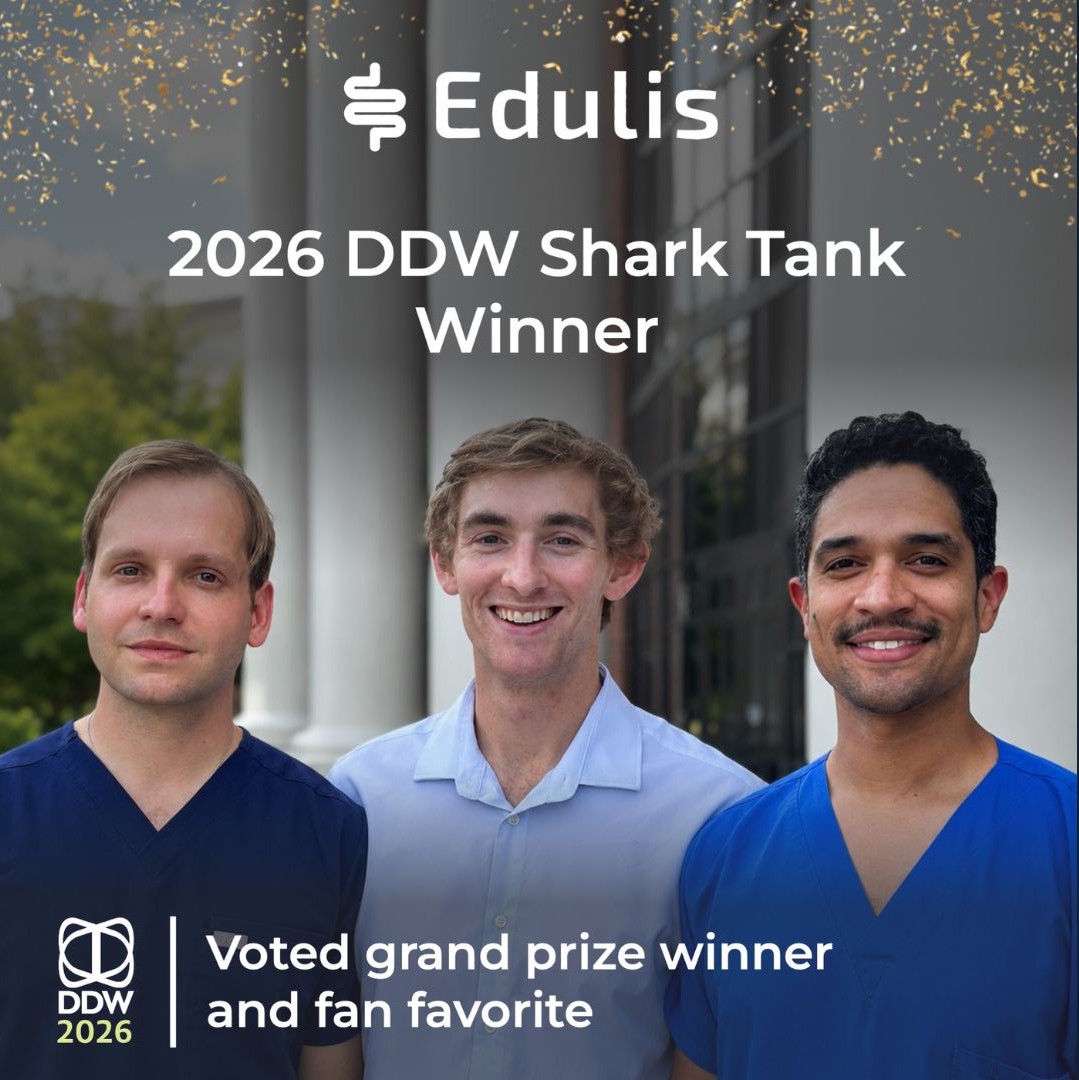
Winning both the AGA Shark Tank and the DDW® Shark Tank validated both the clinical rationale and the commercial framing of the Edulis platform in front of a GI innovation-savvy audience. For Dr. Lamm, the victory was particularly special — a full-circle moment for someone who had founded the company as a 2022 AGA Innovation Fellow. For Dr. Matonis, the event was also a direct business development opportunity — soliciting sponsored research partnerships, early investment, and clinical co-investigator relationships with gastroenterologists who could eventually serve as site champions for future trials.
“My call to action: if you’re a strategic, consider a sponsored project with us. You may be curious about the capabilities of our technology — so are we. Let’s do an investigation together.”
The clinical co-founders
Edulis is not Dr. Lamm's first foray into device development. Before co-founding the company, he worked with engineers at Georgia Tech and Washington University to prototype a faster abdominal paracentesis device and an advanced imaging probe for stratifying high-risk colon polyps. Dr. Matonis is emphatic that his clinical co-founders are full-time founders, not hands-off advisors:
“These are not white-haired physicians with big egos asking for a third of the company. They sleep on my couch when we're doing animal studies in Tennessee. That's what you need.”
For Dr. Lamm, Edulis is the next step in a longer arc of clinician-led device development, and the motivation is straightforward:
“I wanted to create something tangible — something that could address a real need for patients, and that I could help mold into the clinical world. Being part of a start-up, and hopefully one day a scale-up, is what gets me out of bed in the morning.”
The path to Edulis specifically, Dr. Lamm says, came not from a single eureka moment but through the same disciplined customer discovery process that shaped the company's commercial framing. The clinical case for the platform, however, reinforces itself in clinic on a routine basis:
“When I do an upper endoscopy for a patient with dyspepsia and offer nothing more than essentially a rule-out test, I wish our product was already out there. When I do a colonoscopy for a patient with a tight Crohn's stricture and offer a balloon dilation and outpatient medication optimization, I wish our product already existed. I can't wait to move this forward.”
Dr. Genere brings a complementary lens. For him, founding Edulis is less a trade-off against clinical work than an extension of it:
“I strongly believe physicians have an important responsibility to participate in innovation, because we are uniquely positioned to recognize where current therapies fall short. I don't see my work with Edulis as a trade-off, but rather as an opportunity to amplify my impact beyond the individual patient encounter.”
That conviction is grounded in what he sees in clinic:
“Since starting a specialty practice focused on GI strictures, I've had an intimate view of the major gaps that still exist in treatment. I've seen many of my patients cycle through therapies that are limited, imprecise, or simply not durable enough … Targeted medical therapy, delivered directly and precisely to diseased tissue, is where the field needs to go.”
Looking ahead
The team is actively seeking clinical collaborators and advisors to engage early — particularly those with experience in fibrostenotic Crohn’s management or endoscopic drug delivery — as they build toward their pivotal efficacy studies. The team is also eager to expand its application areas beyond stricture treatment, including colorectal cancer, microbiome engineering, and even weight loss. If the vision holds, Edulis may one day offer gastroenterologists something they have never had for stricturing Crohn’s disease or other chronic gastrointestinal conditions: a way to treat the problem, not just manage its consequences.
If you’d like to learn more, you can follow Edulis Therapeutics through their campaign page to receive updates on their preclinical progress.