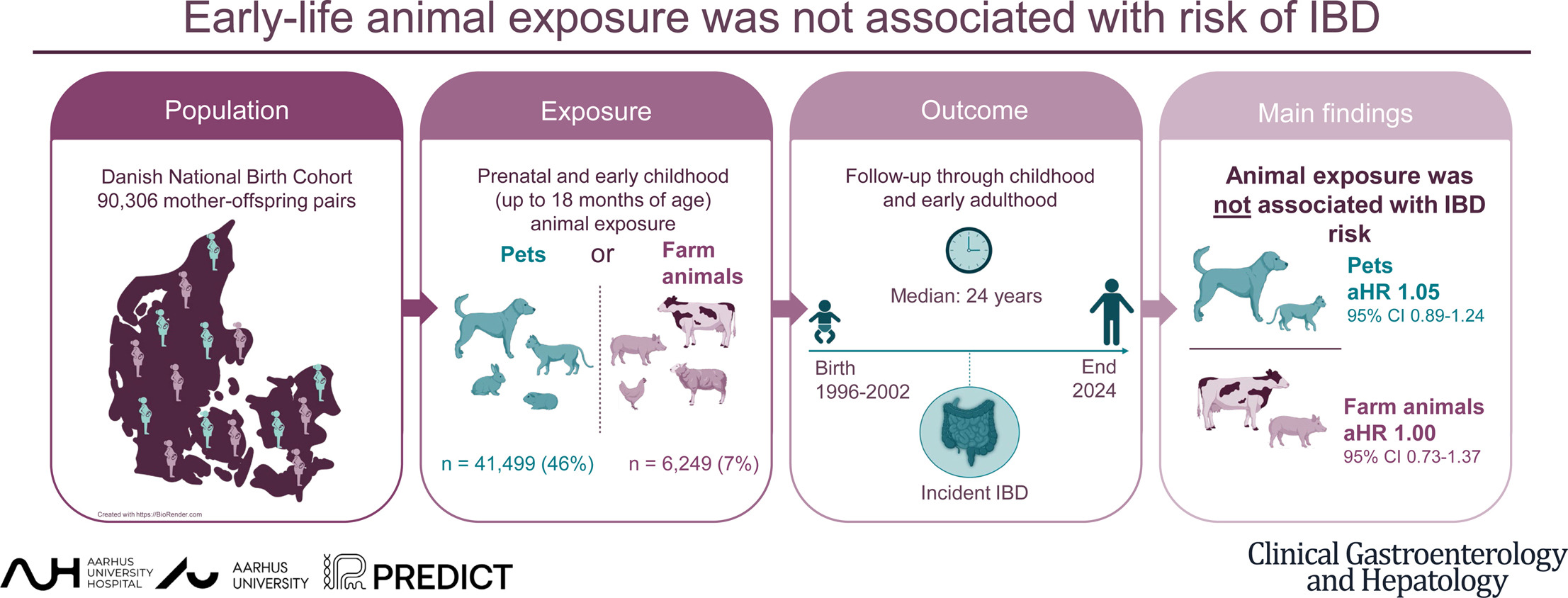
Exposure to pets or farm animals during pregnancy and early childhood was not associated with risk of inflammatory bowel disease (IBD) in a nationwide Danish birth cohort of 90,306 offspring followed for a median of 24 years, according to a study published online in Clinical Gastroenterology and Hepatology.

“Our study adds large-scale prospective evidence that exposure to pets or farm animals during pregnancy and the first 18 months of life is unlikely to be a major determinant of subsequent IBD risk,” first and corresponding author Christina Balmer, MD, a PhD student in the Department of Hepatology and Gastroenterology at Aarhus University Hospital and the Department of Clinical Medicine at Aarhus University in Denmark, told GI & Hepatology News. “Importantly, our findings do not diminish the importance of early life as a critical period for immune development — instead, they highlight the need to investigate other environmental exposures during this period that may influence the gut microbiome and subsequent IBD risk.”
IBD incidence continues to rise globally, and genetic susceptibility accounts for only a small proportion of disease risk, according to the authors. Early life is considered a critical window for immune development, and animal exposure has been proposed as a potential determinant of IBD risk, consistent with the hygiene hypothesis, which links reduced microbial diversity and a westernized lifestyle to rising rates of immune-mediated diseases.
Previous findings have been inconsistent, the authors wrote. Most case-control studies have been small, hospital-based, and reliant on retrospective questionnaires, and two prospective cohorts that examined early-life pet exposure found no association with IBD risk.
Study design
To investigate the association, Dr. Balmer and colleagues analyzed data on 90,306 offspring from the Danish National Birth Cohort, which enrolled pregnant women during the first trimester between 1996 and 2002. In telephone interviews, mothers reported pet ownership or living on a farm with animals at week 12 of pregnancy and, for 63,958 offspring, which animals the family had kept from birth to 18 months. Exposed offspring were compared with unexposed offspring.
The researchers examined exposure to several animal categories, including dogs, cats, birds, rodents, cattle, pigs, and poultry. The primary outcome was IBD, defined as at least two hospital contacts with a diagnostic code within two years in the Danish National Patient Registry; Crohn’s disease (CD) and ulcerative colitis (UC) were secondary outcomes.
Among the study population, 46% of children were exposed to household pets prenatally, while 7% were exposed to farm animals. Over a median follow-up of 24 years, 615 participants (0.7%) developed IBD, with a median age at diagnosis of 19 years.
Findings
After adjustment for sex, year of birth, number of children in the household, municipality at birth, parental IBD, and parental education, prenatal pet exposure was not associated with IBD risk (adjusted hazard ratio, 1.05), nor was prenatal farm animal exposure (adjusted hazard ratio, 1.00). IBD developed in 0.7% of offspring in both the exposed and unexposed groups. These findings remained consistent when individual animal categories were examined and when CD and UC were analyzed separately.
In a subgroup of 63,958 children with available information on both prenatal and postnatal exposure, the team also investigated whether the timing of animal contact influenced outcomes. Neither exposure only during pregnancy (adjusted hazard ratio, 1.10) nor exposure only from birth to 18 months (adjusted hazard ratio, 0.73) was associated with IBD risk. The early-childhood-only estimate was based on 21 cases among 4,093 children, and its confidence interval was consistent with no difference in risk. Additional analyses found no clear associations among children with a parental history of IBD or those diagnosed before age 18.
Next steps
Although previous studies have indicated that animal exposure may influence intestinal microbial diversity and composition, the authors wrote that this influence may not translate into a measurable association with IBD risk — or that animal exposure may not adequately capture the broader microbial exposures relevant to IBD.
However, Dr. Balmer said the team’s findings do not necessarily contradict the hygiene hypothesis. “Animal ownership is only an indirect measure of microbial exposure and may not fully reflect the microbial environment relevant to IBD development,” she added. “Therefore, our findings do not rule out a role for microbial exposure in the development of IBD.”
In the paper, the authors wrote that the findings do not support early-life animal exposure as a major determinant of IBD and suggest that prevention strategies may need to focus on other environmental factors. They also wrote that the potential role of animal exposure later in childhood warrants further investigation.
“Previous studies have suggested a protective association with animal exposure later in childhood, particularly after age 5,” Balmer said. “One possible explanation is that animal exposure at this age may reflect other environmental and lifestyle factors, such as greater exposure to green space and increased physical activity, which have previously been associated with a lower risk of IBD. Therefore, animal exposure later in childhood warrants further investigation.”
Given the increasing global incidence of IBD, Dr. Balmer added that there is a clear need for larger-scale prospective cohort studies examining both environmental risk factors and biological measurements (such as biomarkers and gut microbiome profiling) of the disease. “[Future] research should also look beyond exposures traditionally associated with the hygiene hypothesis and investigate other potential environmental risk factors, including air pollution, pesticides, and chemical exposures through food and the environment,” she said. “Finally, larger studies including individuals with a family history of IBD are needed to investigate whether familial predisposition modifies the associations between environmental exposures and IBD risk.”
The study had limitations, the authors noted. Animal exposure was based on maternal reports without objective verification, did not capture intensity or duration, and was not assessed after 18 months. Because prenatal and early-childhood exposure status matched for 87% to 88% of offspring, the analysis had limited ability to separate the two periods. With a median age at diagnosis of 19 years, the findings mainly reflect early-onset IBD, and the relatively small number of cases limited precision for less common exposures and subgroups. Residual confounding could not be excluded. Participants had more favorable socioeconomic characteristics than the Danish background population, and findings from a predominantly European-ancestry population may not apply elsewhere.
Dr. Balmer reported travel support from Celltrion. Coauthors Julsgaard, Torres, and Jess reported fees from companies including AbbVie, Johnson & Johnson, Takeda, Eli Lilly, Pfizer, and Ferring; Torres also reported grants from AbbVie and Janssen, and Agrawal reported consulting for Sanofi and National Institutes of Health support.