Patients with moderately to severely active Crohn’s disease had similar improvements in symptoms and intestinal inflammation whether they started guselkumab with intravenous infusions or subcutaneous injections, according to an analysis of three phase 3 trials published online in Clinical Gastroenterology and Hepatology. Treatment benefits were maintained through 96 weeks.
The authors said the findings support comparable efficacy for the two induction routes.
Guselkumab, a drug that blocks interleukin-23, is approved for adults with moderately to severely active Crohn’s disease. Treatment can begin with intravenous (IV) infusions or subcutaneous (SC) injections, followed by SC injections to maintain the benefits.
Geert R. D’Haens, MD, PhD, of Amsterdam University Medical Centers in the Netherlands, and colleagues compared results from three trials: GALAXI 2 and GALAXI 3, which evaluated IV induction, and GRAVITI, which evaluated SC induction. The trials enrolled adults with active Crohn’s disease who had not responded well to standard treatments or biologic drugs, or who could not tolerate them. Patients were randomly assigned to treatment or placebo, and neither the patients nor the researchers knew which treatment they received.
In GALAXI 2 and 3, 582 patients received guselkumab and 148 received placebo. In GRAVITI, 230 patients received guselkumab and 117 received placebo.
Patients in the GALAXI trials received 200 mg of guselkumab by IV infusion at weeks zero, four, and eight. Those in GRAVITI received 400 mg by SC injection on the same schedule. Afterward, patients received maintenance treatment with 100 mg by SC injection every eight weeks or 200 mg every four weeks.
Because patients were not randomly assigned to IV or SC induction across the trials, the researchers used a statistical method to account for differences between the groups, including disease severity, corticosteroid use, and previous biologic treatment. The comparison, planned and run after the trials were unblinded, covered six efficacy measures at week 12, including clinical remission, defined as a Crohn’s Disease Activity Index score below 150, and endoscopic response and remission, based on the Simple Endoscopic Score for Crohn’s Disease.
Week 12 outcomes
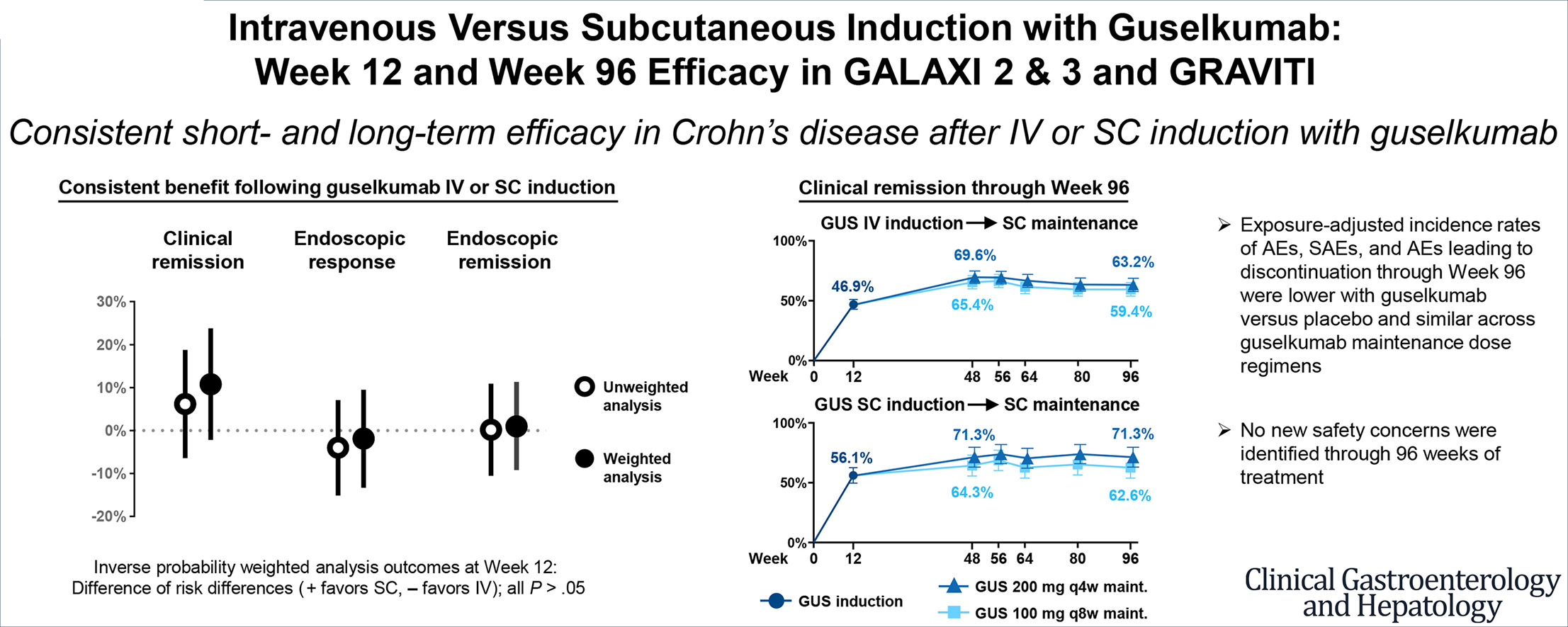
After accounting for differences between the groups, 58% of patients who started treatment with SC injections achieved clinical remission at week 12, compared with 46% who started with IV infusions. Endoscopic response rates were 36% vs. 33%, respectively, while endoscopic remission rates were 28% vs. 23%.
None of these differences was statistically significant. Across all six measures, the difference between the two routes’ placebo-adjusted treatment effects ranged from 1 to 11 percentage points.
In all three trials, guselkumab was more effective than placebo. At week 12, clinical response rates were 64% with guselkumab vs. 29% with placebo in GALAXI 2, 61% vs. 18% in GALAXI 3, and 74% vs. 33% in GRAVITI.
Clinical remission rates were also higher with guselkumab: 47% vs. 22% in GALAXI 2, 47% vs. 15% in GALAXI 3, and 56% vs. 21% in GRAVITI.
By week four, both induction routes produced greater improvements in abdominal pain and stool frequency, and higher clinical response and remission rates, than placebo. Levels of C-reactive protein and fecal calprotectin, two markers of inflammation, also declined.
Subgroup analyses
Additional analyses showed that IV and SC induction were similarly effective regardless of disease duration, location, or severity, including among patients with higher levels of inflammation or disease affecting the small intestine, colon, or both.
Long-term outcomes
At week 96, clinical remission rates in the GALAXI trials were 59% with the lower maintenance dose and 63% with the higher dose. These results included all patients originally assigned to treatment, with those who had missing data or treatment failure counted as not achieving remission.
Corresponding remission rates in GRAVITI were 63% and 71%.
Endoscopic remission rates ranged from 28% to 31% in GALAXI and 38% to 47% in GRAVITI. Deep remission rates, which combine clinical and endoscopic remission, were 26% and 29% in GALAXI and 35% and 39% in GRAVITI. At least 96% of patients who achieved remission or responded to treatment at week 96 had also been free of corticosteroids for the previous 90 days.
Among patients who continued treatment in the long-term extensions, deep remission rates ranged from 40% to 51%.
Safety findings were generally similar with both approaches. Serious infections were uncommon, and no new safety concerns were identified through 96 weeks.
Study limitations included the lack of a direct randomized comparison between IV and SC induction, possible differences between the patient groups that researchers could not account for, and differences between the trials in rescue therapy criteria and timing. These differences, along with dose adjustment being allowed in the GALAXI extension but not in GRAVITI, may have influenced long-term outcomes, the authors wrote.
“Given the consistency of efficacy and safety across routes of induction, the choice between IV and SC guselkumab induction can be guided by patient preference and access considerations,” the authors concluded.
Johnson & Johnson funded the trials and helped design the studies and analyze and interpret the data. Dr. D’Haens and several coauthors reported financial relationships with pharmaceutical companies, including Johnson & Johnson. Eight coauthors were company employees.