Nearly one-quarter of 162,456 adults with available laboratory data in Stockholm, Sweden, were classified as high risk for metabolic dysfunction-associated steatohepatitis (MASH) despite having no recorded diagnosis, according to a retrospective cohort study published online ahead of print in Clinical Gastroenterology and Hepatology.
The findings also showed that nearly 45% of patients with an established diagnosis of MASH had already experienced a major adverse liver outcome (MALO) at baseline. Researchers led by Emilie Toresson Grip, of Quantify Research AB and Karolinska Institutet in Stockholm, Sweden, characterized patients at risk of MASH and compared subsequent liver outcomes, cardiovascular events, and mortality across risk groups.
“Our results highlight the need for improved screening and management strategies for MASH with fibrosis stages F2-F4 in the primary care setting, to facilitate earlier intervention and improved patient outcomes,” the researchers wrote.
Study design and population
Researchers identified 162,456 adults in Stockholm with sufficient laboratory information to calculate the Fibrotic NASH Index (FNI) between January 2011 and October 2020. The validated noninvasive score incorporates aspartate aminotransferase (AST), high-density lipoprotein (HDL) cholesterol, and glycated hemoglobin (HbA1c) to identify patients at risk of MASH with fibrosis stages F2 through F4.
Patients were categorized according to their first available FNI score:
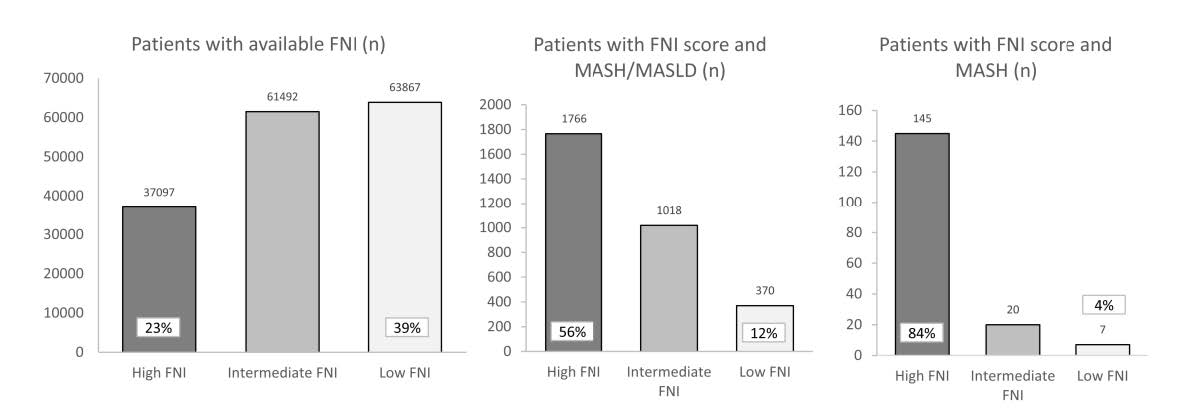
High risk: 37,097 patients (23%) with an FNI of at least 0.33 and at least one cardiometabolic risk factor.
Intermediate risk: 61,492 patients (38%) with an FNI of at least 0.10 but below 0.33 and at least one cardiometabolic risk factor.
Low risk: 63,867 patients (39%) with an FNI below 0.10, with or without cardiometabolic risk factors.
Patients in these risk groups had no recorded diagnosis of MASH or metabolic dysfunction-associated steatotic liver disease (MASLD).
For comparison, investigators identified 17,209 patients with an established diagnosis of MASLD or MASH in Sweden, including 615 with a recorded MASH diagnosis.
The outcomes assessed included MALO, defined as compensated or decompensated cirrhosis, hepatocellular carcinoma, liver transplantation, or liver-related death. Researchers also assessed major adverse cardiovascular events (MACE), comprising myocardial infarction, ischemic stroke, or cardiovascular death. All-cause mortality was assessed separately.
Patients were followed until an outcome, emigration, or death, and those with a history of MALO or MACE were excluded from the respective analyses of incident outcomes. Analyses accounted for differences in age, sex, type 2 diabetes, hypertension, hyperlipidemia, and body mass index.
Liver outcomes and disease burden
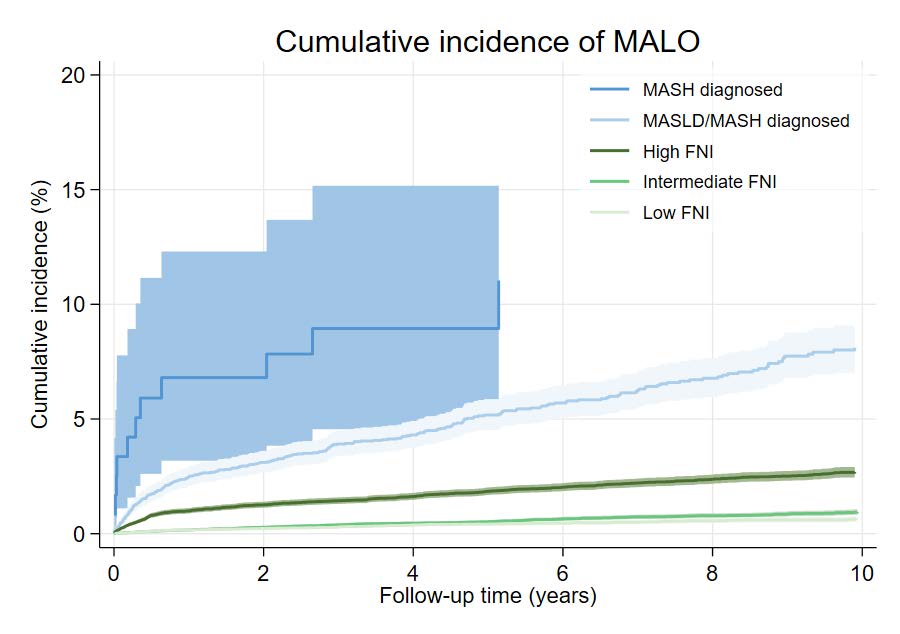
Patients with established MASH had the highest incidence of MALO; among the FNI groups, incidence was highest in the high-risk group.
At baseline, nearly 45% of patients with diagnosed MASH had a history of MALO, compared with 0.6% of those in the high-risk FNI group. Cirrhosis was recorded in 42% of patients with established MASH.
During follow-up, the incidence of MALO was 21.6 events per 1,000 person-years among patients with diagnosed MASH, compared with 4.0 events per 1,000 person-years in the high-risk FNI group and 0.7 events per 1,000 person-years in the low-risk group.
After adjustment, patients with diagnosed MASH had approximately 6.7 times the hazard of MALO compared with patients classified as high risk. Those in the high-risk FNI group had approximately 4.6 times the hazard of MALO compared with the low-risk group.
The five-year cumulative incidence of MALO was:
10% among patients with diagnosed MASH.
2% among patients at high risk.
0.6% among patients at intermediate risk.
0.3% among patients at low risk.
Among 172 patients with diagnosed MASH who had available FNI data in Stockholm, 84% were classified as high risk at their first FNI assessment. When all available measurements before or after diagnosis were considered, 93% had a high FNI score at some point during the study period.
Cardiovascular events and mortality
Patients classified as high risk by FNI also had higher rates of cardiovascular events and all-cause mortality than those in the low-risk group.
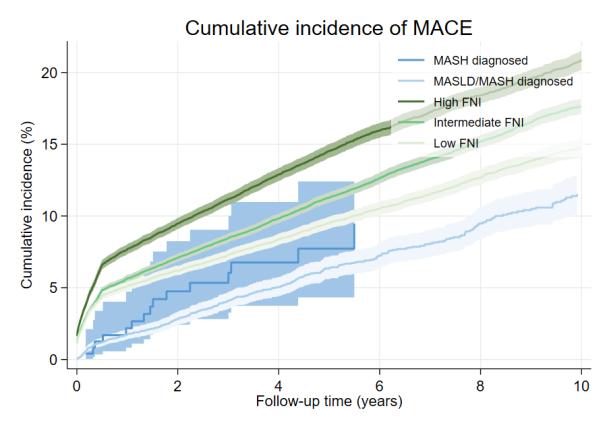
The incidence of MACE was 27.9 events per 1,000 person-years in the high-risk group, compared with 20.0 in the intermediate-risk group and 12.2 in the low-risk group.
After adjustment, the hazard of MACE was 1.8 times higher among high-risk patients compared with low-risk patients. However, the adjusted difference in MACE hazard between patients with diagnosed MASH and those in the high-risk FNI group was not statistically significant.
At five years, the cumulative incidence of MACE was 13% in the high-risk group, 10% in the intermediate-risk group, and 6% in the low-risk group, compared with 7% among patients with diagnosed MASH.
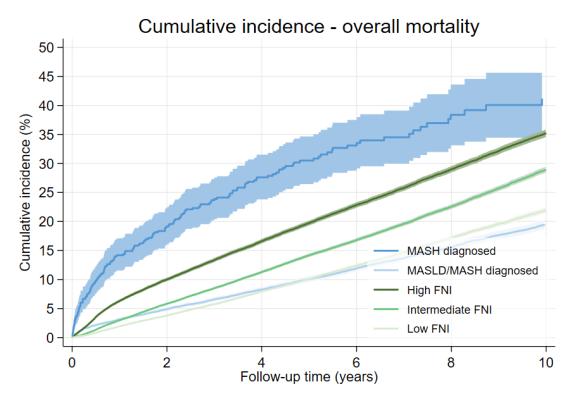
All-cause mortality was highest among patients with established MASH, at 68.3 deaths per 1,000 person-years, followed by the high-risk FNI group at 44.2 deaths per 1,000 person-years.
After adjustment, patients with diagnosed MASH had approximately 2.7 times the hazard of all-cause mortality compared with those in the high-risk FNI group, and high-risk patients had approximately 1.7 times the hazard of low-risk patients.
Five-year cumulative mortality was 31% among patients with diagnosed MASH, 20% among high-risk patients, 14% among intermediate-risk patients, and 10% among low-risk patients. Adjusting for baseline differences substantially narrowed these gaps, the researchers reported.
Subgroup and sensitivity analyses
The association between FNI category and MALO was stronger in women than in men. Compared with low-risk patients of the same sex, high-risk women had approximately 5.5 times the adjusted hazard of MALO, vs. approximately 3.7 times for men. Intermediate-risk women had approximately twice the hazard of low-risk women, while intermediate-risk men showed no significant increase. Results did not differ significantly between women younger than 50 and those 50 or older, though MALO events were few among younger women. Restricting the low-risk group to patients with at least one cardiometabolic risk factor did not change the MACE results.
Limitations and clinical implications
The investigators acknowledged several limitations, including potential misclassification from diagnostic codes, missing information on ethnicity and alcohol consumption, and the absence of histologic confirmation of MASH.
They also noted that FNI was originally developed in patients with available liver biopsy data, potentially limiting its accuracy when applied to a broader healthcare population. The cohort was drawn from patients who had laboratory testing during routine care, which the authors described as a healthcare-seeking population.
Although 23% of patients were classified as high risk by FNI, the five-year cumulative incidence of MALO in this group was 2%. The researchers noted that the high proportion of patients classified as high or intermediate risk, combined with relatively low absolute event rates, suggests that FNI may overestimate the prevalence of fibrotic MASH in this population, potentially leading to unnecessary referrals. They called for additional research comparing the clinical utility of FNI with other risk scores and emphasized the need for more accurate tools to identify patients at risk.
The investigators also emphasized that the high prevalence of existing liver complications among patients with diagnosed MASH suggests delayed diagnosis.
“Further work is needed to find a balance between diagnosing patients too late, and over-referral of false positive cases,” the researchers wrote.
The study was funded by Novo Nordisk Denmark A/S. Emilie Toresson Grip and Helena Skröder reported employment with Quantify Research. Pierre Johansen, an employee of Novo Nordisk Denmark A/S, and Kamal Kant Mangla, an employee of Novo Nordisk, reported ownership of Novo Nordisk shares. Ron Basuroy was an employee and shareholder of Novo Nordisk at the time of the study. Hannes Hagström, Jeffrey V. Lazarus, and Jörn M. Schattenberg reported research funding, consulting relationships, honoraria, or other financial relationships with multiple pharmaceutical and healthcare companies, including Novo Nordisk.

Expert insight
GI & Hepatology News invited Brian DeBosch, MD, PhD, AGAF, professor of pediatrics and co-chief of the Division of Pediatric Gastroenterology, Hepatology and Nutrition at Indiana University School of Medicine, to provide commentary on the study.
What are the barriers to earlier MASH detection?
Dr. DeBosch: MASH is a common metabolic disease that can progress to cirrhosis and liver transplant. Moreover, its intertwined pathophysiology renders MASH an independent risk factor for MACE. Observations that nearly half of patients with MASH have MALO at baseline underscore the urgency for earlier screening to stratify treatment-eligible patients. Ideally, this screening would apply in a general population in favor of a referral or subspecialty population. However, at least two major barriers exist to fully address this.
First, MASH is largely asymptomatic, particularly at its earliest stages. This limits the number of patients who might even present for screening. Second, gold-standard diagnosis of MASH currently involves liver biopsy, which is time-consuming, costly, and invasive. Multiple noninvasive serologic and imaging-based screening tests are proposed, but their full validation remains under investigation, and some tests require specialized assays (e.g., Enhanced Liver Fibrosis test), equipment (e.g., vibration-controlled transient elastography), or are age-dependent (e.g., Fibrosis-4 index). The current study applies FNI, an age-independent MASH risk score calculated based on blood tests that are routinely quantified in a standard clinical care setting: AST, HbA1c, and HDL.
What are the clinical implications of the study’s findings?
Dr. DeBosch: First, the data indicate FNI can discriminate patients at higher risk for major adverse liver and cardiovascular outcomes using common, noninvasive laboratories. Furthermore, when applied to a MASH-undiagnosed population, simple screening measures unveil an underrecognized population at risk for MASH, MALO, and MACE. Most importantly, however, the data reveal that earlier MASH screening deployed in a general population with risk factors may be far more accessible and potentially impactful than previously appreciated.
Dr. DeBosch reported having no relevant disclosures.