The US Multi-Society Task Force on Colorectal Cancer recommends colonoscopy every three to six months to clear polyps in patients with serrated polyposis syndrome (SPS), followed by surveillance every one to two years, according to a new consensus statement published online in Gastroenterology. The recommendations also emphasize improved recognition of the syndrome, which the task force described as widely underrecognized despite its association with increased colorectal cancer risk.
The consensus statement, developed by representatives of the American College of Gastroenterology, AGA, and the American Society for Gastrointestinal Endoscopy, provides 11 recommendations addressing diagnosis, genetic testing, polyp detection and removal, surveillance, and screening of first-degree relatives. The statement is also being published in The American Journal of Gastroenterology and Gastrointestinal Endoscopy.
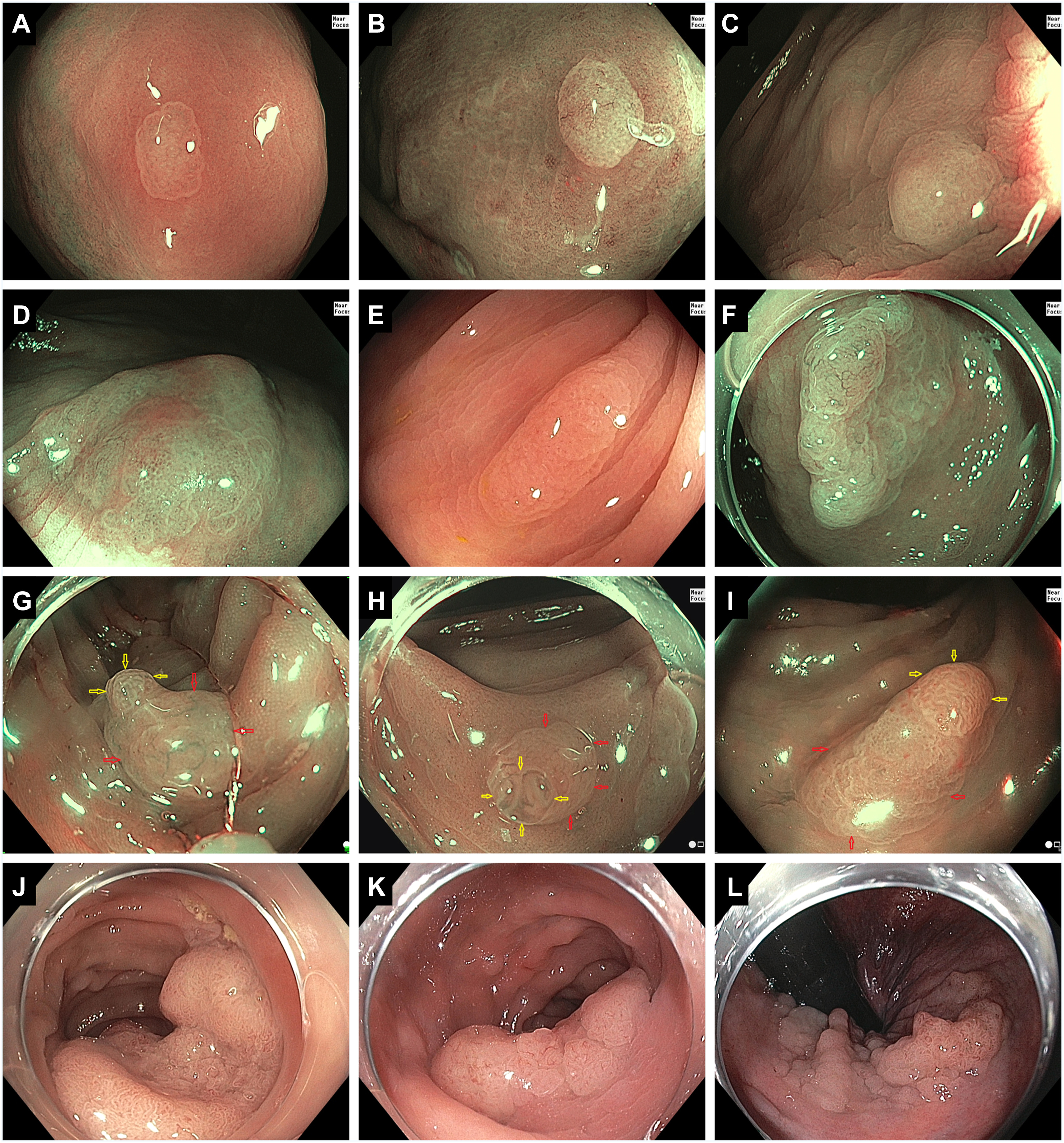
SPS is the most common gastrointestinal polyposis syndrome and may affect approximately 1 in 250 people undergoing screening colonoscopy, according to the task force. The task force noted that diagnosis depends on recording the number, size, and location of serrated polyps.

“Clinicians should be aware that all serrated polyps (hyperplastic polyps, sessile serrated lesions, and traditional serrated adenomas) detected over the lifetime of a patient count toward an SPS diagnosis,” Douglas K. Rex, MD, MACP, MACG, Distinguished Professor Emeritus of Medicine at Indiana University School of Medicine and Chancellor’s Professor at Indiana University Indianapolis, the statement’s lead and corresponding author, told GI & Hepatology News. “While some patients have sufficient polyps to make the diagnosis in a single colonoscopy, in others the necessary number, size, and location of lesions is identified only after multiple colonoscopies.”
Consensus development and diagnostic criteria
The nine-member task force reviewed English-language medical literature published between January 2005 and June 2025, searching MEDLINE, EMBASE, the Database of Abstracts of Reviews and Effects, and the Cochrane Database of Systematic Reviews. Case reports and studies involving patients with inflammatory bowel disease were excluded.
The panel assessed evidence using the Oxford 2011 Levels of Evidence framework and classified recommendations as strong or weak through consensus. The recommendations were independently approved by the governing boards of the three participating societies.
The task force strongly recommended using the 2019 World Health Organization criteria for SPS diagnosis. These criteria identify two forms of the syndrome:
Type 1: At least five serrated polyps proximal to the rectum, all measuring at least 5 mm, with at least two measuring 10 mm or larger.
Type 2: More than 20 serrated polyps throughout the colon, including at least five proximal to the rectum.
The cumulative number of serrated polyps identified and removed over a patient’s lifetime can be used to establish the diagnosis.
“Recognition of SPS is facilitated by recording the numbers, size range, and location of serrated polyps in the procedure report whenever multiple serrated polyps are removed,” Dr. Rex said.
The statement also noted that patients with multiple serrated polyps who approach but do not meet the diagnostic criteria may have increased colorectal cancer risk during surveillance.
The authors wrote that SPS “could be encountered and diagnosed up to several times per year by a busy endoscopist.” They added that practitioners performing more than 200 to 300 colonoscopies a year who are not periodically diagnosing SPS “should measure their detection skills for serrated polyps.”
Colorectal cancer risk and surveillance outcomes
The task force cited a meta-analysis of 36 studies involving 2,788 patients with SPS that found colorectal cancer was present in 14.7% at the time of diagnosis, while 7.7% had received a colorectal cancer diagnosis before SPS was identified.
The same analysis reported colorectal cancer in 2.8% of patients during surveillance, with a mean interval of 28.9 months for cancers identified during surveillance.
However, the task force noted that cancer incidence during surveillance was lower in more recent studies, including several reporting no cases.
Colorectal cancer risk also varied by SPS subtype, according to the statement. Patients meeting Type 1 criteria or both Type 1 and Type 2 criteria had higher risk than those meeting Type 2 criteria alone. Sessile serrated lesions (SSLs) with dysplasia and concurrent advanced conventional adenomas were associated with increased risk.
The panel noted that approximately half of colorectal cancers in patients with SPS occur in the rectosigmoid colon, a distribution that led the 2019 World Health Organization criteria to place greater emphasis on sigmoid lesions. At minimum, all rectosigmoid lesions 5 mm or larger should be resected, the authors wrote.
Colonoscopy and endoscopic management
The task force strongly recommended that colonoscopy in patients with SPS be performed by endoscopists with documented SSL detection rates of at least 6%.
“Because serrated lesions are typically subtle and missed during colonoscopy, colonoscopists treating SPS should be proven high SSL detectors,” Dr. Rex said.
High-definition white-light colonoscopy, with or without virtual or dye-spray chromoendoscopy, was recommended.
In a cited tandem colonoscopy trial involving patients with SPS, the indigo carmine plus acetic acid arm detected more additional SSLs than the indigo carmine or white-light arms (63.4% vs. 39.1% vs. 21.6%; P<.001). Nearly all additional serrated polyps were smaller than 10 mm, according to the statement.
The panel also strongly recommended documenting serrated polyp number, size, and location at least until an SPS diagnosis is established.
“After making an SPS diagnosis, continuing to count serrated lesions of different size groups (e.g., smaller than 10 mm and 10 mm or larger) allows colonoscopists to understand if the polyp burden is being brought under control,” Dr. Rex said.
For patients without concurrent colorectal cancer, the task force recommended endoscopic management as the preferred strategy over surgery for primary management of SPS.
The panel recommended cold-snare resection of SSLs and hyperplastic polyps, with or without submucosal injection for larger lesions, except when dysplastic areas are endoscopically evident.
The task force suggested, in a weak recommendation, that patients whose polyp burden is deemed endoscopically unmanageable be referred to an expert in advanced endoscopic resection before surgery.
“If a colonoscopist considers that the polyp burden is too high for endoscopic control to be achieved, patients should be referred to an experienced endoscopic resectionist,” Dr. Rex said.
The task force cited observational studies suggesting that most patients with SPS can be managed with colonoscopy and polypectomy. During the initial clearing phase, approximately 10 to 16 polyps were removed per colonoscopy, compared with five to seven during surveillance.
“Effective endoscopists in SPS must be willing to resect large numbers of lesions in single colonoscopies in some patients, in order to get ahead of the polyp burden,” Dr. Rex said.
Surveillance intervals based on polyp burden
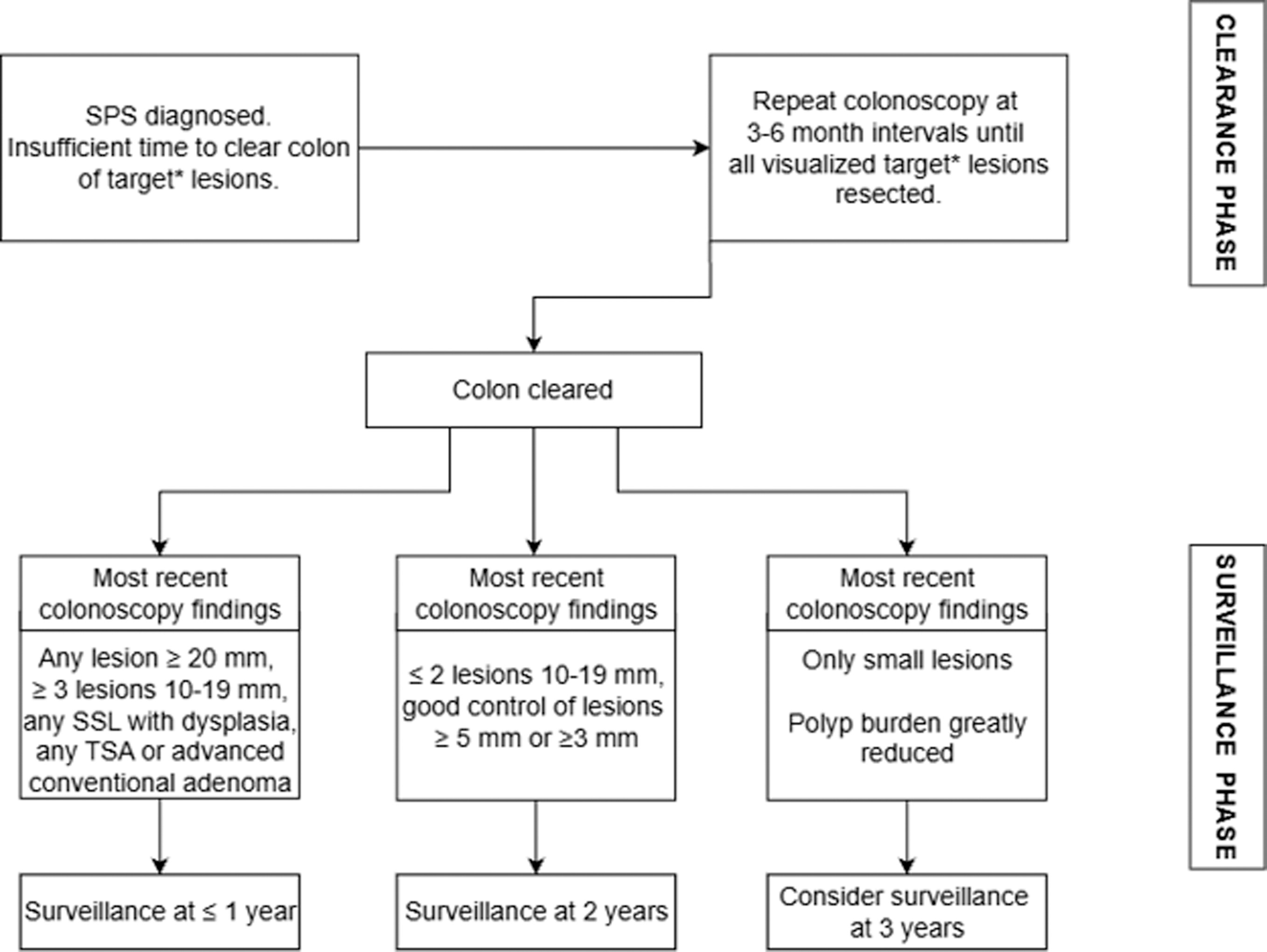
The task force recommended repeat colonoscopy every three to six months during the clearing phase until target lesions are removed — usually all conventional adenomas, all lesions proximal to the sigmoid colon, and all rectosigmoid serrated polyps 5 mm or larger (3 mm or larger in some programs). After clearance, surveillance at one- to two-year intervals was strongly recommended.
Previous recommendations often called for annual colonoscopy in patients with SPS, according to the statement. However, the authors cited observational studies finding that selected patients could undergo colonoscopy at two-year intervals without increased colorectal cancer risk or increased incidence of advanced neoplasia.
Figure 2 of the consensus statement presents a proposed framework for individualizing surveillance intervals based on polyp size, number, histology, and control of the polyp burden. The authors wrote that the framework is not meant to imply strict evidence-based recommendations but is intended to help high-detecting colonoscopists extend intervals beyond one year in select patients. The tiers are based on findings at the most recent colonoscopy:
One year or less: Patients with any lesion measuring at least 20 mm, three or more lesions measuring 10 to 19 mm, any SSL with dysplasia, any traditional serrated adenoma, or an advanced conventional adenoma.
Two years: Patients with no more than two lesions measuring 10 to 19 mm and good control of lesions measuring at least 5 mm or at least 3 mm.
Consider three years: Patients with only small lesions and substantially reduced polyp burdens.
The task force suggested that patients with greatly reduced polyp burdens be considered for three-year intervals, a weak recommendation the authors attributed to a lack of high-quality observational data. They wrote that no substantial evidence supports extending intervals beyond three years.
Genetic testing and family screening
The task force found no established, consistent genetic basis for SPS and recommended against routine germline genetic testing based solely on an SPS diagnosis.
Testing was recommended when patients also have conventional adenomas or hamartomatous polyps meeting established criteria for genetic evaluation, or a family history suggesting a hereditary gastrointestinal cancer syndrome.
In one cited analysis of 258 patients with SPS who underwent genetic testing, four had germline variants, of whom three had pathogenic variants in Lynch syndrome genes and one had an RNF43 variant.
The task force also addressed colorectal cancer risk among first-degree relatives. Studies cited in the statement reported approximately fivefold higher colorectal cancer risk among first-degree relatives of patients with SPS compared with reference populations.
The panel suggested that first-degree relatives undergo colonoscopy at age 40, 10 years before the youngest colorectal cancer diagnosis in the family, or five years before the youngest SPS diagnosis, whichever occurs earliest.
The recommendation was graded as weak, with the task force noting mixed findings from two small studies evaluating the yield of screening colonoscopy among first-degree relatives.
Limitations
The task force acknowledged gaps in the supporting evidence. Four of the 11 recommendations, including the strong recommendations on use of World Health Organization criteria and on endoscopist detection rates, were based on Oxford Level 5 evidence; under the framework, higher levels represent weaker study designs. The authors wrote that limited data exist to support evidence-based surveillance intervals and that evidence supporting earlier screening of first-degree relatives is mixed. Studies of genetic testing in SPS were cross-sectional, and no randomized trial has compared submucosal injection with no injection for resecting SSLs. After approval by the three societies’ governing boards, the document moved to publication without further peer review.
Conclusion
The authors wrote, “SPS by itself is not an indication for germline genetic testing. Importantly, colonoscopy in SPS should be performed by endoscopists skilled in the detection of serrated polyps. Indeed, most patients with SPS can be managed effectively by skilled and committed colonoscopists.”
Seven of the nine authors reported industry relationships, including consulting for Boston Scientific, Olympus, Medtronic, Exact Sciences, Geneoscopy, and Natera; Douglas K. Rex also reported an ownership interest in Dova Health Intelligence. Joseph C. Anderson and Elena M. Stoffel reported no competing interests.