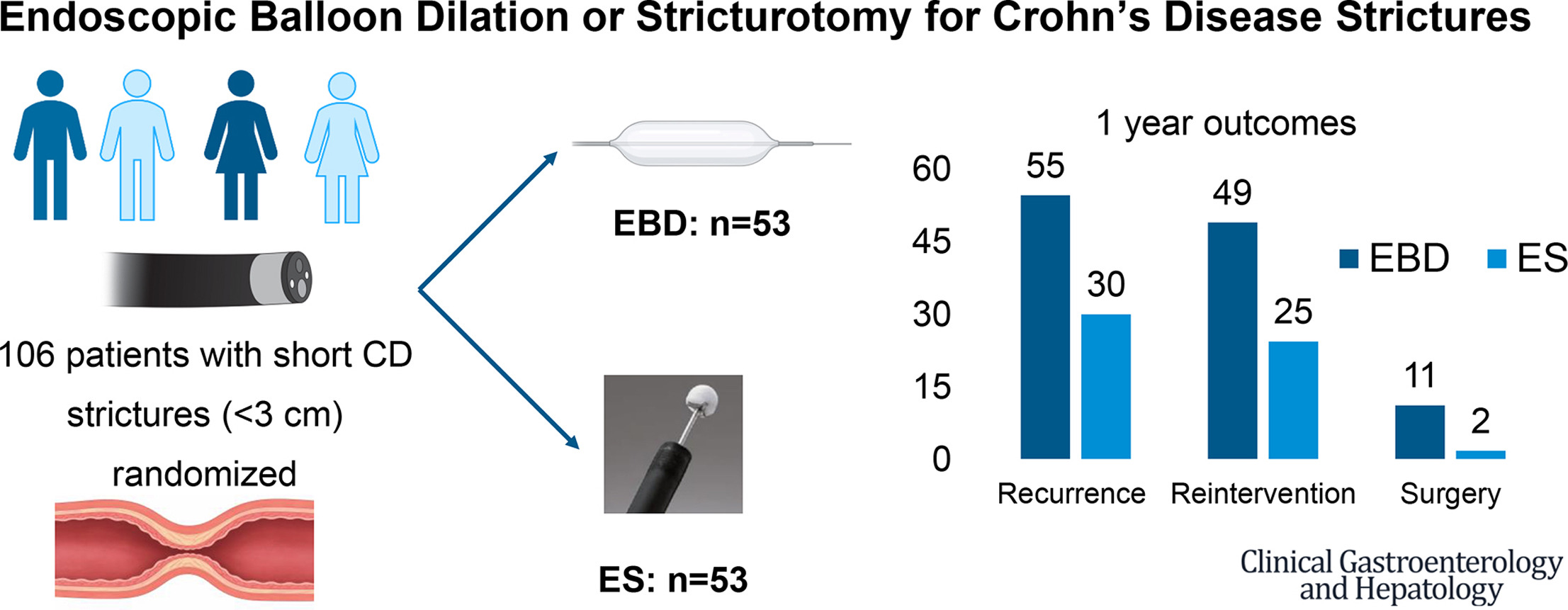
Endoscopic stricturotomy was associated with lower rates of recurring symptoms and repeat procedures than balloon dilation among patients with short Crohn’s disease strictures, according to a randomized trial of 106 patients published in Clinical Gastroenterology and Hepatology. After one year, symptoms had returned in 30% of patients treated with stricturotomy compared with 55% of those treated with balloon dilation.
The findings come from the BEST-CD trial, which the authors described as the first randomized comparison of endoscopic stricturotomy (ES) with endoscopic balloon dilation (EBD) for Crohn’s disease strictures.
“The future of Crohn’s stricture management is unlikely to be a choice between medications, endoscopy, and surgery,” first author Partha Pal, MD, director of inflammatory bowel diseases at the Asian Institute of Gastroenterology in Hyderabad, India, told GI & Hepatology News. “Rather, it will involve selecting the right intervention for the right stricture, at the right time, through multidisciplinary collaboration.”
According to the authors, EBD is the standard first-line endoscopic treatment for certain Crohn’s disease strictures, offering a bowel-preserving alternative to surgery.
ES uses an electrosurgical knife to make controlled cuts in narrowed areas of the intestine, which may widen the bowel more durably, they wrote.

Study design and methods
Dr. Pal, senior author D. Nageshwar Reddy, MD, and colleagues enrolled patients in the open-label, single-center trial between February 2023 and April 2025. They randomly assigned 106 adults aged 18 to 65 years to EBD or ES, with 53 patients in each group.
Eligible strictures were shorter than 3 cm and reachable with standard endoscopy. The study included anastomotic strictures, which form where bowel segments were surgically joined, and de novo strictures, which do not. Patients with deep ulcers, nearby fistulas, or abscesses were excluded.
One experienced endoscopist performed all procedures. EBD involved gradually inflating a balloon to widen the narrowed area to 12 to 20 mm.
The primary outcome was the return of symptoms within one year, measured using the Crohn’s Disease Obstruction Score, which assesses abdominal pain, nausea, vomiting, and dietary restrictions.
Secondary outcomes included the need for additional procedures, surgery, emergency department visits, and hospitalization. The researchers also tracked complications within 30 days of treatment.
Recurrence and reintervention
The researchers estimated that treating five patients with ES instead of EBD would prevent one recurrence within one year. Additional procedures were required in 25% of patients treated with ES compared with 49% treated with EBD.
Emergency department visits related to strictures occurred in 19% of patients treated with ES compared with 51% treated with EBD. Stricture-related hospitalization rates were 15% vs. 34%, respectively.
Surgery rates did not differ significantly between groups (2% with ES vs. 11% with EBD).
Initial symptom improvement was similar in both groups, occurring in 98% of patients treated with ES and 94% treated with EBD. Procedural success rates were 94% and 100%, respectively.
Subgroup findings and safety
Exploratory subgroup analyses suggested a greater benefit of ES for de novo strictures, whereas no clear difference was observed in the smaller subgroup with anastomotic strictures. “These subgroup findings should be interpreted cautiously,” Dr. Pal said.
In exploratory analyses, longer strictures were associated with a greater risk of recurring symptoms, additional procedures, and surgery, even among strictures shorter than 3 cm.
The results remained largely unchanged after researchers accounted for changes in advanced medical treatment.
Complications occurred in 13% of patients treated with ES compared with 23% treated with EBD, a difference that was not statistically significant. The higher rate with EBD was driven mainly by minor events; clinically significant complications occurred in three ES patients and two EBD patients. The authors noted that the trial was not powered to compare safety and wrote that “comparable safety between ES and EBD cannot be concluded.”
Bleeding, the most common complication, occurred in four ES patients and five EBD patients. One EBD patient required surgery for a perforation, while one ES procedure was stopped because of a suspected perforation, followed by planned surgery.
Clinical implications and limitations
The authors cited limitations including the single-center design, use of one endoscopist, lack of blinded symptom assessments and imaging confirmation of recurrence, and evaluation of only one EBD session. They described the findings as proof of concept and called for larger multicenter trials.
Dr. Pal reported consulting fees or speaker honoraria from Johnson & Johnson, Takeda, Cipla, Sun Pharma, Zydus Biosciences, and Dr. Reddy’s Laboratories. The remaining authors reported no conflicts of interest. The trial received no external funding.

Expert insight
Dr. Pal elaborated on the clinical significance of the findings.
How should the findings influence the choice between balloon dilation and stricturotomy for patients with short Crohn’s disease strictures?
Dr. Pal: EBD has long been the standard bowel-preserving endoscopic treatment for short Crohn’s disease strictures. However, recurrence and the need for repeated interventions remain important limitations.
In the BEST-CD trial, involving 106 randomized patients, endoscopic stricturotomy significantly reduced clinical recurrence at one year compared with EBD (30.1% vs. 54.7%; P = .01). The need for repeat intervention was also substantially lower (24.5% vs. 49.1%; P = .01), alongside reductions in emergency department visits and hospitalizations.
These findings suggest that stricturotomy should be considered an important alternative to balloon dilation for appropriately selected short Crohn’s strictures, particularly in centers with the necessary expertise.
Our message is not that balloon dilation should be abandoned, but that stricturotomy deserves a more prominent place in the therapeutic armamentarium for Crohn’s disease strictures.
Which patients are most likely to benefit from stricturotomy?
Dr. Pal: Based on our trial, patients with short Crohn’s disease strictures (less than 3 cm) that are technically accessible for endoscopic treatment are potential candidates.
Stricturotomy may be particularly attractive when a durable bowel-preserving intervention is desired, especially in patients who might otherwise require repeated dilations.
However, stricture length alone is insufficient for treatment selection. The degree of inflammation, angulation, associated penetrating complications, anatomical accessibility, and the availability of advanced therapeutic endoscopy expertise must all be considered.
Further studies are needed to identify which anatomical and clinical subgroups derive the greatest benefit.
What are the main safety concerns with stricturotomy, and what expertise is needed to perform it?
Dr. Pal: The principal concerns are bleeding and perforation, as stricturotomy involves controlled electrosurgical incision of the strictures rather than radial balloon expansion.
Safe performance requires advanced therapeutic endoscopy skills, familiarity with electrosurgical techniques, careful assessment of stricture anatomy, and the ability to recognize and manage adverse events, including endoscopic hemostasis and defect closure.
In our trial, serious procedural complications were uncommon but occurred, underscoring the importance of careful patient selection and appropriate expertise.
Stricturotomy should therefore not be regarded as a simple substitute for dilation in every endoscopy unit. Training, technical standardization, and multidisciplinary support will be essential before broader adoption.