Surveillance for pancreatic cystic lesions and hepatocellular carcinoma (HCC) in older adults should be individualized based on comorbidities, functional status, and fitness for treatment rather than age alone, according to an AGA clinical practice update published in Clinical Gastroenterology and Hepatology.
Pancreatic cystic lesions are incidentally found in as many as 26% to 38% of patients older than 70 who undergo abdominal imaging, and an estimated 8.1% of the Medicare population has a cirrhosis diagnosis, according to the update.
The expert review outlines nine best practice advice statements based on published literature and expert opinion. The AGA Institute Clinical Practice Updates Committee and the AGA Governing Board commissioned and approved the review, which underwent internal and external peer review. The recommendations do not carry formal evidence quality ratings because systematic reviews were not performed.

“Ultimately, these recommendations encourage clinicians to ask a fundamental question: if surveillance identifies cancer or a concerning precursor lesion, will we be able to offer an intervention that meaningfully improves this patient’s outcome?” lead author Koushik K. Das, MD, professor of medicine in the Division of Gastroenterology at Washington University School of Medicine in St. Louis, told GI & Hepatology News.
“That question should be central to shared decision-making in all interventions and revisited as patients age and their health status changes,” he said.
Pancreatic cyst surveillance
The update includes six statements on pancreatic cystic lesion surveillance:
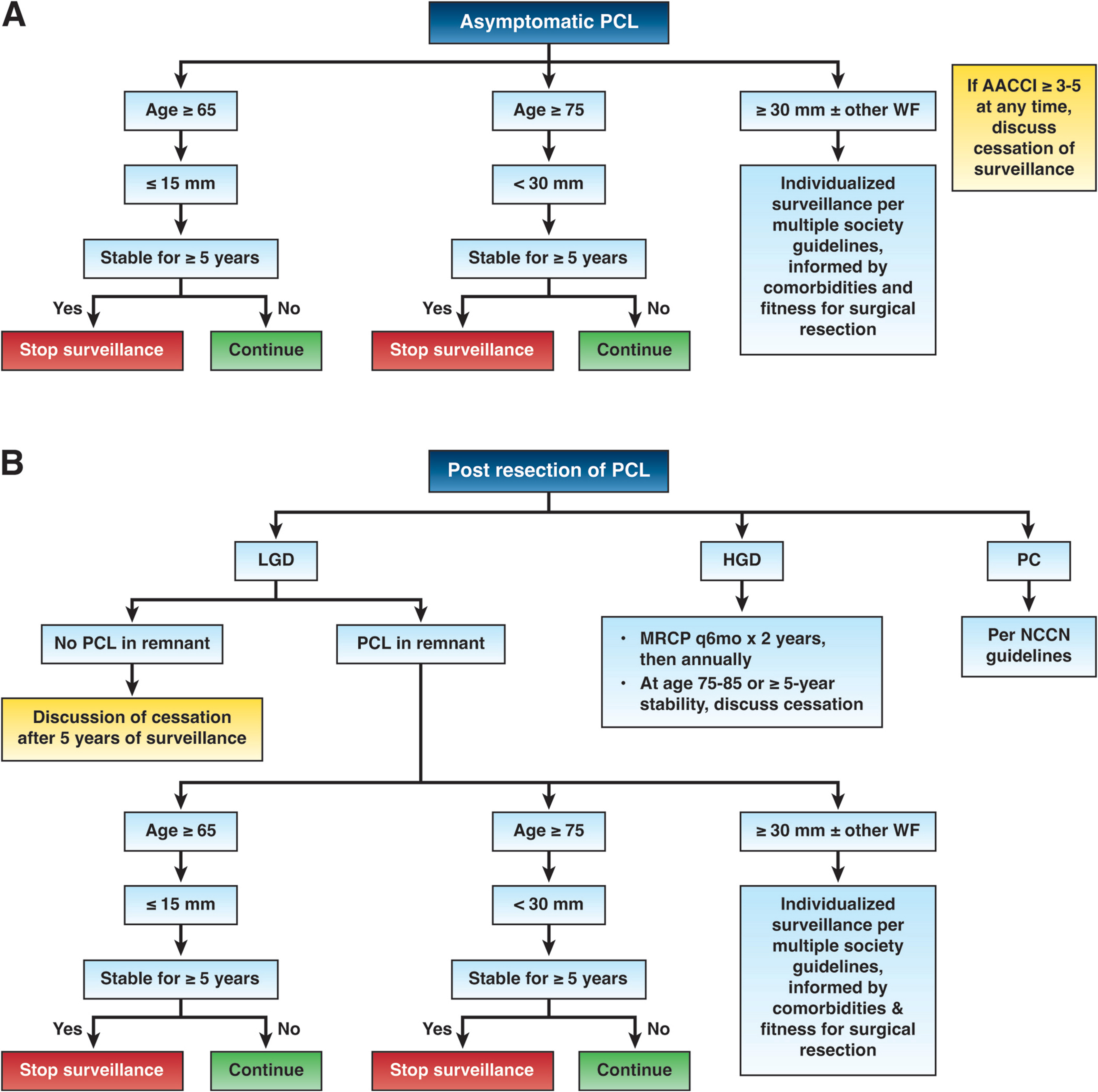
Significant comorbidities: Regardless of age, patients with incidental cystic lesions and significant comorbidities should be counseled against routine surveillance, particularly when lesions are low risk. The update defines significant comorbidities as an age-adjusted Charlson comorbidity index of at least 3 to 5. It cites the low attributable mortality from pancreatic cancer and the high risks of intervention in this population.
Patients older than 65 years: Patients with lesions 15 mm or smaller that have been stable for five years should be considered for discontinuation of surveillance after detailed shared decision-making. Stable means no growth of 3 mm or more per year or 6 mm or more over two years, with no worrisome features or high-risk stigmata. The update cites the potential for increased morbidity from intensive surveillance in this population.
Patients older than 75 years: Patients with lesions smaller than 30 mm that meet the same criteria should have a detailed discussion about the questionable value of ongoing surveillance. Surveillance may be discontinued if they understand their small, population-specific risk of future pancreatic cancer or high-grade dysplasia.
New comorbidities: If significant comorbidities that may preclude resection develop at any point, that should prompt discussion of stopping surveillance. This applies even with prior worrisome features or high-risk stigmata, provided there is no evidence of high-grade dysplasia or pancreatic cancer.
No high-grade dysplasia or cancer after resection: Surveillance of the remnant pancreas can continue per the age-based statements, counting the surveillance period before resection. Stopping should be discussed after five years of stability.
High-grade dysplasia or cancer after resection: For high-grade dysplasia, magnetic resonance imaging with magnetic resonance cholangiopancreatography is advised every six months for two years, then annually, as long as patients remain candidates for completion pancreatectomy. For pancreatic cancer, surveillance should follow current oncologic guidelines and the treatment course. In both cases, physicians should discuss stopping with oncology teams after five years of stability without new worrisome features or high-risk stigmata.
Dr. Das emphasized that most pancreatic cystic lesions, particularly small lesions that have remained stable over time, carry a very low risk of causing clinically significant disease. At the same time, the authors noted that even in expert centers, pancreatic resection can carry a 1% to 4% mortality risk and a 40% to 50% adverse event rate, and that up to 75% of resected cystic lesions harbor only low-grade dysplasia on final pathology.
In a retrospective cohort of 3,844 patients with presumed branch-duct intraductal papillary mucinous neoplasms cited in the update, patients 65 or older with lesions 15 mm or smaller after five years of surveillance had an all-cause mortality rate of 4.9%, compared with a disease-specific mortality rate of 0.3%.
“Continuing to survey patients who will not benefit, who are not candidates for aggressive therapies, or for whom aggressive therapies are not within their goals of care exposes them to undue risk without clear benefit,” Dr. Das said.
HCC surveillance
The update includes three statements on HCC surveillance:
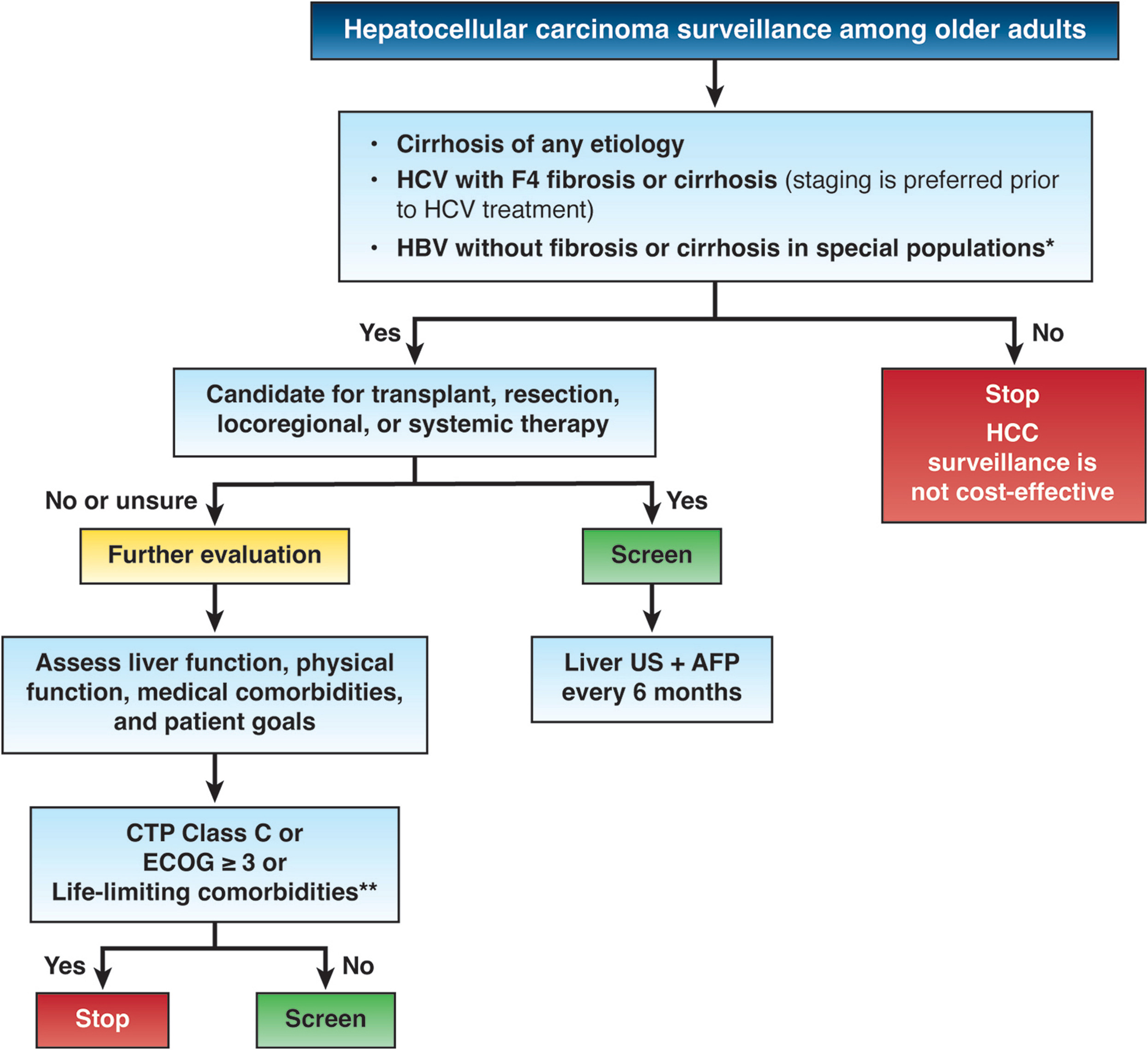
Viral hepatitis: Oral antivirals for hepatitis B and C lower HCC risk but do not eliminate it. Surveillance in older adults with viral hepatitis should be based on fibrosis stage and HCC risk rather than age alone.
Cirrhosis: Surveillance should be considered for older adults with cirrhosis of any etiology because HCC risk increases with age, unless life expectancy is less than one to two years.
Limited life expectancy: Surveillance should stop when estimated life expectancy is less than one to two years because of comorbidities, impaired functional status, or liver decompensation, such as Child-Turcotte-Pugh class C cirrhosis, when transplant is not an option. Shared decision-making can inform these decisions.
According to the update, observational studies and meta-analyses have found that long-term suppression of hepatitis B replication is associated with a 40% to 50% reduction in HCC risk. Direct-acting antivirals for hepatitis C have been associated with up to a 70% reduction in HCC risk among patients who achieve a sustained virologic response.
“For HCC, the message is complementary [to that for pancreatic cystic lesions] but not identical,” Dr. Das said. He emphasized that older age alone should not prompt discontinuation of HCC surveillance, particularly in patients with cirrhosis, because HCC risk increases with age and effective treatments may remain available. Instead, he recommended considering liver disease severity, functional status, comorbidities, and eligibility for transplantation or other potentially beneficial therapies.
Clinical considerations
“Chronologic age alone is a poor measure of an individual’s health, life expectancy, or ability to tolerate treatment,” Dr. Das said. In the paper, the authors concluded that, in making decisions about continued surveillance, “complex, multidisciplinary considerations on attributable mortality to the disease being surveyed, surveillance-related morbidity, and predicted life expectancy are crucial.”
Dr. Das identified challenges in applying these recommendations in practice, noting that “surveillance often continues by default” despite changes in patients’ health and treatment options. Prognostic uncertainty can further complicate decisions, particularly around surgical eligibility, he said, and “patients may interpret discontinuing surveillance as abandoning care or accepting that a cancer will be missed.”
“We can address these challenges by making reassessment an explicit part of surveillance care. Health systems can help by incorporating surveillance reassessment into electronic health record reminders and care pathways,” he said. “Communication is equally important. Physicians should explain that stopping surveillance can be an active, evidence-based decision.”
Dr. Das and colleagues acknowledged that the advice on continued surveillance after resection of lesions without high-grade dysplasia or cancer represents a shift based on expert opinion, given the lack of randomized data, and is not fully aligned with international guidelines. They also noted that although small, stable cysts in older patients appear highly unlikely to progress to pancreatic cancer, that risk does not disappear. In addition, gastroenterologists who manage cyst surveillance may find it difficult to judge whether a patient is fit for surgery, they wrote.
Dr. Das called for prospective longitudinal studies involving older adults that assess not only cancer incidence but also cancer-specific mortality, competing causes of death, treatment eligibility, treatment-related morbidity, quality of life, and healthcare utilization. “These studies should help identify how age, comorbidity burden, frailty, functional status, lesion characteristics, and life expectancy interact to determine the net benefit of surveillance,” he said.
Dr. Das has served as a consultant for Olympus; coauthor Marina Serper, MD, MS, has received research grant support from Grifols and Transplant Genomics; and coauthor Santhi Swaroop Vege, MD, has received financial support from UpToDate.