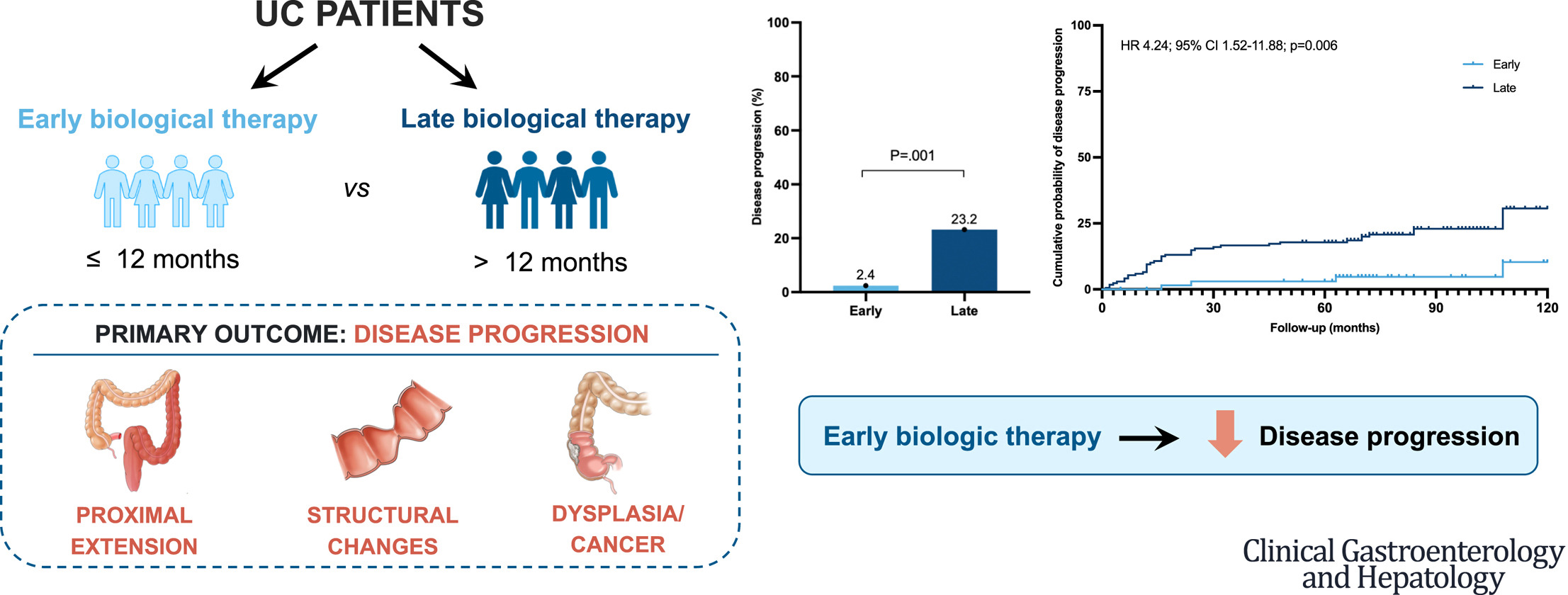
Initiating biologic therapy within 12 months of diagnosis was associated with a lower risk of disease progression in patients with moderate-to-severe ulcerative colitis (UC), according to a multicenter retrospective study of 236 patients published in Clinical Gastroenterology and Hepatology. Disease progression occurred in 6% of patients who received early biologic therapy compared with 23% of those who started treatment later. However, early treatment was not associated with significant differences in colectomy, hospitalization, or corticosteroid use.
Starting biologic therapy early in the disease course may reduce the long-term risk of disease progression, according to the study, although no statistically significant differences were observed in traditional clinical outcomes.
Study design and patient characteristics
Investigators conducted a retrospective cohort study across 11 centers in Portugal to assess whether early biologic therapy was associated with improved outcomes in patients with UC, particularly a lower risk of disease progression.
The study included 236 adult patients with moderate-to-severe UC who had received biologic therapy because of disease activity and had at least five years of follow-up. Early intervention was defined as initiating biologic therapy within 12 months of diagnosis, while late intervention was defined as starting treatment more than 12 months after diagnosis.
Of the participants, 68 (29%) received early biologic therapy and 168 (71%) received late biologic therapy. Median follow-up after treatment initiation was 6.9 years. Median age at diagnosis was 32 years, and 59% had pancolitis before biologic initiation.
Most patients (95%) received anti-tumor necrosis factor (TNF) therapy, while 5% initiated vedolizumab. Nearly half (48%) received combination treatment with an anti-TNF agent and azathioprine.
The primary outcome was disease progression, defined as a composite of proximal extension, structural changes (colonic tubularization or stricture formation), and dysplasia or cancer. Secondary outcomes included a composite clinical outcome of colectomy, UC-related hospitalization, and corticosteroid use, as well as the evaluation of each outcome separately.
The investigators also evaluated potential predictors of outcomes, including disease activity, disease severity, excessive corticosteroid use, prior exacerbations, and duration of clinical activity before biologic initiation. Excessive corticosteroid use was defined as more than one corticosteroid course annually or corticosteroid treatment lasting at least three months during the year before biologic initiation.
Baseline characteristics were generally similar between treatment groups, although patients receiving early biologic therapy had more severe disease at treatment initiation. Acute severe UC was present in 46% of the early-treatment group compared with 21% of the late-treatment group. Anemia was also more common in the early-treatment group (57% vs. 34%), as were endoscopic findings consistent with greater disease activity.
Patients in the late-treatment group had experienced a longer period of clinical activity before biologic initiation, with a median of five months compared with two months in the early-treatment group.
Disease progression
The primary composite outcome occurred in four patients (6%) receiving early biologic therapy compared with 39 patients (23%) receiving late biologic therapy.
Kaplan-Meier analysis showed a cumulative probability of disease progression of 10% in the early-treatment group compared with 31% in the late-treatment group.
After adjustment for potential confounders, including disease extent, severity, activity, corticosteroid overuse, and prior clinical activity, late biologic therapy initiation remained independently associated with disease progression, with a 4.39-fold higher hazard. Higher baseline modified Mayo scores were also independently associated with progression.
When investigators examined individual components of the primary outcome, the differences were statistically significant for proximal disease extension and structural colonic changes but not for dysplasia or cancer.
Proximal disease extension
Proximal disease extension occurred in 13 of 72 eligible patients (18%) in the late-treatment group compared with none of 25 in the early-treatment group. This outcome was assessed only among patients with proctitis or left-sided colitis before biologic initiation.
Kaplan-Meier analysis showed a cumulative probability of proximal extension of 23% in the late-treatment group compared with 0% in the early-treatment group.
Because no proximal extension events occurred in the early-treatment group, treatment timing could not be included in the multivariable regression model for this outcome. Higher baseline modified Mayo scores were independently associated with proximal extension.
Structural colonic changes
Structural colonic changes, including strictures and tubularization, occurred in 22 patients (13%) receiving late biologic therapy compared with two patients (3%) receiving early biologic therapy. The cumulative probability of structural changes was 18% in the late-treatment group compared with 3% in the early-treatment group. After multivariable adjustment, late biologic therapy initiation was independently associated with structural colonic damage, with a 4.83-fold higher hazard.
Dysplasia and cancer
Dysplasia or cancer occurred in six patients (4%) receiving late biologic therapy and two patients (3%) receiving early biologic therapy, with no statistically significant difference between groups. The late-treatment group included one case of colonic adenocarcinoma and five cases of low-grade dysplasia. The early-treatment group included one case of adenocarcinoma and one case of low-grade dysplasia. The investigators noted that the low prevalence of dysplasia and cancer may have contributed to the absence of a significant difference between groups.
Clinical outcomes
Despite the differences in structural disease progression, early biologic therapy was not associated with significant improvements in the composite clinical outcome of colectomy, UC-related hospitalization, and corticosteroid use.
The composite clinical outcome occurred in 36 patients (53%) receiving early biologic therapy and 83 patients (49%) receiving late biologic therapy. Kaplan-Meier analysis showed cumulative probabilities of 70% and 78%, respectively, without a statistically significant difference.
Individual analyses similarly found no significant differences in colectomy rates, hospitalizations, or corticosteroid use according to treatment timing.
The investigators also identified several independent predictors of the composite clinical outcome.
Excessive corticosteroid use before biologic initiation was associated with a 3.47-fold higher hazard of the composite clinical outcome. Greater baseline disease severity was associated with a 1.87-fold higher hazard, while higher modified Mayo scores were also independently associated with increased risk.
The investigators suggested that greater baseline disease severity among patients receiving early biologic therapy may have masked differences in clinical outcomes between the early- and late-treatment groups.
Safety outcomes
Serious adverse events occurred in 7.4% of patients receiving early biologic therapy and 7.7% receiving late biologic therapy. Nonserious adverse events occurred in 6% and 8%, respectively. Serious adverse events were defined as events resulting in hospitalization, posing a threat to life, or requiring treatment discontinuation. No statistically significant differences in adverse event rates were observed between the early- and late-treatment groups.
Study limitations
The investigators acknowledged several limitations, primarily related to the retrospective design and associated missing data.
Disease duration before biologic initiation was calculated from the date of diagnosis, an approach the investigators acknowledged has limitations.
Disease extent was assessed endoscopically, and the investigators acknowledged that histologic evaluation could have provided additional precision but was not feasible because of the retrospective design.
The study population also lacked ethnic diversity, as all participants were white, potentially limiting the generalizability of the findings to other populations.
In addition, the investigators emphasized that not all patients with UC require biologic therapy. According to the study, mesalamine (mesalazine) is an effective therapy in mild-to-moderate disease, and a strategy of universal early biologic therapy could expose some patients to unnecessary treatment escalation.
The authors called for prospective studies to confirm the findings, evaluate shorter intervals for initiating biologic therapy, and assess outcomes in additional populations, including older adults and pediatric patients.
Conclusion
The investigators emphasized the potential importance of identifying patients at increased risk of progression and limiting prolonged periods of active disease and excessive corticosteroid exposure.
“Regarding disease progression, there appears to be a critical window — within the first 12 months — during which intervention can alter the natural history of UC, redefining the therapeutic window of opportunity,” the authors concluded.
The authors reported no conflicts of interest.

Expert insight
GI & Hepatology News invited Joseph Sleiman, MD, FACP, of Cleveland Clinic’s Department of Gastroenterology, Hepatology and Nutrition, to provide an independent perspective on the study. Dr. Sleiman is also an assistant professor of medicine at Cleveland Clinic Lerner College of Medicine of Case Western Reserve University.
“The present study is particularly valuable for examining proximal disease extension and structural changes, outcomes that receive less attention than hospitalization, colectomy, and dysplasia,” Dr. Sleiman said. “These features may nevertheless have meaningful implications for symptoms and disease management. Exploring whether earlier treatment modifies their development is therefore an important research question.”
He continued, “The observed associations are encouraging, although the retrospective design supports a more cautious interpretation than the paper’s title’s language of prevention suggests. Early biologic initiation was not associated with demonstrably better hospitalization, surgery, or corticosteroid outcomes. The estimate for structural damage with late initiation was also imprecise.”
He pointed out that the confidence interval around the 4.83 hazard ratio for structural damage ranged from about 1.1 to 20.6, which he attributed to the relatively small number of events.
However, he noted that the methods used to identify structural changes warrant closer examination.
“Although the authors provide definitions, further information about standardized reporting, blinded adjudication, interobserver agreement, and the handling of undocumented findings would strengthen confidence in their ascertainment across centers. Tubularization is particularly dependent on endoscopic interpretation and is not itself a validated quantitative measure of fibrosis. Reporting strictures and tubularization separately would help clarify which component contributed most to the association,” Dr. Sleiman said.
Another unanswered question, according to Dr. Sleiman, is whether the abnormalities were newly developed or newly documented.
“Follow-up appears to begin at biologic initiation, but the main text does not clearly describe how pre-existing structural changes or dysplasia were excluded from the corresponding analyses. Documentation of an adequate baseline examination would help establish that subsequent findings represented incident progression, particularly among patients with longer disease duration before treatment,” he said.
Dr. Sleiman also cautioned that the therapies used in the study may limit how broadly the findings can be applied.
“Approximately 95% of patients initiated anti-TNF therapy, with few receiving vedolizumab, limiting extrapolation to newer therapeutic mechanisms,” Dr. Sleiman said. “Historical cohorts are necessary to evaluate long-term outcomes; nevertheless, reporting treatment-initiation dates and accounting for calendar era would help distinguish treatment timing from changes in monitoring and access. Differences in infliximab and concomitant azathioprine use may also merit consideration.”
Dr. Sleiman also raised the possibility that differences in surveillance intensity influenced the detection of structural changes. He noted that median follow-up was reasonably comparable, although longer in the late-treatment group (7.0 vs. 6.3 years).
“Kaplan-Meier and Cox analyses appropriately accommodate differing observation periods under their assumptions. However, they do not resolve potential differences in colonoscopy frequency or opportunities to detect structural abnormalities. Additional information on surveillance intensity would therefore be useful.”
Finally, Dr. Sleiman said the number of covariates relative to the limited structural and extension events raises the possibility of model instability, adding that more parsimonious or penalized analyses could help assess the robustness of these estimates.
“Overall, this study offers valuable hypothesis-generating evidence that earlier biologic initiation may be associated with less subsequently documented UC progression,” he concluded. “Its contribution is to broaden the discussion of disease modification beyond conventional clinical endpoints. Prospective evaluation with clearly documented baseline status, standardized outcome assessment, and comparable surveillance would help determine whether these associations represent prevention of new structural damage.”