Upadacitinib was linked to a lower risk of treatment failure than five other advanced therapies for ulcerative colitis (UC) in a large U.S. real-world study, especially among patients who had used an advanced therapy in the previous 12 months.
The retrospective study, published in Clinical Gastroenterology and Hepatology, compared upadacitinib with infliximab, adalimumab, vedolizumab, ustekinumab, and tofacitinib. Upadacitinib also was associated with the highest proportion of follow-up spent in corticosteroid-free disease stability.
“These findings provide real-world support for the high-efficacy profile of upadacitinib reflected in network meta-analyses and the AGA guideline,” senior author Siddharth Singh, MD, MS, professor of medicine in the division of gastroenterology and hepatology at Mayo Clinic in Scottsdale, Arizona, told GI & Hepatology News. “It should be strongly considered, particularly after prior advanced-therapy exposure. In UC, effectiveness is also part of the safety equation: uncontrolled disease can mean corticosteroid exposure, hospitalization, and surgery. Treatment selection should still be individualized based on safety considerations, prior therapies, comorbidities, and patient preferences.”
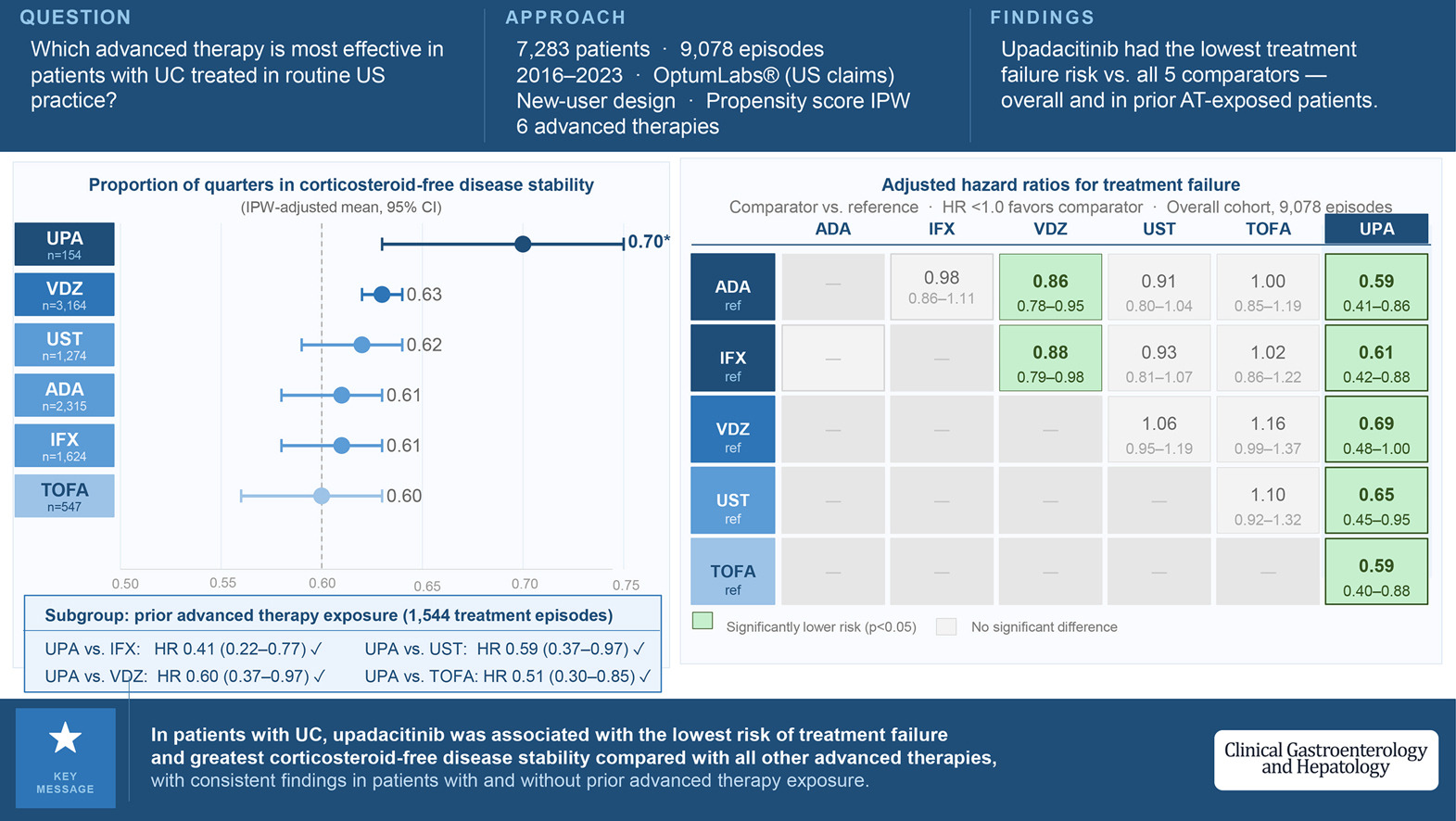
Dr. Singh and colleagues analyzed US insurance claims from the OptumLabs Data Warehouse. The study included 7,283 adults with UC who started one of the six therapies between 2016 and May 2023, representing 9,078 treatment episodes.
Treatment failure was defined as hospitalization or surgery for UC, or a new systemic corticosteroid prescription lasting more than 14 days and starting more than 90 days after treatment began. Stopping or switching treatment did not count as treatment failure. The researchers adjusted for measured differences among the treatment groups. Median follow-up was 68 weeks for upadacitinib and 63 to 92 weeks for the other therapies.
Of the 9,078 treatment episodes, 3,164 involved vedolizumab, 2,315 adalimumab, 1,624 infliximab, 1,274 ustekinumab, 547 tofacitinib, and 154 upadacitinib. Patients who received upadacitinib or tofacitinib, both Janus kinase (JAK) inhibitors, were more likely to have used an advanced therapy in the previous 12 months, at 44% and 42%, respectively. The rates were 32% for ustekinumab, 24% for vedolizumab, and about 2% for adalimumab and infliximab.
Before adjustment, treatment failure occurred in 30% of upadacitinib treatment episodes, compared with 41% for ustekinumab, 46% for vedolizumab, 48% for tofacitinib, 49% for adalimumab, and 50% for infliximab. After adjustment, upadacitinib was associated with a 31%-41% lower risk of treatment failure than each of the other five therapies.
Vedolizumab also was associated with a 12% lower risk of treatment failure than infliximab and a 14% lower risk than adalimumab, the two tumor necrosis factor (TNF) inhibitors in the study. No significant differences were found among several other pairwise comparisons.
The advantage associated with upadacitinib was particularly consistent among the 1,544 treatment episodes in patients who had received advanced therapy in the previous 12 months. In that group, upadacitinib (68 episodes) was associated with a 40%-59% lower risk of treatment failure than infliximab, vedolizumab, ustekinumab, and tofacitinib. The difference vs. adalimumab was not statistically significant.
Among the 7,534 treatment episodes without advanced therapy use in the previous 12 months, upadacitinib (86 episodes) was associated with about a 40% lower risk of treatment failure than adalimumab and tofacitinib. Differences vs. infliximab, vedolizumab, and ustekinumab were not statistically significant. However, some patients may have received advanced therapy more than 12 months earlier and therefore could not be considered treatment-naive, the authors noted.
The upadacitinib findings were directionally consistent in two post hoc sensitivity analyses — one limited to treatment starts in 2022 or later and one limited to each patient’s first treatment episode — although some comparisons did not reach statistical significance, including the comparison with vedolizumab in both analyses.
On the secondary outcome, patients receiving upadacitinib spent an adjusted average of 70% of follow-up quarters with stable disease and no corticosteroid use, the highest proportion among the six therapies. The other therapies ranged from 60% to 63%. The authors did not report whether these differences were statistically significant.
The authors acknowledged several limitations. Claims data did not include measures of disease activity, endoscopic findings, inflammatory biomarkers, or patient-reported outcomes, and differences among treatment groups may have influenced the results despite statistical adjustment. Reasons for stopping or switching treatment were unavailable, and upadacitinib had a smaller sample and more limited longer-term follow-up because of its 2022 approval for UC. Newer therapies could not be evaluated: interleukin-23 (IL-23) p19 antagonists and sphingosine-1-phosphate receptor modulators were excluded because few patients had received them during the study period.
The Crohn’s and Colitis Foundation supported the study, and Dr. Singh received National Institute of Diabetes and Digestive and Kidney Diseases support. Several authors reported financial relationships with pharmaceutical companies.

Expert insight
Dr. Singh shared his commentary on the findings.
What makes this study important?
Dr. Singh: Physicians are choosing among more than a dozen advanced therapies for ulcerative colitis, yet there is very little head-to-head evidence to guide those decisions. We compared six advanced therapies across more than 9,000 treatment starts in routine clinical practice.
Which previously treated patients may benefit most?
Dr. Singh: Once a patient has failed an advanced therapy, the choice of the next treatment becomes particularly important. Our findings support consideration of upadacitinib after prior advanced-therapy exposure, including after anti-TNF therapy. However, we could not reliably determine the total number of prior therapies, so whether these findings extend to patients with multiple treatment failures is uncertain.
What should physicians consider in advanced therapy-naive patients?
Dr. Singh: For patients starting advanced therapy, there is no one-size-fits-all answer, and our findings do not change that. Vedolizumab was associated with better outcomes than adalimumab, consistent with the VARSITY trial. JAK inhibitor estimates are less certain because relatively few therapy-naive patients received them, and those patients may have differed in ways we could not fully measure.
Is there anything else you’d like to add?
Dr. Singh: Real-world studies can inform clinical decisions, but head-to-head randomized trials remain the strongest way to establish comparative efficacy. This was an observational study, so residual confounding cannot be excluded, and IL-23 antagonists were not captured. Importantly, many JAK inhibitor safety restrictions were informed by older, higher-cardiovascular-risk rheumatoid arthritis populations. UC patients differ in important ways, so treatment decisions should incorporate the totality of UC-specific efficacy and safety evidence.