Altered gut bacteria may help explain why patients with inflammatory bowel disease (IBD) frequently identify foods as symptom triggers, new translational research suggests.
More than 85% of patients with Crohn’s disease or ulcerative colitis in remission reported reactions to certain foods, compared with 33% of people without IBD. Laboratory experiments suggested that inflammation may contribute to these reactions by disrupting how gut bacteria break down food.
The findings, published in Gastroenterology, suggest that intestinal inflammation may reduce bacteria that help break down food, leaving the body exposed to more food antigens and triggering immune responses involving mast cells, Bruna B. Da Luz, PhD, Alberto Caminero, PhD, both of the Farncombe Family Digestive Health Research Institute at McMaster University in Hamilton, Ontario, Canada, and colleagues reported.
“The increasing prevalence of adverse food reactions represents a growing challenge in medicine,” Dr. Caminero told GI & Hepatology News. “Our research has the potential to improve the diagnosis and treatment of non-classical food-related reactions in IBD, and potentially in other chronic intestinal disorders such as irritable bowel syndrome. The identification of bacteria with efficient food-degrading capabilities may also have broader applications in well-defined conditions such as food allergies and celiac disease.”
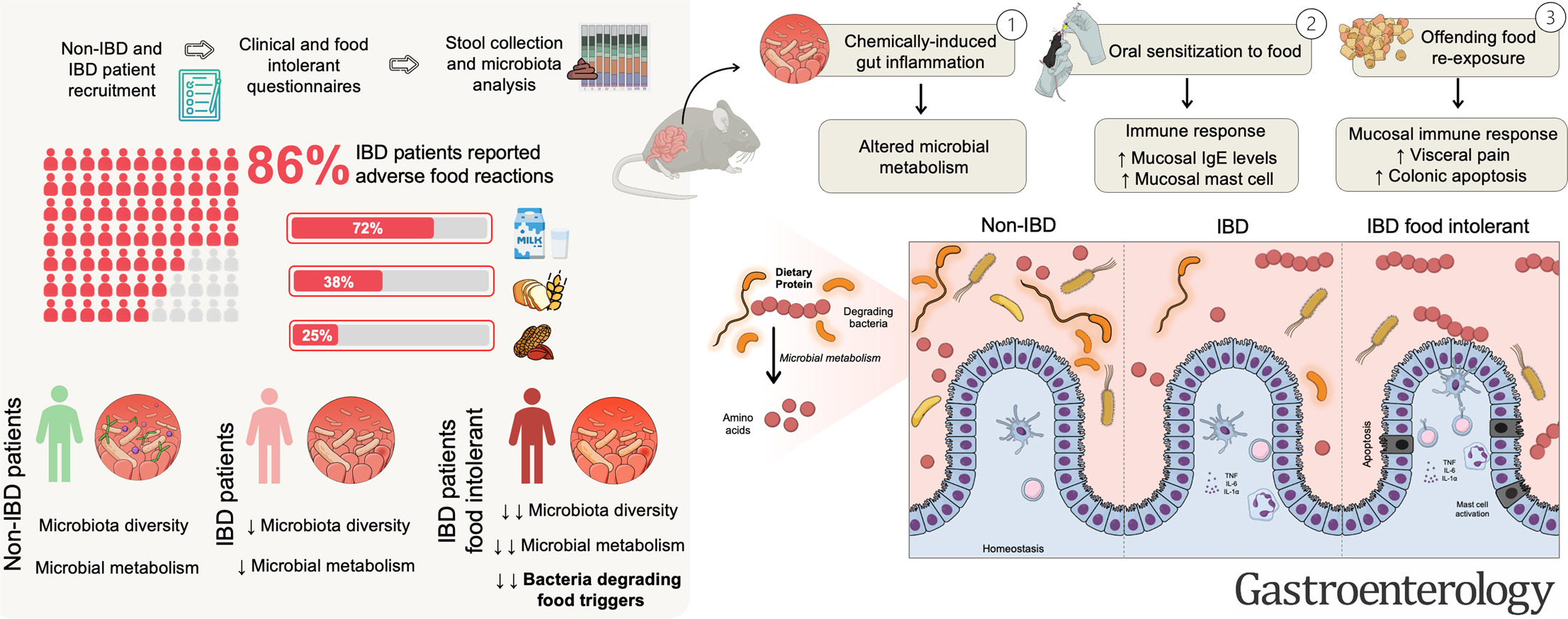
The study included several mouse experiments and 148 adults recruited at McMaster University from 2021 to 2023. The human study included 58 patients with Crohn’s disease, 46 with ulcerative colitis, and 44 people without IBD. All patients with IBD were in clinical and histologic remission. Participants answered questions about food intolerances and symptoms and provided stool samples to study their gut bacteria.
Food intolerance was reported by 85% of patients with Crohn’s disease and 86% of those with ulcerative colitis, compared with 33% of controls. Patients with Crohn’s disease reported reactions to an average of 3.5 foods and those with ulcerative colitis to 3.2, compared with 1.3 among controls. Common triggers were dairy, wheat, peanuts and tree nuts, caffeine, and fiber. Common symptoms were discomfort, bloating, diarrhea, and abdominal pain.
About 40% of patients with IBD said their food-related symptoms began before their diagnosis, while 60% said the symptoms worsened after diagnosis. Among patients with ulcerative colitis, 76% said their food intolerances began after diagnosis.
The analysis showed that IBD, rather than food intolerance, was the main factor linked to differences in gut bacteria. Patients with IBD had less diverse gut bacteria than controls. Lower diversity was also linked to reporting more food intolerances among patients with ulcerative colitis and controls.
Patients who reported food intolerances also had lower levels of bacteria that help break down food triggers, particularly Clostridial and Bifidobacteriales. In laboratory tests, stools from patients with IBD were less able than stools from controls to break down two dairy proteins, beta-lactoglobulin and beta-casein. This difference was greater among patients who reported food intolerances.
The mouse experiments offered clues about how these reactions may develop. After intestinal inflammation was induced, mice sensitized to dairy or gluten showed an immune response when those foods were reintroduced. Mice sensitized to dairy had higher levels of immunoglobulin E and inflammatory cells and greater sensitivity to colorectal distension. Similar results were seen with gluten and in a second model of intestinal inflammation.
Mast cells appeared to play a role in these reactions. In mice sensitized to dairy, treatment with the mast cell stabilizer cromolyn sodium reduced inflammation, cell death, and visceral sensitivity.
Inflammation also reduced levels of Bifidobacterium and Clostridium, bacteria that help break down dairy proteins. Transferring gut bacteria from mice that had intestinal inflammation to germ-free mice increased food sensitivity and adverse reactions. In contrast, giving mice dairy-digesting Clostridium sporogenes or Bifidobacterium longum reduced several signs of immune activation.
The findings do not show that the same process causes food intolerance in patients. The human study was observational and relied on patients reporting their own food reactions because reliable tests for most food-related reactions in inflammatory bowel disease are not available. The authors also said it remains unclear what causes food intolerance to develop. Possible factors include genetics, infections, changes in gut bacteria, and stress.
The findings may help explain why some patients continue to have food-related symptoms even when IBD is in remission, but they do not point to a specific treatment. The authors cautioned that unnecessary food avoidance can lead to nutritional deficiencies. They said clinical studies are needed before recommending treatments targeting gut bacteria.
Crohn’s and Colitis Canada and the Canadian Institutes of Health Research funded the study, with additional support for several investigators. Neeraj Narula, MD, reported honoraria from multiple pharmaceutical and healthcare companies. The other authors reported no disclosures.

Expert insight
Dr. Caminero spoke with GI & Hepatology News about the findings.
How should these findings change the way physicians counsel patients with IBD who report food intolerances, particularly dairy or wheat?
Dr. Caminero: Although this research is still at an early stage, our findings could open new avenues for identifying and treating IBD patients with specific food intolerances. Profiling systemic or mucosal IgE-mediated immune responses to specific foods may help us better identify patients with true food-specific immune responses and develop more personalized dietary approaches. This could improve symptom management while avoiding unnecessary food restrictions that may increase the risk of nutritional deficiencies.
Our findings also suggest that specific beneficial gut bacteria could help reduce food-related symptoms. We found that supplementation with bacteria capable of breaking down specific food triggers reduced the clinical responses induced by those foods in animal models. These findings raise the possibility that carefully selected bacteria with food-degrading capabilities could one day be used to help patients with IBD and well-characterized intolerances.
Further clinical studies are needed to determine whether these approaches are safe and effective.
Could testing for microbial changes, IgE responses, or mast cell activity eventually help distinguish true food sensitivity from other causes of GI symptoms in patients with IBD?
Dr. Caminero: Yes. Profiling systemic or mucosal IgE-mediated immune responses to specific foods, together with assessing mucosal mast cell numbers or activity (for example, tryptase levels), may help us identify patients with genuine food-specific immune responses and better understand food-driven symptoms such as abdominal pain.
Although elevated systemic IgE levels have been reported in patients with IBD, they are generally lower than those observed in patients with classical food allergies, and further research is needed to understand their clinical relevance. We are currently working on well-defined clinical trials to investigate how immune responses to specific food triggers develop in patients with IBD.
We also believe that the gut microbiota may provide additional markers of food sensitivity. In particular, profiling bacteria involved in the breakdown of specific food components, such as members of the Clostridium group, could help distinguish patients with well-defined food sensitivities or those more susceptible to develop them. However, further studies are needed to determine whether these microbial changes can be used as reliable biomarkers or therapeutic targets.
Do the findings suggest that restoring food-metabolizing gut bacteria could eventually offer an alternative to eliminating trigger foods from the diet?
Dr. Caminero: We found that intestinal inflammation promotes food sensitization by disrupting microbial metabolism of dietary antigens. Importantly, supplementation with bacteria depleted during inflammation attenuated food-driven responses and colitis worsening in preclinical models. These findings raise the possibility of using microbiome-based therapies, including probiotics with efficient food-degrading capabilities, to help manage food intolerances in patients with IBD. However, further work is needed to identify the most effective bacterial strains or communities for therapeutic use and to determine their safety and efficacy in well-defined preclinical and clinical studies.