According to findings published in Clinical Gastroenterology and Hepatology, strategies designed to reduce the effect of age on Fibrosis-4 (FIB-4) appeared to preserve its discrimination for detecting liver fibrosis among 938 patients with metabolic dysfunction-associated steatotic liver disease (MASLD), with the observations also supported in a nationally representative U.S. cohort.

Corresponding author Fernando Bril, MD, of the Division of Endocrinology, Diabetes and Metabolism at the University of Alabama at Birmingham, pointed to one approach in particular.
“Because age is included in the FIB-4 formula, its performance is affected at the extremes of age, leading to potential misclassification,” he told GI & Hepatology News. “We found that simply removing age from the equation resulted in an age-independent score, based only on aspartate aminotransferase, alanine aminotransferase, and platelet count, that performed similarly to FIB-4 overall and potentially better at the extremes of age.”
Study details
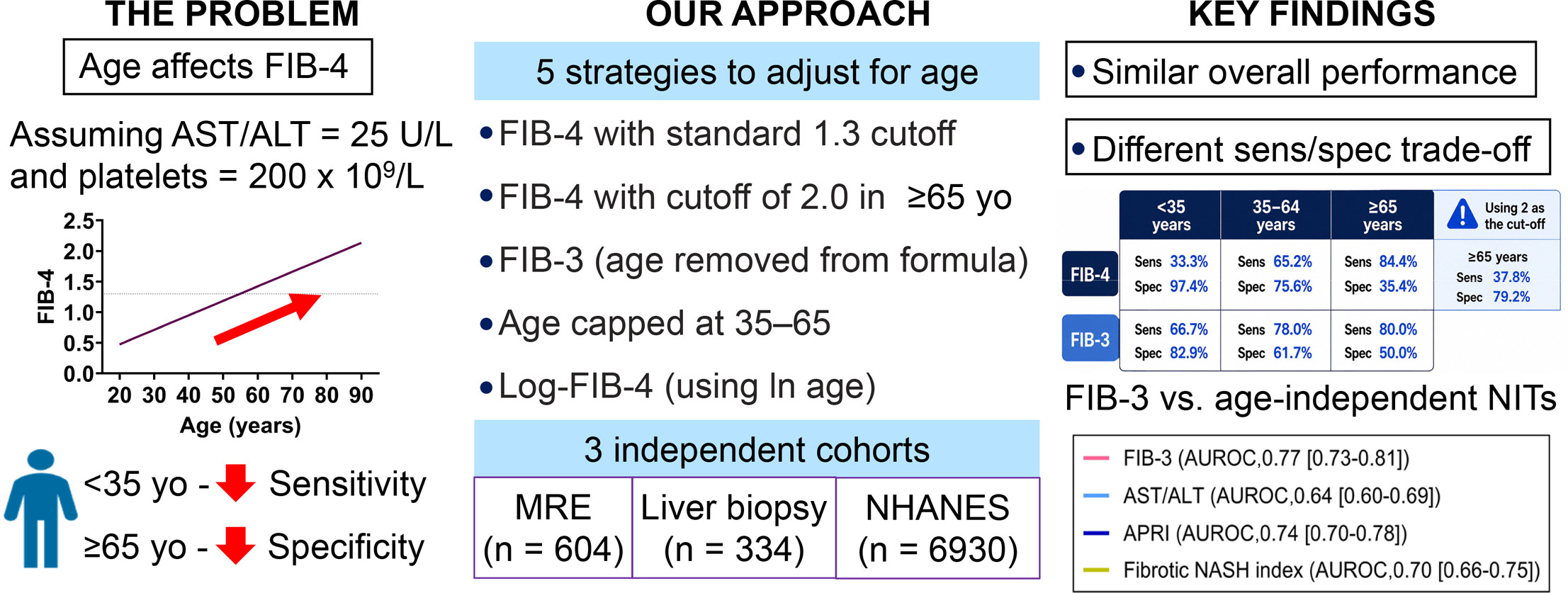
In this cross-sectional study, the investigators used two independent cohorts of patients with MASLD to compare FIB-4 and four alternative strategies for detecting clinically significant fibrosis (stage F2 or higher), advanced fibrosis (stage F3 or higher), and cirrhosis. The five approaches were:
Standard FIB-4: A standard cutoff of 1.3 for all patients.
Age-adjusted FIB-4: A cutoff of 2.0 for patients aged 65 years or older (1.3 for younger patients).
FIB-3: Age was removed from the FIB-4 formula.
Capped FIB-4: Ages of 35 and 65 were used for patients younger than 35 and older than 65, respectively.
Log-transformed FIB-4: The natural logarithm of age was used.
Magnetic resonance elastography served as the reference standard in the first cohort (n = 604), which comprised adults with MASLD evaluated at a tertiary care center’s hepatology clinics between 2018 and 2025. Liver biopsy was used in the second cohort (n = 334), which included patients from Gainesville, Florida, and Birmingham, Alabama. Among the 938 patients, the mean age was 54 years, 50% were female, the mean body mass index was 34.7 kg/m², and 42% had diabetes.
The investigators also evaluated the five strategies in an unselected population (n = 6,930) using data from the 2017-20 National Health and Nutrition Examination Survey (NHANES), with a FibroScan-AST (FAST) score of 0.35 or higher serving as the reference standard. Cutoffs for FIB-3 and log-transformed FIB-4 were derived in the magnetic resonance elastography cohort and applied unchanged to the biopsy and NHANES cohorts.
Index performance
Across the two primary cohorts, 20% of patients had clinically significant fibrosis, 13% had advanced fibrosis, and 3% had cirrhosis.
All five strategies appeared to demonstrate similar discrimination for detecting clinically significant and advanced fibrosis, whether magnetic resonance elastography or liver biopsy was used as the reference standard. Areas under the receiver operating characteristic curve ranged from 0.76 to 0.77 against magnetic resonance elastography and from 0.77 to 0.81 against liver biopsy. The investigators considered the cirrhosis analyses, which included 16 cases in each cohort, exploratory.
According to the investigators, the strategies differed in sensitivity and specificity at prespecified or calculated cutoff points, but these differences had little effect on positive and negative predictive values. In the magnetic resonance elastography cohort, FIB-3 detected clinically significant fibrosis with 73.6% sensitivity and 69.7% specificity, vs. 62.3% and 74.9% for standard FIB-4. In the biopsy cohort, the figures were 83.8% and 45.7% for FIB-3 vs. 76.3% and 60.6% for standard FIB-4. Across strategies, positive predictive values ranged from 32.7% to 40.6% and negative predictive values from 87.1% to 92.5%.
Positive predictive values “remained modest across all strategies,” the authors wrote, which they said reinforces the need for confirmatory testing after an initial screening step.
The investigators reported that FIB-3 provided a balanced trade-off between sensitivity and specificity at the extremes of age (younger than 35 years and 65 years or older). In a pooled, exploratory analysis, FIB-3 identified 66.7% of patients younger than 35 with clinically significant fibrosis vs. 33.3% for standard FIB-4, with 82.9% specificity. Among patients aged 65 years or older, FIB-3’s specificity was 50.0% vs. 35.4%, with sensitivity of 80.0% vs. 84.4%. Only nine patients younger than 35 and 45 patients aged 65 years or older had clinically significant fibrosis, and the investigators made no formal comparisons in these subgroups.
In the NHANES cohort, FIB-3 had an area under the curve of 0.71 vs. 0.67 for standard FIB-4 (P < .001) and showed a more balanced sensitivity and specificity in participants younger than 35 years and older than 65 years, the investigators reported. Because the FAST score and all of the evaluated indices incorporate aspartate aminotransferase, they noted, performance in that cohort may be overestimated.
Clinical implications
The findings suggest that age-specific FIB-4 thresholds may not fully address the problem introduced by age, Dr. Bril noted. In the pooled analysis, among patients aged 65 years or older, increasing the FIB-4 cutoff from 1.3 to 2.0 increased specificity from 35.4% to 79.2% but decreased sensitivity from 84.4% to 37.8%.
The authors also wrote that a single FIB-4 cutoff of 1.3 “can be satisfactorily used” without switching to 2.0 for older adults, though they noted the higher cutoff may still have a role in rural or community settings where access to confirmatory testing, such as elastography, is limited.
“An age-independent test such as FIB-3 could simplify screening algorithms by using a single approach across age groups while reducing age-driven misclassification,” Dr. Bril said. However, he cautioned, “These findings are not sufficient to replace guideline-recommended FIB-4 in routine clinical practice.”
In particular, Dr. Bril noted that the potentially better performance of FIB-3 among patients younger than 35 years and those aged 65 years or older was exploratory and based on relatively small numbers of patients with clinically significant fibrosis.
The authors acknowledged potential selection bias because the primary cohorts comprised patients referred for magnetic resonance elastography or liver biopsy, limiting the extent to which the findings can be extrapolated to the general population. The NHANES analysis was intended to address that limitation, they wrote, but it used the FAST score as a surrogate reference standard for fibrotic metabolic dysfunction-associated steatohepatitis rather than histologic fibrosis or magnetic resonance elastography and was therefore considered complementary to the primary analyses.
“External validation in larger and more diverse populations is needed to confirm these findings and determine whether FIB-3 can improve fibrosis screening without increasing unnecessary downstream testing,” Dr. Bril said. The authors called for prospective studies to test how age-independent approaches affect clinical outcomes and how they could fit into MASLD screening pathways.
The study authors reported no conflicts of interest.