A modified hepatic encephalopathy (HE) staging tool produced more consistent grades than the West Haven criteria in a prospective, single-center study of patients hospitalized with decompensated cirrhosis, published in Clinical Gastroenterology and Hepatology.
When two observers independently assessed each of 128 patients, they assigned the same grade to 95% of patients using the modified Hepatic Encephalopathy Staging Tool (mHEST), compared with 52% using West Haven, which the authors described as the most commonly used HE grading tool in clinical practice.
The tool uses standardized orientation questions and level of consciousness to grade HE. The authors said it was designed primarily for use in clinical trials, and they developed it partly because West Haven grades can vary widely between observers, especially at lower grades.
“This is about more than creating another scoring system,” first author Annarein J.C. Kerbert, MD, PhD, of Leiden University Medical Center in the Netherlands, told GI & Hepatology News. “Our goal is to provide clinicians and researchers with a user-friendly, reproducible language for describing hepatic encephalopathy. We see mHEST as an important step toward more objective assessment, while recognizing that further work is needed to validate this promising tool.”
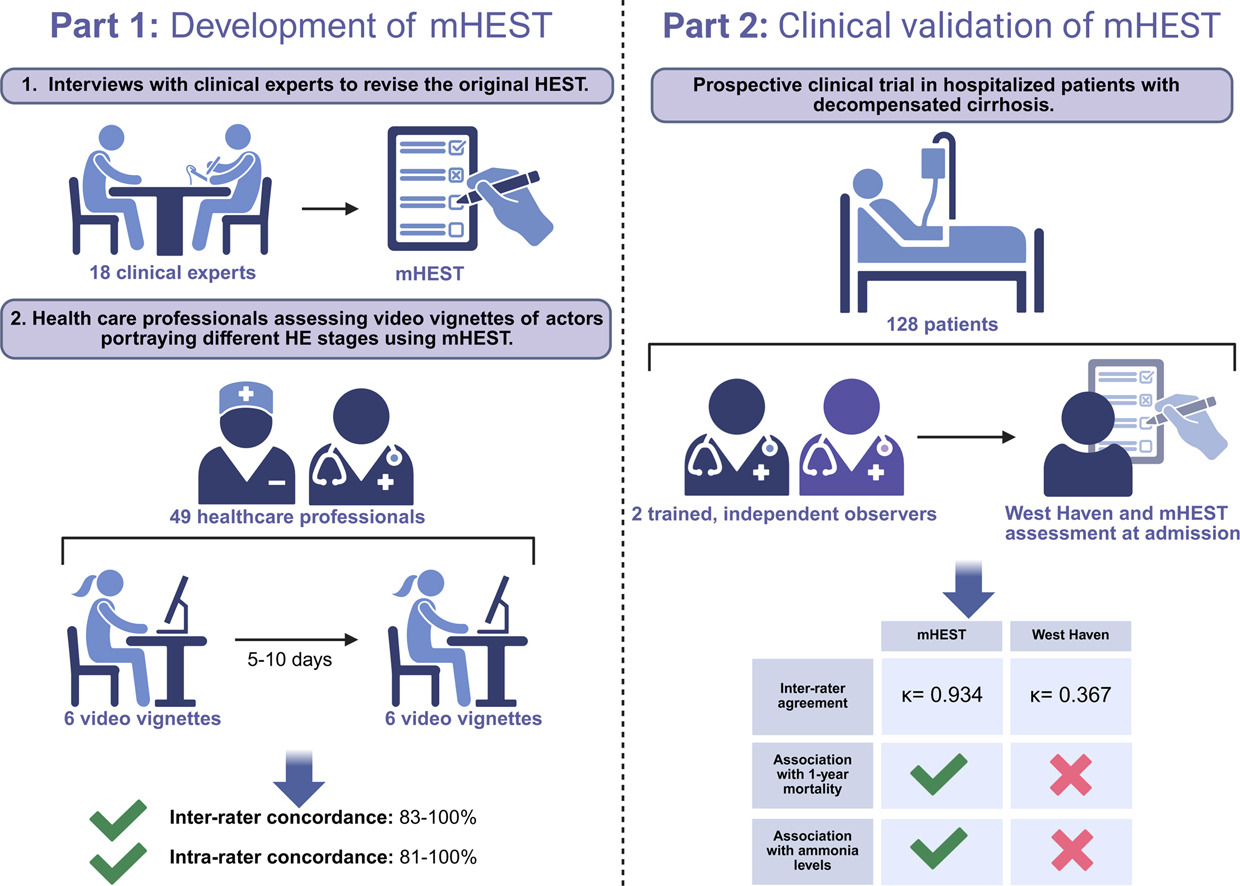
The study had two parts. To develop mHEST, the researchers interviewed 18 clinical experts and gathered feedback from five physicians. They removed asterixis from the original Hepatic Encephalopathy Staging Tool, added two orientation questions (the patient’s birth year and the current president or national leader), revised a third, and more clearly defined each grade.
Unlike West Haven, mHEST uses a fixed rule — two or more incorrect answers to its orientation questions — to separate grade 0/1 from grade 2, while grades 3 and 4 are based mainly on confusion and level of consciousness. It does not distinguish minimal HE from grade 1 disease.
The researchers first tested mHEST using six videos of actors portraying different grades of HE. Among 49 nurses, nurse practitioners, and physician assistants, agreement on each video ranged from 90% to 100% in the first round and from 83% to 100% among the 42 who repeated the ratings five to 10 days later. Test-retest agreement ranged from 81% to 100%.
The clinical portion, an observational study, included 128 adults hospitalized with acute decompensation of cirrhosis at Royal Free Hospital in London. Within 24 hours of admission, two observers drawn from a pool of five trained medical students, residents, and consultants independently assessed each patient using both West Haven and mHEST. They did not know each other’s ratings, the patient’s clinical context, or the treating clinician’s West Haven grade. The researchers compared the tools’ agreement between observers, their association with plasma ammonia levels and one-year transplant-free survival, and their effect on established scoring systems. Patients were followed for 12 months.
Patients had a mean age of 61 years, 36% were women, 45% had overt HE (grade 2 or higher) as graded by the treating clinician using West Haven, and more than three-quarters had acute-on-chronic liver failure (ACLF). Within one year, 46% died and 3% underwent liver transplantation.
The gap between the tools was concentrated at lower grades: West Haven agreement was 57% or lower at grades 0, 1, and 2, compared with 80% at grade 3 and 100% at grade 4, while mHEST agreement was 93% or higher at every grade. Observers also agreed on ACLF classification in 100% of cases using mHEST vs. 88% with West Haven.
Plasma ammonia levels, measured in 81 patients, rose steadily with increasing mHEST grades, a pattern not seen with West Haven.
One-year transplant-free survival declined steadily as mHEST grade increased. In unadjusted analyses, a low mHEST grade (0 or 1) was associated with better survival, while a low West Haven grade was not. The mHEST association remained significant in one of two adjusted models; in the other, which accounted for age and MELD-Na score, it fell just short of statistical significance. Neither tool was significantly associated with 90-day mortality.
The tools also disagreed on whether some patients had covert (grade 0 or 1) or overt HE. Depending on the observer, 21% to 22% of patients were graded covert by West Haven but overt by mHEST, and 3% to 9% the reverse. One-year survival in these groups tracked primarily with mHEST grade, according to the authors.
Limitations included the use of actors in the video study and a small, single-center cohort of acutely ill patients. There is no gold standard for grading HE, and the study did not compare mHEST with other emerging staging tools. The tool is designed for overt HE and does not assess the executive and psychomotor deficits of minimal or covert HE, which require formal psychometric testing; the authors described it as complementary to, not a replacement for, that testing. They also said performance in less severely ill patients requires further study.
The FDA has accepted mHEST for use in clinical trials of HE treatments, according to the authors. However, they said global, multicenter validation in independent cohorts is needed “before mHEST can be recommended for routine clinical practice.”
Mallinckrodt Pharmaceuticals funded the tool-development portion of the study. Dr. Kerbert reported no disclosures. Corresponding author Rajiv Jalan, is a founder of Yaqrit Discovery and a co-founder of Cyberliver; other co-authors reported stock in or research collaborations with those companies, and one reported grants, fees, or honoraria from multiple companies, including Mallinckrodt.
Expert insight
Dr. Kerbert provided additional context on the findings.
How could mHEST change the way physicians assess and manage patients with suspected overt HE?
Dr. Kerbert: Although mHEST would not directly change the management of HE, its potential clinical benefit is a more standardized assessment of disease severity. This could make it easier to determine whether a patient’s condition is improving or worsening, also when assessed by different observers.
Because hepatic encephalopathy severity is associated with prognosis, a reliable assessment is important. Our findings suggest that mHEST may not only provide more consistent assessment but could also help clinicians better characterize a patient’s prognosis.
Where could the greater consistency make the biggest difference in clinical care?
Dr. Kerbert: More consistent grading of hepatic encephalopathy with mHEST could have an impact beyond simply describing its severity. Hepatic encephalopathy grading contributes to commonly used prognostic and disease-severity assessments, including the Child-Pugh score and the diagnostic and grading criteria for acute-on-chronic liver failure (ACLF).
Greater consistency in hepatic encephalopathy grading could therefore lead to more consistent disease classification and potentially more consistent clinical decision-making, including decisions on intensive care admission and liver transplant candidacy.
What additional evidence is needed before physicians should consider using mHEST routinely outside clinical trials?
Dr. Kerbert: Our results are encouraging, but further validation is needed. We need to evaluate mHEST across different hospitals, countries, and patient populations. We are planning to perform a multicenter validation study that also includes sequential assessments.