No single class of treatment has demonstrated a definitive benefit for persistent irritable bowel syndrome (IBS)-like symptoms in patients with inflammatory bowel disease (IBD) in remission, according to a meta-analysis of 13 randomized controlled trials involving 688 patients published online in Clinical Gastroenterology and Hepatology. Although dietary interventions showed the largest estimated improvement in symptom severity, the evidence was highly uncertain because of differences across studies, imprecise estimates, and risk of bias.
The trials tested dietary, behavioral, pharmacologic, and other interventions in patients with quiescent Crohn’s disease or ulcerative colitis. Seven of the 13 trials (54%) were judged to be at high risk of bias, driven primarily by lack of blinding and subjective endpoints, the authors reported.

Persistent abdominal pain, bloating, altered bowel habits, and urgency affect up to one-third of patients with IBD despite controlled inflammation, according to the authors. Patients with these symptoms report lower health-related quality of life, greater psychological distress, and higher healthcare utilization than patients with quiescent IBD who do not have them, the authors noted.
“Controlling inflammation does not always resolve the symptoms that matter most to patients,” joint first author Manjeet Kumar Goyal, MBBS, MD, DNB, DM, of the Department of Gastroenterology at Cleveland Clinic Akron General in Akron, Ohio, told GI & Hepatology News.
Study design and methods
Researchers conducted a systematic review and meta-analysis of randomized controlled trials identified through searches of PubMed/MEDLINE, Embase, the Cochrane Central Register of Controlled Trials, Scopus, and ClinicalTrials.gov through October 2025.
Eligible trials enrolled adults aged 18 years or older with quiescent IBD and persistent IBS-like symptoms. Studies were required to evaluate symptom-directed interventions using validated outcome measures and include a control group. Comparators varied by trial and included habitual diet, sham or alternative diets, placebo, attention control, wait-list control, and standard medical therapy. Interventions lasted from three weeks to 12 months, and outcomes were assessed between week 3 and month 12.
Of 17,975 records identified, 13 trials met the inclusion criteria, comprising 361 patients assigned to intervention groups and 327 assigned to control groups. Seven trials specified that patients met formal Rome diagnostic criteria for IBS.
The primary outcome was IBS symptom severity, assessed using validated instruments, most commonly the Irritable Bowel Syndrome Severity Scoring System (IBS-SSS). Quality of life was evaluated as a secondary outcome.
Researchers grouped trials by intervention class and analyzed symptom severity and quality-of-life outcomes separately. Standardized mean differences (SMDs) were pooled using random-effects models with Hartung-Knapp adjustment. Negative SMDs favored treatment. The investigators interpreted SMDs of 0.2, 0.5, and 0.8 as small, moderate, and large effects, respectively, and prespecified an absolute SMD of 0.5 as the threshold for a clinically important effect. They assessed risk of bias using the Cochrane Risk of Bias 2 tool and evidence certainty using the Grading of Recommendations, Assessment, Development, and Evaluation framework.
Dietary interventions
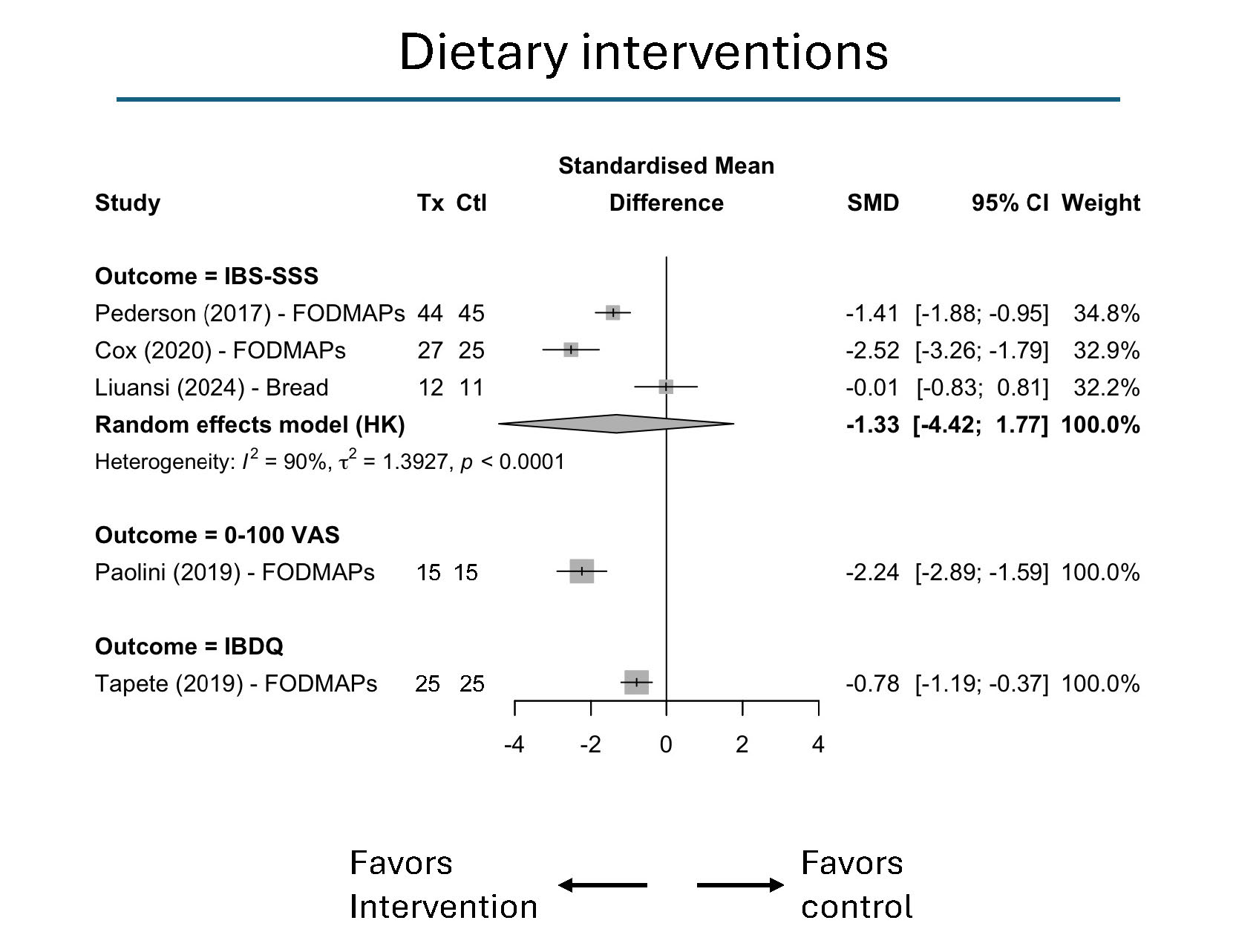
Five trials involving 244 patients evaluated dietary interventions. Four investigated diets low in fermentable oligosaccharides, disaccharides, monosaccharides, and polyols (FODMAPs), while one compared traditionally baked bread with commercially produced bread.
In the three trials reporting symptom severity using the IBS-SSS, the pooled SMD for dietary interventions was −1.33, a large point estimate favoring treatment. However, the range of plausible effects spanned large benefit, no effect, and harm, and heterogeneity between studies was considerable (I² = 90%). The authors rated the certainty of evidence as very low because of risk of bias, inconsistency, and imprecision.
A separate low-FODMAP trial involving 30 patients assessed symptom severity using a 100-point visual analog scale and also favored the diet. Evidence certainty was low because of risk of bias and the small sample size.
Another trial involving 50 patients compared a low-FODMAP diet vs. a high-FODMAP diet and evaluated quality of life using the Inflammatory Bowel Disease Questionnaire (IBDQ). The SMD was −0.78, suggesting a moderate benefit favoring the low-FODMAP diet. Evidence certainty was also low.
“Dietary interventions showed a potentially substantial benefit, but estimates were highly inconsistent and imprecise,” Dr. Goyal said.
Behavioral interventions
Four randomized trials involving 234 patients evaluated behavioral interventions: two of mindfulness-based therapy and two of hypnotherapy.
Two trials assessed IBS symptom severity using the IBS-SSS. The pooled SMD was −0.36, a small effect favoring behavioral interventions, but the range of plausible effects ran from moderate benefit to possible harm. No between-study heterogeneity was observed (I2 = 0%), and evidence certainty was low because of risk of bias and imprecision.
Two additional trials evaluated quality of life using the IBDQ. The pooled SMD was −0.19, a small effect favoring intervention, with a range that included large benefit, no effect, and harm. Substantial heterogeneity (I2 = 72%) and imprecision resulted in very low-certainty evidence.
“Behavioral interventions suggested a smaller possible benefit, although their effectiveness also remained uncertain,” Dr. Goyal said.
Pharmacologic and other interventions
Three randomized trials evaluated pharmacologic interventions: a four-strain probiotic, fluoxetine, and rifaximin. Because the trials assessed different agents and outcomes, their findings were evaluated individually rather than pooled.
A placebo-controlled probiotic trial involving 61 patients yielded an SMD of −0.22 for IBS symptom severity, a small point estimate favoring the probiotic. However, the range of plausible effects included moderate benefit, no effect, and possible harm, and evidence certainty was low.
A trial involving 26 patients evaluated fluoxetine and yielded an SMD of 0.20 for quality of life, with the point estimate favoring the control group. The evidence was rated low certainty because of substantial imprecision.
In contrast, a trial involving 86 patients with Crohn’s disease in remission evaluated rifaximin vs. standard medical therapy and yielded an SMD of −3.40 for quality of life, a large estimated benefit. However, evidence certainty remained low because of risk of bias, and consistency could not be assessed from a single trial.
The authors noted that the apparent quality-of-life benefit was largely driven by the single unblinded rifaximin trial.
One additional randomized trial involving 37 patients evaluated osteopathic manipulation for IBS-like symptoms in patients with Crohn’s disease in remission. It yielded an SMD of −0.94, a large estimated symptom benefit, but evidence certainty was low because of risk of bias and imprecision.
Risk of bias and study limitations
Beyond the seven trials at high risk of bias, four (31%) were judged to be at low risk and two (15%) raised some concerns.
The authors identified lack of blinding and reliance on subjective patient-reported outcomes as major limitations, particularly in dietary and behavioral trials. Because functional gastrointestinal outcomes are highly placebo-responsive, the absence of blinding likely biased results toward perceived treatment effects, according to the authors. They also acknowledged that some studies may have included patients with residual inflammatory activity.
“The apparent benefits should be interpreted cautiously: more than half of the trials were at high risk of bias, and studies differed in how they defined remission, selected patients, and measured outcomes,” Dr. Goyal said. “Dietary and behavioral findings should not be used to rank treatments because these were not direct comparisons.”
Conclusions
The investigators concluded that current evidence does not support routine adoption of any single intervention class for managing IBS-like symptoms in patients with quiescent IBD.
“Our study highlights uncertainty about treatment effectiveness; it does not establish that these treatments are ineffective,” Dr. Goyal said.
“The findings support an individualized approach rather than routine adoption of one treatment,” they added. “Persistent symptoms should prompt careful assessment of whether inflammation is truly controlled and whether another explanation is present.”
“A patient can be in remission and still feel unwell,” they said. “Recognizing this distinction helps validate persistent symptoms and creates space to address their effect on daily functioning and quality of life. It may also help avoid escalating anti-inflammatory treatment solely because symptoms persist when objective assessment supports remission.”
“Future trials need adequate sample sizes, consistent definitions of quiescent IBD and IBS-like symptoms, appropriate controls, and blinding where feasible,” Dr. Goyal said. “Longer follow-up should establish whether improvements are durable and accompanied by meaningful gains in quality of life.”
The study authors also suggested that future research compare dietary strategies, including low-FODMAP and low-sulfur approaches, to better characterize their effectiveness and potential mechanisms. They cited their earlier analysis of the Crohn’s & Colitis Foundation’s SPARC-IBD dataset, which found that patients with quiescent Crohn’s disease and IBS-like symptoms had gut microbiomes enriched for sulfide-producing bacteria compared with patients without symptoms.
“These mechanistic observations provide biological plausibility for dietary interventions but should not be interpreted as confirmation of clinical efficacy,” the study said.
Shrinivas Bishu, MD, reported consulting for AbbVie and Johnson & Johnson, as well as funding from the Crohn’s & Colitis Foundation and the National Institute of Diabetes and Digestive and Kidney Diseases. The other authors reported no relevant disclosures.