Patients with acute severe ulcerative colitis (ASUC) treated with upadacitinib had a lower rate of colectomy within 52 weeks than those treated with tofacitinib in a multicenter real-world study published in Clinical Gastroenterology and Hepatology.
The difference was not statistically significant early in treatment but grew over time. By week 52, 23% of patients who received upadacitinib had undergone colectomy vs. 43% of those who received tofacitinib, reported Robert Gilmore, MBChB, FRACP, a gastroenterologist at Mater Hospital Brisbane in Australia and a lecturer at the University of Queensland, and colleagues.
“While this work is hypothesis-generating and of significant interest given the lack of advances in ASUC care since infliximab, the retrospective nature of this work cannot be ignored,” Dr. Gilmore told GI & Hepatology News.
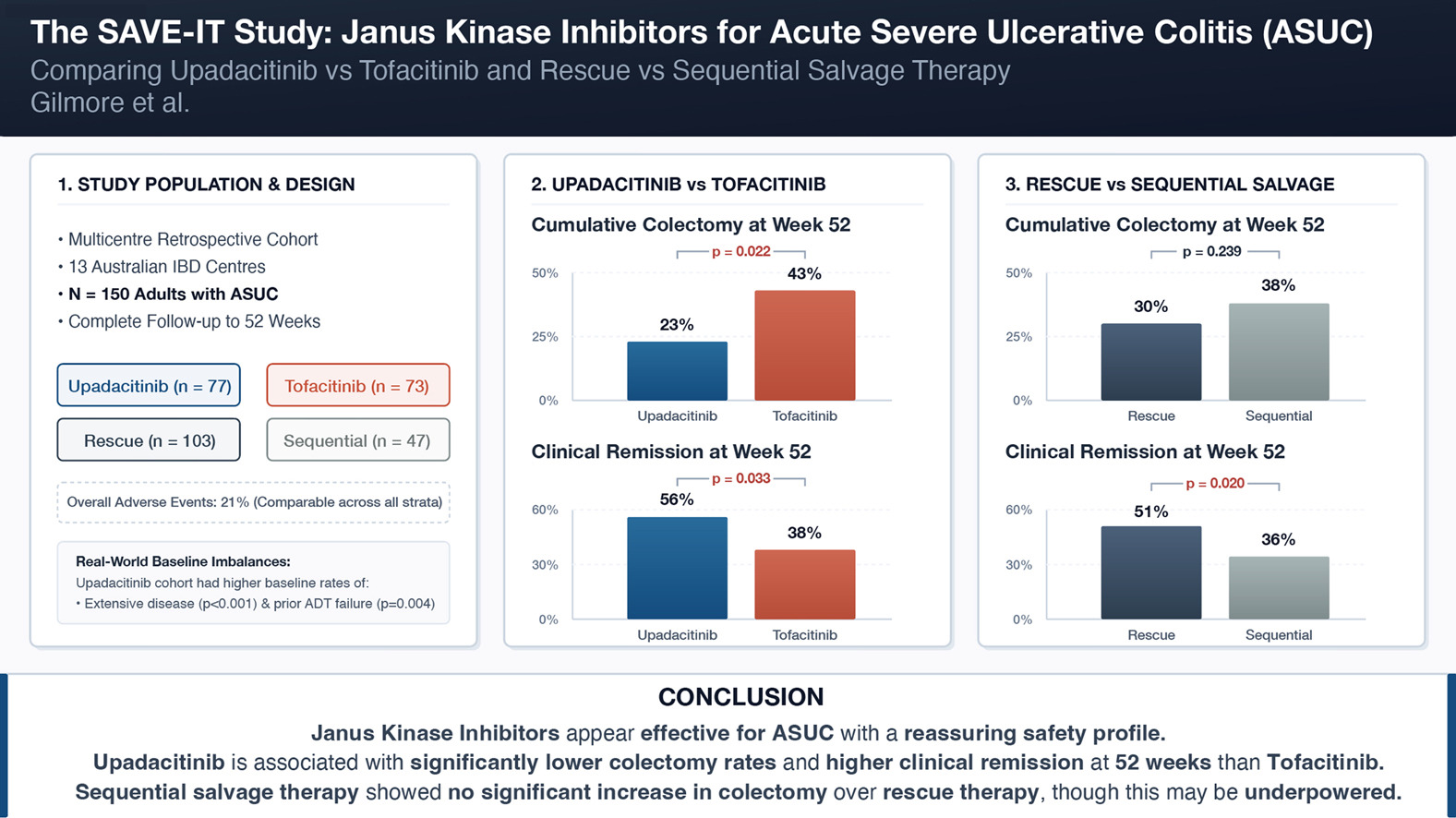
The retrospective study, which the authors described as the largest real-world study to date of Janus kinase (JAK) inhibitors in ASUC, included 150 adults treated at 13 inflammatory bowel disease (IBD) centers in Australia from April 2021 through April 2024. All received a JAK inhibitor after corticosteroid treatment and were followed for 52 weeks or until colectomy. The primary outcome was cumulative colectomy by week 52. The researchers compared upadacitinib with tofacitinib. Separately, they compared JAK inhibitors used as rescue therapy after corticosteroid failure with those used as sequential salvage therapy after both corticosteroids and infliximab failed during the same hospitalization.
Of the 150 patients, 77 received upadacitinib and 73 received tofacitinib. Most patients in the upadacitinib group (92%) received 45 mg once daily. Most in the tofacitinib group (81%) received an off-label dose of 10 mg three times daily during early induction. Overall, 69% received a JAK inhibitor as rescue therapy and 31% as sequential salvage therapy.
The groups differed at baseline. Patients receiving upadacitinib were more likely to have extensive ulcerative colitis and prior advanced therapy failure. The researchers used statistical methods to account for differences in age, sex, disease extent, and prior advanced therapy failure.
Overall, 33% of patients underwent colectomy within 52 weeks. The rate increased from 11% during the initial hospitalization to 21% by week eight and 29% by week 16. Clinical remission was achieved by 54% of patients at week eight and 46% at week 52.
Colectomy rates with upadacitinib vs. tofacitinib were 10% vs. 12% during the initial hospitalization, 16% vs. 26% by week eight, and 23% vs. 34% by week 16. None of these differences was statistically significant. By week 52, however, the difference had reached 23% vs. 43% and was statistically significant after weighting. The upadacitinib rate did not change between weeks 16 and 52, so the widening gap reflected additional colectomies in the tofacitinib group.
Upadacitinib also was linked to higher clinical remission rates than tofacitinib at week 16, 64% vs. 31%, and week 52, 56% vs. 38%. Biochemical remission rates were 56% vs. 30% at week 16 and 50% vs. 24% at week 52. At week 16, 59% of patients receiving upadacitinib were in clinical remission without corticosteroids vs. 28% receiving tofacitinib. The difference at week 52 was not statistically significant.
“We have now seen a number of retrospective studies examining upadacitinib vs. tofacitinib for the management of moderate-severe [ulcerative colitis], as summarized by this systematic review,” Dr. Gilmore said. “As with our study, upadacitinib appeared superior for a variety of clinical outcomes, with comparable safety outcomes.”
The authors noted that the largest previous cohort, which included 111 patients with ASUC followed for a median of six months, found no significant difference between the two drugs. They wrote that their longer follow-up and larger sample were the factors most likely to explain the discrepancy. They added that differences in their cohort were small during the first eight weeks and became more pronounced afterward.
In the second comparison, the 47 patients who received sequential salvage therapy had a higher inflammatory burden at admission than the 103 who received rescue therapy, according to the paper. This included higher C-reactive protein levels and higher rates of fever (30% vs. 12%) and tachycardia (79% vs. 54%).
By week 52, 38% of patients who received sequential salvage therapy had undergone colectomy vs. 30% who received rescue therapy, a difference that was not statistically significant. No additional colectomies occurred in the sequential salvage group after week 16. However, patients who received rescue therapy had higher rates of clinical remission at week 16 (54% vs. 33%) and week 52 (51% vs. 36%), with similar patterns for corticosteroid-free clinical remission and biochemical remission. Rates did not differ significantly at week eight.
Adverse events occurred in 21% of patients in both JAK inhibitor groups, and serious adverse events occurred in 7% overall. Colectomy, the primary outcome, was not counted as a serious adverse event. Four patients developed herpes zoster, and none had received a zoster vaccine. No venous blood clots, major adverse cardiac events, or cancers were reported during follow-up. Inpatient prophylaxis against venous blood clots was used in 97% of patients.
“Rigorous randomized prospective studies must be undertaken before any strong recommendation regarding choice of a JAK inhibitor or routine use of sequential salvage therapy,” Dr. Gilmore said.
The authors acknowledged several limitations, including the study’s retrospective and nonrandomized design, variation in treatment across centers, and incomplete endoscopic and intestinal ultrasound follow-up. Ninety percent of patients who received upadacitinib were treated in 2023 or 2024, compared with 34% of those who received tofacitinib. Because of that imbalance, the authors wrote that residual confounding related to treatment era could not be excluded. In a sensitivity analysis that also adjusted for calendar year, the week 52 colectomy difference remained significant, and the week 16 difference became significant.
The authors also cautioned that because the rescue and sequential salvage groups differed substantially at baseline, effect estimates for that comparison may reflect the different populations. The relatively young cohort and one-year follow-up also limited assessment of outcomes in older patients, long-term effectiveness, and rare adverse events.
Several authors reported financial relationships with pharmaceutical companies, including AbbVie, Pfizer, Janssen, Takeda, Bristol Myers Squibb, Ferring, and Celltrion. One author reported grants from Janssen during the conduct of the study, which received no specific funding.

Expert insight
Dr. Gilmore shared his perspective on the findings with GI & Hepatology News.
When should physicians consider a JAK inhibitor as sequential salvage therapy after infliximab failure rather than proceeding to colectomy?
Dr. Gilmore: Colectomy should be considered a viable option at all times throughout the course of ASUC admission and beyond. Sequential salvage therapy is not an alternative to this vital and often life-saving intervention, but an adjunct medical therapy in a carefully selected population of patients. In our hospital, sequential salvage is typically only offered as an option to patients younger than age 60, with few comorbidities and no signs of toxicity, after discussion at a multidisciplinary meeting including experienced IBD physicians, colorectal surgeons, and associated allied health professionals.
Which patients with ASUC are the best candidates for JAK inhibitor therapy, and which patients should physicians approach more cautiously?
Dr. Gilmore: This is an important question, which was not addressed by this study, so my reply is anecdotal and based on personal experience. Careful patient screening is vital as mentioned above. Patients must be aware we have limited evidence for these therapies in ASUC, certainly as sequential salvage therapy, and as such results may be unpredictable. JAK inhibitors are not suitable for many patients, and ASUC is no exception.
As a rescue therapy, patients with prior nonresponse to infliximab are ideally suited to benefit from a JAK inhibitor. The alternative option for primary medical rescue being cyclosporine, which is certainly backed by a much larger evidence base, but has limitations regarding drug administration, tolerability, and ongoing maintenance therapy.
As sequential salvage therapy, in this case after primary nonresponse to infliximab, JAK inhibitors have the benefit of rapid onset, but also crucially rapid clearance in the event of further nonresponse or toxicity and need for surgical intervention.