Once-weekly apraglutide reduced parenteral support volume in patients with short bowel syndrome and intestinal failure in a phase 3 randomized trial published in Clinical Gastroenterology and Hepatology, although differences among patients with a colon in continuity were not statistically significant.
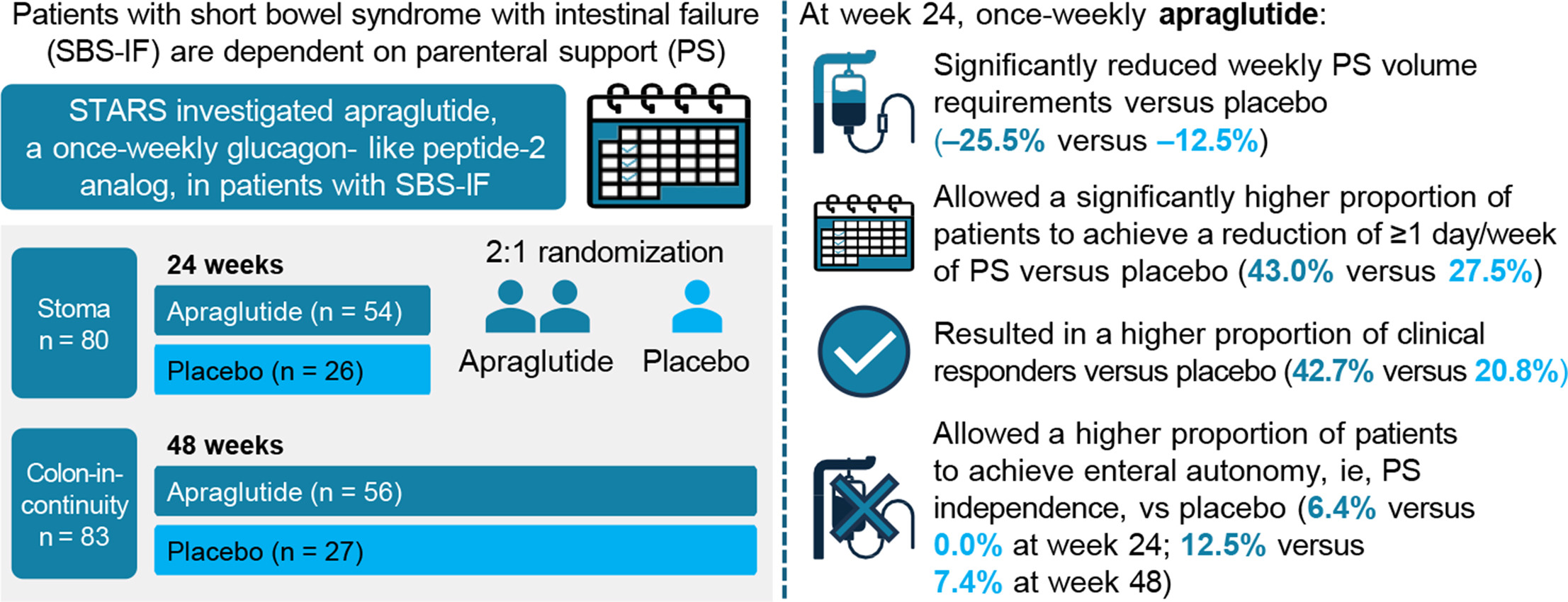
At 24 weeks, weekly parenteral support volume fell by 26% with apraglutide vs. 13% with placebo in the overall study population.
In addition, 43% of patients receiving apraglutide required parenteral support on at least one fewer day per week, compared with 28% receiving placebo.
“People living with short-bowel syndrome who are dependent on parenteral support often manage a complex, lifelong treatment regimen that can include parenteral support multiple days each week alongside other medications and comorbidities,” corresponding author Francisca Joly, MD, PhD, of Hôpital Beaujon in Clichy, France, and the University of Paris, told GI & Hepatology News. “Reducing both the amount and frequency of [parenteral support] has the potential to give patients more time free from therapy. In addition, a once-weekly treatment schedule may help simplify the overall treatment regimen and potentially support medication adherence over time.”
Apraglutide is an investigational, long-acting glucagon-like peptide-2 (GLP-2) analog that promotes intestinal adaptation and is designed for once-weekly dosing, according to the paper. The authors noted that other GLP-2 analogs, including teduglutide and glepaglutide, carry a higher injection burden than once-weekly apraglutide.
The double-blind STARS trial included 163 adults treated at 68 centers. All had less than 200 cm of small intestine remaining and needed parenteral support at least three days per week. Patients were randomly assigned 2-to-1 to receive subcutaneous apraglutide or placebo. Patients weighing at least 50 kg received 3.5 mg, and those under 50 kg received 1.4 mg — lower than the protocol-specified 5 mg and 2.5 mg because of dilution and volume loss during injection preparation, according to the paper.
Investigators grouped patients by their remaining bowel anatomy. Eighty had a jejunostomy or ileostomy without a colon in continuity, and 83 had a colon in continuity. Treatment lasted 24 weeks for patients with a stoma and 48 weeks for those with a colon in continuity.
Before randomization, patients completed a structured period to optimize and stabilize parenteral support. At baseline, they received about 13 liters per week over six days.
The primary endpoint was the percentage change in weekly parenteral support volume at week 24. Weekly volume fell by about 2.9 liters with apraglutide vs. 1.5 liters with placebo, and separation from placebo was seen as early as week eight, according to the paper.
Among patients with a stoma, weekly parenteral support volume fell by 26% with apraglutide vs. 8% with placebo at 24 weeks, a key secondary endpoint.
Among patients with a colon in continuity, however, the differences were not statistically significant. At week 48, weekly parenteral support volume fell by 35% with apraglutide vs. 23% with placebo. In addition, 52% of patients receiving apraglutide needed support on at least one fewer day per week, compared with 44% receiving placebo.
“Responses in these patients may take longer to fully emerge and may continue to increase with longer treatment exposure,” Dr. Joly said.
A clinical response, defined as at least a 20% reduction in weekly volume at both weeks 20 and 24, occurred in 43% of patients receiving apraglutide vs. 21% receiving placebo. Among patients with a stoma, response rates were 41% vs. 15%, respectively.
By week 24, seven patients receiving apraglutide (6%) reached enteral autonomy — independence from parenteral support — compared with none receiving placebo, although the difference was not statistically significant in the prespecified analysis. All seven maintained it through week 48, including three patients with a stoma followed in an extension study. Among patients with a colon in continuity, seven receiving apraglutide and two receiving placebo had achieved enteral autonomy by week 48, a key secondary endpoint that was not statistically significant. The seven included four who had reached it by week 24.
Adverse events occurred in 89% of both groups. Serious events occurred in 36% of patients receiving apraglutide vs. 32% receiving placebo, while severe events occurred in 27% vs. 30%, respectively. Nausea, headache, and central venous catheter infection were among the most common events. One apraglutide recipient with preexisting cardiovascular disease died suddenly; the death was deemed unrelated to treatment.
“As with therapies that enhance intestinal absorption, appropriate monitoring of fluid and nutritional status is important as parenteral support requirements decrease,” Dr. Joly said.
The authors noted that the heterogeneous study population may have influenced outcomes because remaining bowel anatomy and disease severity could affect treatment response. Although investigators grouped patients by anatomy, the trial had enough statistical power to assess these subgroups for only certain secondary endpoints. The authors also wrote that the 1.4-mg dose may have influenced results; it was given only to patients weighing less than 50 kg, a group that included 15 apraglutide recipients. In their discussion, the authors noted that the protocol-defined approach to reducing parenteral support may have contributed to differences in effect size compared with studies using other methods. They also noted that patients with a colon in continuity showed greater variability and a higher placebo response.
Dr. Joly and colleagues concluded that apraglutide reduced both weekly infusion volume and the number of treatment days, while allowing some patients to stop parenteral support entirely. They described enteral autonomy as “a desired milestone in management and a treatment goal for both patients and healthcare providers.”
Ironwood has said the FDA indicated a confirmatory phase 3 trial is needed to seek approval of apraglutide, and the company has begun enrolling that trial, STARS-2.
Ironwood Pharmaceuticals funded the trial and participated in its design, analysis, and interpretation. Dr. Joly and several authors reported consulting, research, speaking, or advisory relationships with Ironwood or other pharmaceutical and nutrition companies; three authors were Ironwood employees and one was an Ironwood consultant.

Expert Insight
Dr. Joly shared her commentary with GI & Hepatology News.
Which patients with short bowel syndrome and intestinal failure are most likely to benefit from apraglutide?
Dr. Joly: Since short bowel syndrome with intestinal failure (SBS-IF) is heterogeneous, the magnitude and timing of response may vary according to individual clinical characteristics. Apraglutide is being developed for adults with SBS-IF who are dependent on parenteral support, rather than for a specific anatomical subgroup. These findings support the potential of once-weekly apraglutide to reduce parenteral support dependence in this population.
How should physicians interpret the smaller, nonsignificant benefits among patients with a colon in continuity?
Dr. Joly: Patients with colon-in-continuity (CIC) are a heterogeneous population, with differences in remnant bowel anatomy, nutritional and fluid requirements, and intrinsic capacity for intestinal adaptation that can influence both the magnitude and timing of treatment response. Importantly, responses in these patients may take longer to fully emerge and may continue to increase with longer treatment exposure.
The totality of the data in patients with CIC is encouraging. In STARS, apraglutide-treated patients with CIC experienced continued reductions in parenteral support through week 48, with a mean 35.4% reduction from baseline. More than half achieved at least one additional day off parenteral support per week, and some achieved enteral autonomy.
These findings are further supported by STARS Nutrition, a prospective metabolic balance study conducted specifically in patients with SBS-IF and CIC (Verbiest et al., 2024). With once-weekly apraglutide, patients demonstrated significant improvements in intestinal absorption together with a 52% reduction in parenteral support volume at week 52; 78% achieved at least one additional day off parenteral support and 22% achieved complete independence from parenteral support.
What safety concerns and monitoring requirements should physicians consider when prescribing apraglutide?
Dr. Joly: As with therapies that enhance intestinal absorption, appropriate monitoring of fluid and nutritional status is important as parenteral support requirements decrease, so that support can be adjusted using a protocol-defined approach incorporating clinical assessment, fluid balance, urine output, and oral intake. The study also included prespecified safety monitoring, including gastrointestinal surveillance and monitoring for adverse events of special interest.
Overall, STARS demonstrated that once-weekly subcutaneous apraglutide significantly reduced [parenteral support] requirements in patients with SBS-IF, with a well-tolerated safety profile consistent with prior evidence. In STARS, overall adverse events and serious adverse events occurred at similar rates between apraglutide and placebo. No malignancies were reported during the study.