Incident cancer risk was low and comparable across contemporary advanced therapy classes in patients with inflammatory bowel disease (IBD), according to findings from an administrative claims-based study published online in Clinical Gastroenterology and Hepatology.
The retrospective active-comparator, new-user cohort study included 15,687 adults with IBD and no cancer diagnosis in the preceding year who initiated tumor necrosis factor (TNF) antagonists, vedolizumab, anti-interleukins, or Janus kinase (JAK) inhibitors between 2016 and 2023. The primary outcome was incident cancer, excluding nonmelanoma skin cancer, occurring at least three months after treatment initiation.
In an interview with GI & Hepatology News, corresponding author Siddharth Singh, MD, MS, professor of medicine in the Division of Gastroenterology and Hepatology at Mayo Clinic Arizona, said the findings were reassuring across treatment classes.

“In nearly 15,700 patients with IBD, the overall risk of incident cancer was low and comparable across all contemporary advanced therapies, TNF antagonists, vedolizumab, anti-interleukins, and JAK inhibitors, with consistent findings in Crohn’s disease and ulcerative colitis and at the individual-agent level,” Dr. Singh said.
“We found no signal that any one class of advanced therapy carried a higher overall cancer risk than another,” he added.
Incidence by therapy class
The study used deidentified medical and pharmacy claims from the OptumLabs Data Warehouse. Patients had Crohn’s disease or ulcerative colitis and initiated an advanced therapy between January 2016 and May 2023. The analysis included 8,031 patients who initiated TNF antagonists, 3,985 who initiated vedolizumab, 3,287 who initiated anti-interleukin therapies, and 384 who initiated JAK inhibitors.
Patients were followed for a median of 2.6 years. Mean patient age was 45 years, 52% were female, 58% had Crohn’s disease, and 42% had ulcerative colitis.
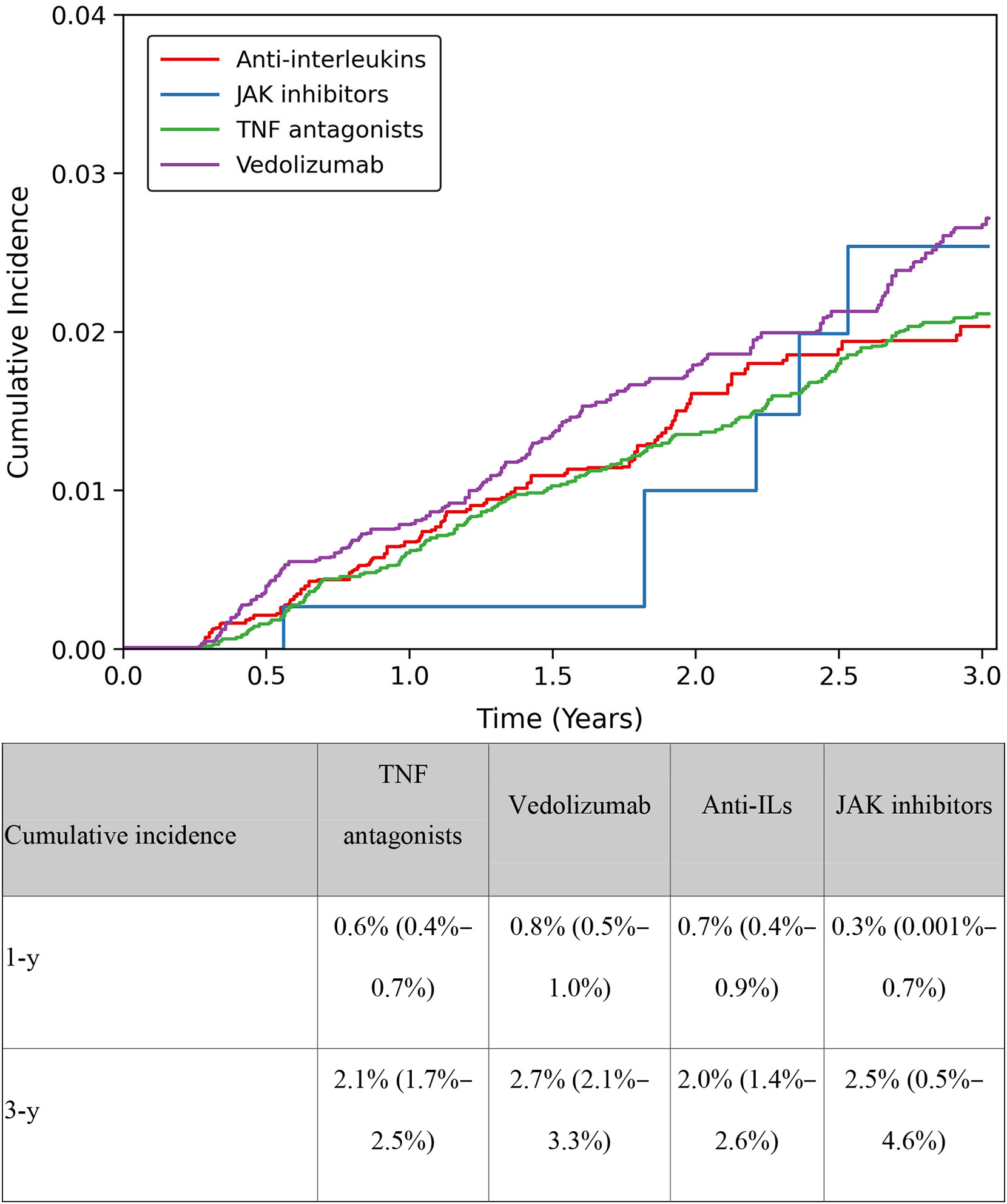
Overall, 273 patients developed cancer during follow-up. The three-year cumulative incidence of cancer was 2.1% with TNF antagonists, 2.7% with vedolizumab, 2.0% with anti-interleukins, and 2.5% with JAK inhibitors.
After adjustment, cancer risk with vedolizumab, anti-interleukins, and JAK inhibitors was not significantly different from cancer risk with TNF antagonists, the study’s primary comparator group. The adjusted hazard ratios were 1.01 for vedolizumab, 0.94 for anti-interleukins, and 0.85 for JAK inhibitors.
Findings were similar in analyses stratified by IBD phenotype. In patients with Crohn’s disease, hazard ratios compared with TNF antagonists were 1.00 for vedolizumab, 0.95 for anti-interleukins, and 0.44 for JAK inhibitors. In patients with ulcerative colitis, the corresponding hazard ratios were 1.03, 0.84, and 0.99.
Comparative estimates were also similar in analyses by cancer type — solid organ, hematological, and melanoma — although the authors noted that event rates were low. Across the cohort, 13 patients developed lymphoma and 17 developed melanoma.
The findings also were consistent in an exploratory agent-level analysis restricted to the six agents with adequate sample size — adalimumab, infliximab, vedolizumab, ustekinumab, risankizumab, and tofacitinib — with no statistically significant difference in overall cancer risk in pairwise comparisons.
What the authors say it means for practice
Concerns about malignancy often influence treatment selection in IBD, particularly as more patients receive advanced therapies earlier and for longer periods, the authors noted.
“The results are reassuring: concern about overall cancer risk shouldn’t, by itself, steer clinicians away from any particular class, freeing therapy choice to be driven mainly by efficacy, disease phenotype, and patient preference,” Dr. Singh said.
In a separate comparison with 6,937 immunomodulator- and advanced therapy-naive patients with newly diagnosed IBD, standardized overall cancer incidence was not increased among patients initiating advanced therapy. Incidence with advanced therapies, at 0.68 to 0.90 cases per 100 person-years, was broadly consistent with the 0.75 cases per 100 person-years observed in the treatment-naive cohort — a finding the authors wrote reinforces the inference that elevated malignancy risk in IBD may be driven substantially by the disease itself rather than by its treatment.
The authors emphasized that individualized risk assessment and longer-term surveillance remain important.
Limitations
The authors cautioned that with only 384 patients initiating JAK inhibitors and few cancer events, the comparative estimates are imprecise and should be viewed as hypothesis-generating rather than as evidence of equivalent long-term safety.
The investigators also cautioned that the findings should be interpreted in light of the study’s observational design, relatively short follow-up, and low number of cancer events, particularly for newer agents.
Because the study used claims data, residual confounding and channeling bias could not be excluded. Prior cancer history could only be assessed during the year before advanced therapy initiation, and several established cancer risk factors, including family history of malignancy and prior colonic dysplasia, could not be captured. The authors also noted that claims-based proxies may not fully capture differences in imaging, dermatologic, or oncologic surveillance.
Dr. Singh cautioned that the findings should not be treated as definitive for the newest agents or for rare, long-latency malignancies.
“These are reassuring real-world data, but not the final word — longer follow-up is needed especially with newer agents, before we can speak to rare, long-latency malignancies or individual drugs,” he said.
The authors concluded that the findings support use of advanced therapies when clinically indicated, while underscoring the need for individualized risk assessment, cancer surveillance, and longer-term studies to clarify malignancy risks associated with specific agents and patient subgroups.
The study was supported by the Crohn’s and Colitis Foundation. Dr. Singh is supported by the National Institute of Diabetes and Digestive and Kidney Diseases. Dr. Singh reported no relevant disclosures. Several coauthors reported research support, consulting fees, advisory board fees, speaker’s fees, and/or other relationships with industry. Additional author disclosures are available with the study.