Advanced therapies are increasingly used within the first year after an inflammatory bowel disease (IBD) diagnosis, but outcome trends differed between Crohn’s disease (CD) and ulcerative colitis (UC), a large U.S. claims study found.
Among patients diagnosed from 2019 through 2023, 53% with CD and 27% with UC started an advanced therapy within one year. Repeated corticosteroid use declined compared with patients diagnosed from 2007 through 2012, although overall corticosteroid use remained common.
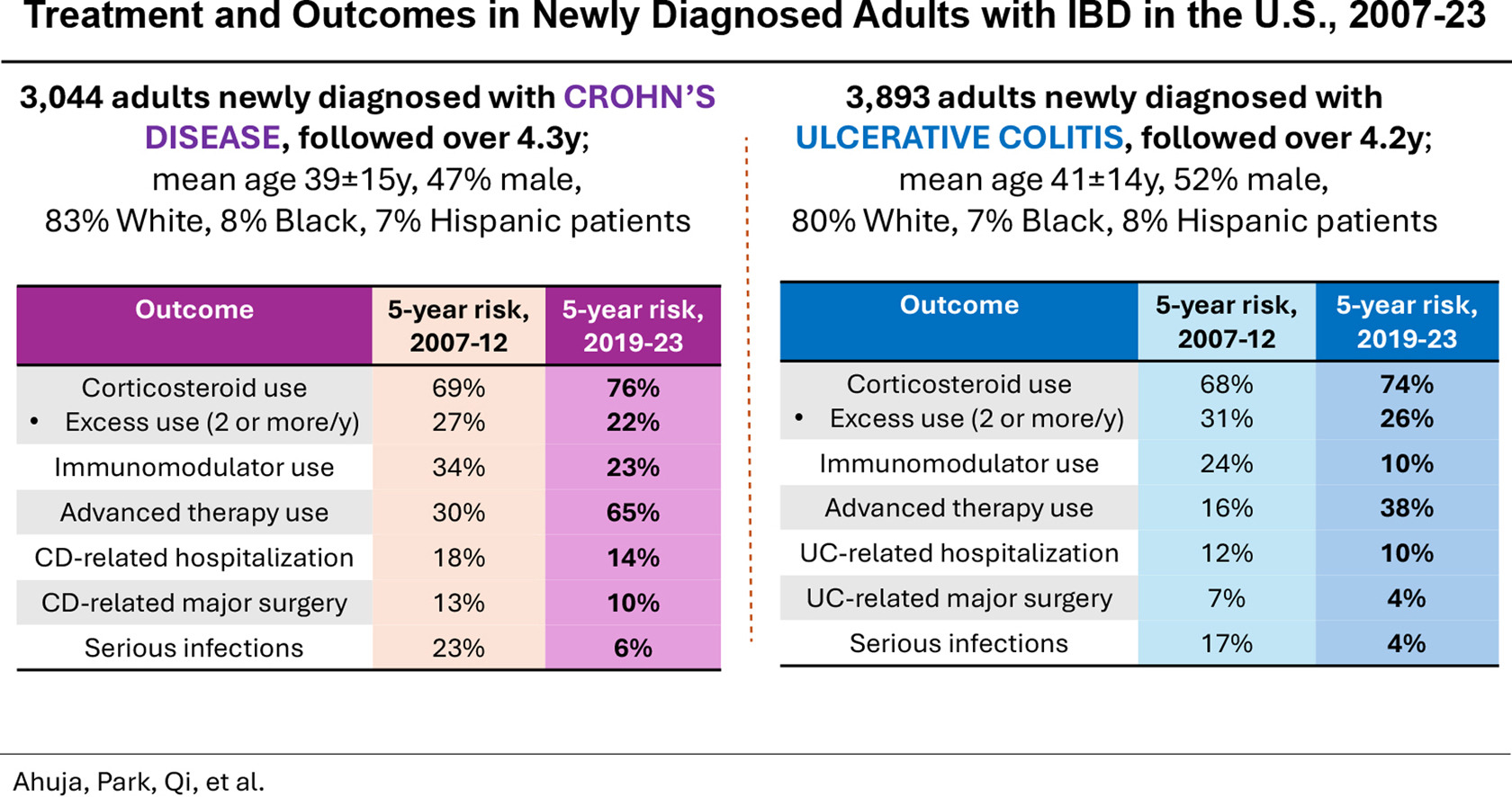
In CD, the estimated five-year risk of IBD-related hospitalization fell from 18% to 14%, but the adjusted comparison was not statistically significant (adjusted hazard ratio, 0.80; 95% confidence interval, 0.62-1.03). Major abdominal surgery also did not decline significantly. In UC, hospitalization remained relatively stable, while colectomy declined significantly.
Reporting in Clinical Gastroenterology and Hepatology, corresponding author Siddharth Singh, MD, MS, professor of medicine in the division of gastroenterology and hepatology at Mayo Clinic in Arizona, Scottsdale, and colleagues conducted a retrospective cohort study using the OptumLabs Data Warehouse, which contains medical and pharmacy claims from commercially insured patients across the U.S.
The analysis included 3,044 adults with newly diagnosed CD and 3,893 with newly diagnosed UC from 2007 through 2023. Patients were aged 18-64 years, had at least four years of claims before diagnosis, had not received previous IBD treatment, and met claims-based criteria for a new IBD diagnosis. Investigators compared patients diagnosed in 2007-2012, 2013-2018, and 2019-2023, assessing medication use, hospitalization, surgery, and safety events over up to five years.
Among patients with CD, use of advanced therapies within five years of diagnosis rose from 30% in the 2007-2012 group to 65% in the 2019-2023 group, while immunomodulator use fell from 34% to 24%. Corticosteroid use within five years rose from 69% to 76%. However, among those who received corticosteroids, the proportion receiving at least two courses within one year fell from 27% to 22%. In the most recent group, 44% received corticosteroids and 53% started an advanced therapy within one year.
The estimated five-year risk of CD-related hospitalization fell from 18% among patients diagnosed in 2007-2012 to 14% among those diagnosed in 2019-2023, although the adjusted comparison was not statistically significant. Serious infections fell from 23% to 6%.
Major abdominal surgery did not decline significantly, with five-year risks of 13% in the earliest cohort and 10% in the most recent cohort.
Among patients with UC, five-year use of advanced therapies rose from 16% to 38%, while immunomodulator use fell from 24% to 10%. Corticosteroid exposure increased from 68% to 74%, but repeated use declined from 31% to 26%.
UC-related hospitalizations remained relatively stable, with five-year risks of 12% in the earliest cohort and 10% in the most recent cohort. However, colectomy declined significantly from 7% to 4%, while serious infections fell from 17% to 4%.
Several subgroup differences emerged. Black patients with CD had higher rates of hospitalization and corticosteroid use than White patients, but rates of repeated corticosteroid use, surgery, and advanced therapy use were similar. Hispanic patients with CD were less likely to receive advanced therapy. Among patients with UC, Hispanic patients had lower corticosteroid use and lower all-cause hospitalization. Overall, the authors reported no consistent racial, ethnic, age, or sex differences in treatment and outcomes.
For both diseases, advanced therapy use was lower among patients diagnosed at ages 40-64 years than among those diagnosed at ages 18-39 years. Patients with UC diagnosed at ages 40-64 years also had a higher risk of colectomy.
The observational study could not determine whether earlier advanced therapy led to changes in outcomes. Claims lacked information on disease activity, disease characteristics, complications, medication adherence, and patient-reported outcomes. Race and ethnicity were imputed for about 70% of patients. In addition, the commercially insured cohort excluded adults older than 64 years and may not represent patients who depend on public insurance. Follow-up was limited to five years.
The National Institute of Diabetes and Digestive and Kidney Diseases supported the study. Dr. Singh reported research funding from Pfizer, and several co-authors disclosed financial relationships with pharmaceutical companies.

Expert Insight
Dr. Singh explained the clinical implications to GI & Hepatology News.
Has this study changed how you treat newly diagnosed Crohn’s disease or ulcerative colitis?
Dr. Singh: It reinforces how I already practice. I don’t wait for patients with Crohn’s disease or moderate-to-severe ulcerative colitis to fail repeated steroid courses. It’s reassuring to see that shift nationally: fewer repeat steroid courses, earlier advanced therapy, and fewer serious infections.
Why do you think earlier use of advanced therapies has not clearly reduced Crohn’s-related surgery?
Dr. Singh: Crohn’s disease often causes bowel damage, such as strictures and fistulas, before it is even diagnosed, and current therapies can’t reverse that damage. Ulcerative colitis is largely inflammatory, so early treatment lowers colectomy risk, which is what we saw. In Crohn’s, early diagnosis and early treatment before bowel damage sets in matters a lot.
Which patients should move to advanced therapy sooner rather than receive another steroid course?
Dr. Singh: AGA guidelines are very informative on approach to managing patients with IBD. In my practice, anyone needing a second steroid course within a year has uncontrolled disease and should move to advanced therapy. Ideally, most patients with Crohn’s disease, especially those with high-risk features like perianal or stricturing disease or extensive disease, should start advanced therapy early, not after steroids fail.
Is there anything else you'd like to say about this work?
Dr. Singh: This is one of the largest contemporary U.S. studies following adults from the time of IBD diagnosis. The encouraging news is less steroid dependence, earlier effective therapy, and fewer serious infections, with broadly similar treatment across racial and ethnic groups. The next challenge is changing the long-term course of Crohn’s disease.