Biochemical responses to elafibranor were sustained through three years of treatment in patients with primary biliary cholangitis (PBC) who had an inadequate response or intolerance to ursodeoxycholic acid, according to longer-term results from the phase 3 ELATIVE trial published online in the Journal of Hepatology.
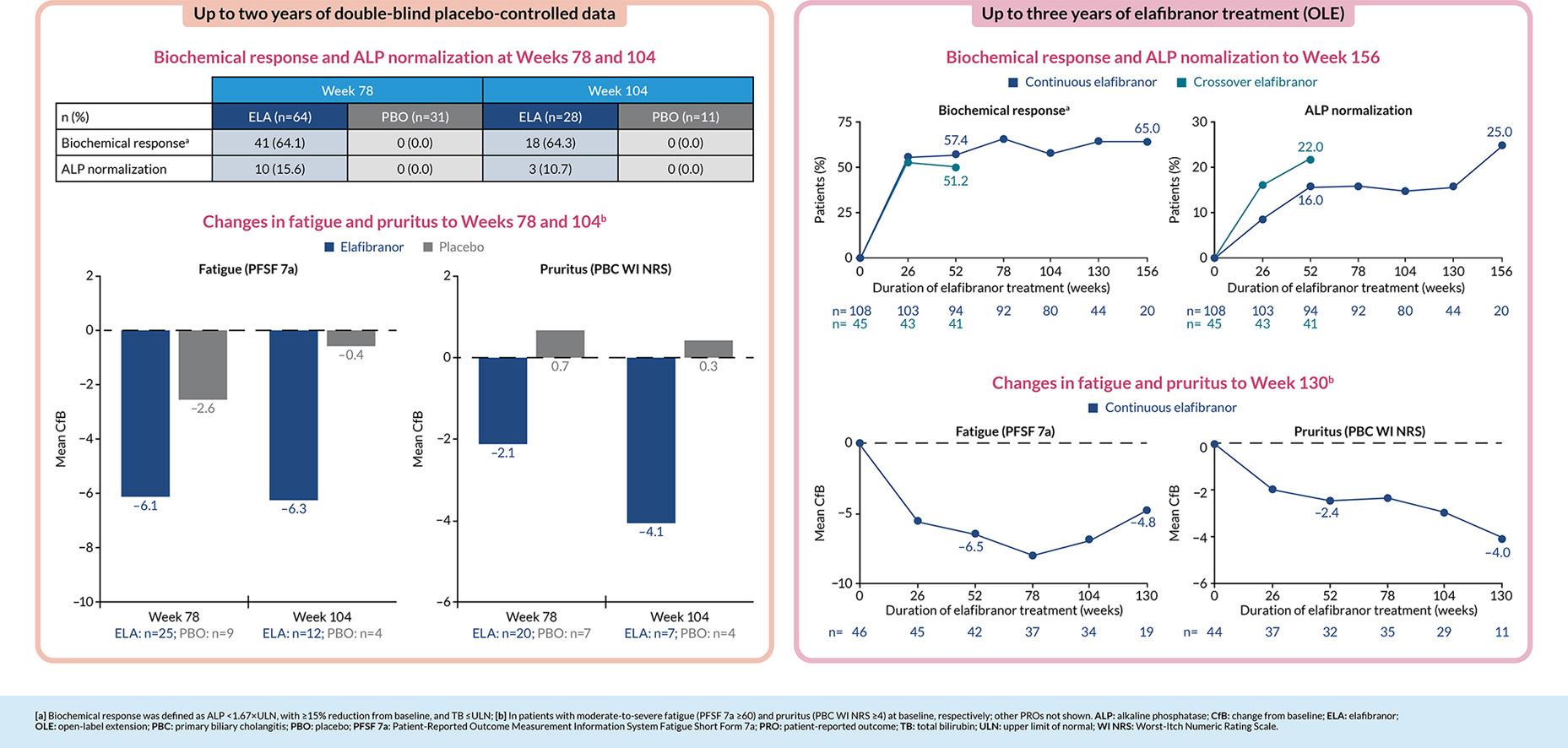
At week 104 of the double-blind period, 64% of patients receiving elafibranor (18 of 28) achieved a biochemical response compared with none receiving placebo (0 of 11). Among patients who continued elafibranor into the trial’s open-label extension (OLE), 65% (13 of 20) had a biochemical response after 156 weeks of treatment.

“These data show that treatment with elafibranor for periods longer than 52 weeks is associated with increasing rates of biochemical response, may improve symptoms and is not associated with any new safety concerns,” Kris V. Kowdley, MD, AGAF, FAASLD, FACP, FACG, the study’s lead and corresponding author, told GI & Hepatology News.
He is director of Liver Institute Northwest in Seattle, clinical professor at Washington State University’s Elson S. Floyd College of Medicine, and senior scientific advisor and medical director at Velocity Clinical Research.
The paper describes biochemical response rates in the extension as sustained, with rates at week 156 comparable to those at week 52. The number of patients with data declined over that period, from 94 at week 52 to 20 at week 156.
Longer-term ELATIVE results
Because PBC is a chronic, progressive disease, the authors wrote that “it is important for newer treatments to demonstrate sustained long-term efficacy and tolerability, as patients are likely to remain on a therapy for extended periods.” Elafibranor, a peroxisome proliferator-activated receptor (PPAR)-α/δ agonist, was the first PPAR agonist to receive accelerated approval in the United States and conditional approval in the European Union as a second-line treatment for PBC, the authors noted.
In the trial’s primary analysis, published in 2024 in the New England Journal of Medicine, 51% of patients receiving elafibranor vs. 4% receiving placebo achieved a biochemical response at week 52. The current report adds placebo-controlled data through 104 weeks and data from the ongoing OLE, with efficacy data extending to 156 weeks and safety data to a maximum exposure of 182 weeks, as of a June 7, 2024, data cutoff.
ELATIVE is an ongoing, double-blind, placebo-controlled phase 3 trial with an OLE. Investigators randomized 161 patients 2:1 to elafibranor 80 mg or placebo once daily for at least 52 weeks. The double-blind period consisted of a 52-week common period followed by a variable period. Patients remained in the variable period until the last enrolled patient completed 52 weeks or until they reached 104 weeks, whichever came first. As a result, 28 elafibranor-treated and 11 placebo-treated patients contributed week 104 biochemical data. Patients completing the first 52 weeks were eligible to enter the OLE to receive elafibranor.
The analyses included biochemical response, alkaline phosphatase (ALP) normalization, changes in liver biochemistry and noninvasive tests of fibrosis, as well as patient-reported measures of fatigue and pruritus. Biochemical response was defined as ALP less than 1.67 times the upper limit of normal, an ALP reduction of at least 15% from baseline, and total bilirubin at or below the upper limit of normal. The post hoc analyses were descriptive, with no hypothesis testing or imputation of missing efficacy data.
Of the 161 randomized patients, 141 completed the double-blind period and 138 entered the OLE. Ninety-three continued elafibranor, while 45 crossed over from placebo to elafibranor.
Liver biochemistry and fibrosis
In addition to the week 104 biochemical response rates, ALP normalization occurred in 11% of patients receiving elafibranor (3 of 28) and none receiving placebo (0 of 11) at that time point. Mean ALP decreased 46% from baseline with elafibranor at week 104 and increased 24% with placebo, although the authors noted that patient numbers were reduced at that time point.
Among patients who received elafibranor in both the double-blind period and the OLE (continuous elafibranor), 59% (47 of 80) had a biochemical response after 104 weeks of elafibranor treatment and 65% (13 of 20) after 156 weeks. ALP normalization occurred in 15% (12 of 80) and 25% (5 of 20), respectively.
Among patients in the continuous elafibranor group who had data at week 52 and beyond, 85% (46 of 54) of those with a biochemical response at week 52 also had a response at their last available assessment through week 156. Among those without a response at week 52, 21% (8 of 38) subsequently achieved one while continuing elafibranor.
“Patients treated with long-term elafibranor therapy in the open-label extension study up to 156 weeks showed increasing rates of biochemical response,” Dr. Kowdley said.
Patients who crossed over from placebo also showed biochemical changes after starting elafibranor. At 13 weeks, mean ALP, gamma-glutamyltransferase, and alanine aminotransferase levels decreased 40%, 34%, and 9%, respectively. After 52 weeks, 51% of crossover patients (21 of 41) had achieved a biochemical response and 22% (9 of 41) had achieved ALP normalization.
Mean total bilirubin in the crossover group increased 14% after 52 weeks. The authors attributed the increase primarily to two patients with advanced disease at baseline — one with marked elevations related to disease progression and one with elevations attributed to concomitant medication use.
Noninvasive measures of fibrosis, including liver stiffness measurement and enhanced liver fibrosis scores, remained stable during longer-term treatment. The authors noted that similar stability was observed with placebo during the double-blind period, indicating no clear treatment effect on these measures. They added that the limited observation period and small number of placebo-treated patients at later time points restricted reliable comparisons. Longer-term data are needed to fully assess elafibranor’s effect on fibrosis, the authors wrote.
Fatigue and pruritus
Among patients with moderate-to-severe fatigue at baseline, mean Patient-Reported Outcome Measurement Information System Fatigue Short Form 7a (PFSF 7a) scores decreased 6.3 points with elafibranor vs. 0.4 points with placebo at week 104, based on 12 and four patients, respectively. At week 52, 67% of patients receiving elafibranor (28 of 42) vs. 31% receiving placebo (5 of 16) achieved a clinically meaningful improvement on this measure, defined as an improvement of at least 3.0 points.
For patients with moderate-to-severe pruritus at baseline, mean PBC Worst-Itch Numeric Rating Scale (PBC WI NRS) scores decreased 4.1 points with elafibranor at week 104 compared with a 0.3-point increase with placebo, based on seven and four patients, respectively.
“Patients treated with elafibranor who had moderate-to-severe fatigue or pruritus showed greater improvements compared to those treated with placebo,” Dr. Kowdley said.
The between-group differences in this analysis were numerical, as the analysis included no hypothesis testing. The authors also noted that the prespecified key secondary pruritus endpoint had not differed significantly between groups at week 52, although other itch measures numerically favored elafibranor.
Among patients receiving continuous elafibranor, numerical improvements in fatigue and pruritus persisted through 130 weeks of elafibranor treatment. Mean decreases were 4.8 points on the PFSF 7a (19 patients) and 4.0 points on the PBC WI NRS (11 patients). In the crossover group, the fatigue improvement on the PFSF 7a was less pronounced after 52 weeks, with a mean decrease of 0.4 points. The authors cautioned that relatively few patients with moderate-to-severe symptoms remained in these analyses at later time points.
Safety findings
The authors reported no unexpected safety findings during the OLE. Treatment-emergent adverse events (TEAEs) occurred in 75% of patients receiving continuous elafibranor and 60% of those who crossed over from placebo. Serious TEAEs occurred in 8% and 13%, respectively, and investigators considered none to be treatment related. No TEAEs led to death during the OLE.
Gastrointestinal events observed during the OLE were generally mild to moderate and nonserious. Renal function remained stable, and investigators reported no new adverse events of special interest involving muscle injury, rhabdomyolysis, or increased creatine phosphokinase.
During the double-blind period, bone fractures occurred in seven patients receiving elafibranor (6.5%) and one receiving placebo (1.9%). During the OLE, fractures occurred in four continuous (4.3%) and four crossover (8.9%) patients. The authors reported that seven of the eight OLE fractures were associated with a fall or trauma and that all eight patients had baseline risk factors such as menopause or low bone mineral density. They also reported that changes in bone mineral density and bone turnover markers through week 52 were comparable between elafibranor and placebo.
Clinical context
“To our knowledge, this is the longest duration of double-blind, placebo-controlled data available for an approved treatment in PBC,” the authors wrote.
They reported that long-term response rates with elafibranor were generally comparable to those in long-term studies of seladelpar, obeticholic acid, bezafibrate, and fenofibrate. However, they cautioned that differences in trial designs, inclusion criteria, patient populations, and exposure time may preclude meaningful comparisons across trials.
Study limitations
“Limitations of the study are the relatively small numbers of patients studied and lack of data on whether there were changes in disease stage or long-term outcomes given the short duration of the study,” Dr. Kowdley said.
The authors noted that patients entered the OLE at different times and with varying prior treatment exposure, requiring broad analysis windows. Longer intervals between OLE visits may also have reduced detection of mild or moderate adverse events because of recall bias. The OLE analysis was a snapshot rather than a formally planned interim analysis and therefore was considered descriptive and exploratory.
The authors also noted that patient numbers declined at later time points and that the week 104 double-blind findings may have been affected by informative dropout and survivor bias. The fatigue and pruritus subgroups were also small. Restricting symptom analyses to patients with moderate-to-severe symptoms at baseline could overestimate effects through regression to the mean, although the authors wrote that this was theoretically just as likely in the elafibranor and placebo groups.
The authors concluded, “Collectively, these results support the sustained long-term efficacy and safety of elafibranor for patients with PBC.”
The trial was sponsored by Ipsen and GENFIT; Ipsen sponsored this analysis and funded medical writing support. Dr. Kowdley reported grants, consulting fees, and honoraria from Ipsen, among other companies; four co-authors are Ipsen employees and shareholders, and most others reported relationships with Ipsen or other pharmaceutical companies.