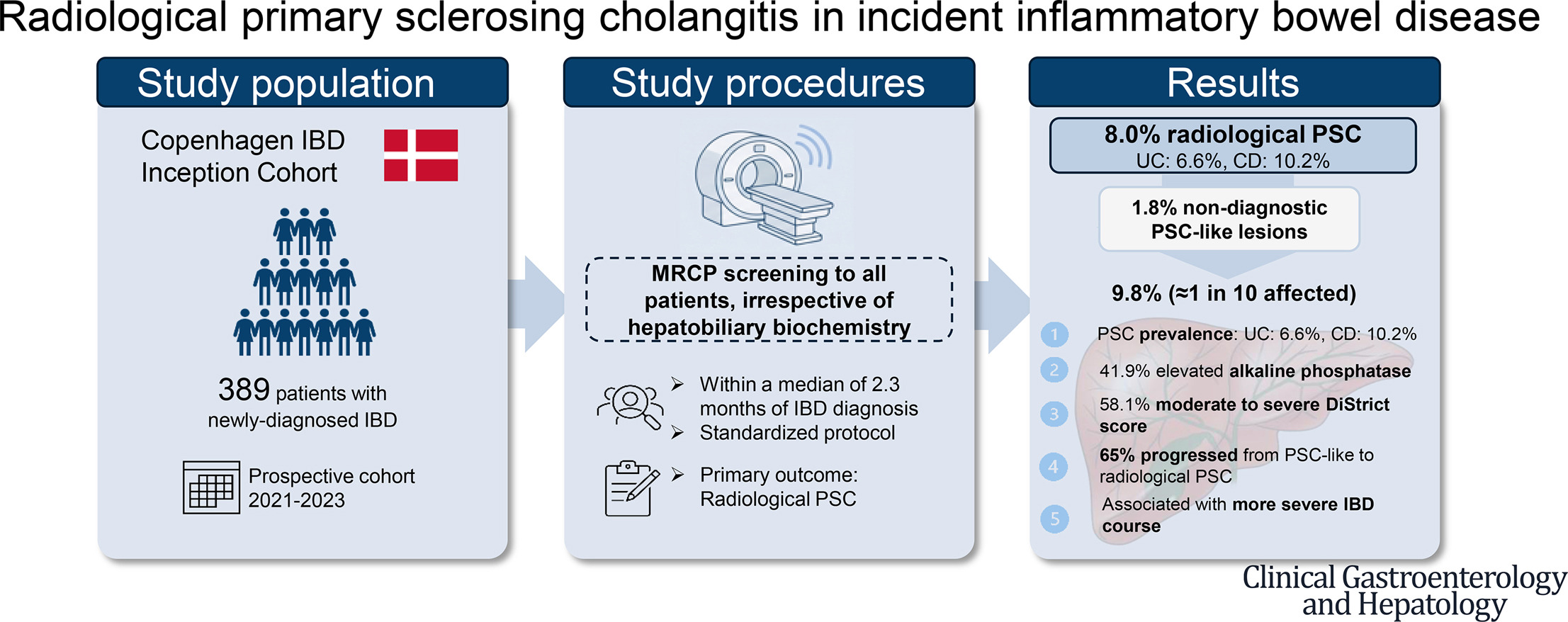
Systematic magnetic resonance cholangiopancreatography (MRCP) screening detected radiological primary sclerosing cholangitis (PSC) in 8% of patients with newly diagnosed inflammatory bowel disease (IBD), with another 1.8% showing PSC-like lesions, according to the prospective Copenhagen IBD Inception Cohort published in Clinical Gastroenterology and Hepatology.
The population-based study enrolled adults with newly diagnosed ulcerative colitis, Crohn’s disease, or IBD unclassified in a defined region of Denmark between May 2021 and May 2023, with IBD unclassified grouped with ulcerative colitis for analysis. All patients were offered standardized MRCP regardless of symptoms or hepatobiliary biochemistry. The primary outcome was the prevalence of radiological PSC and non-diagnostic PSC-like lesions at IBD diagnosis, with patients who had normal MRCP findings serving as the comparator group. Of 527 eligible patients, 389 underwent MRCP within a median of 2.3 months after IBD diagnosis and were followed for a median of two years.

Johan Burisch, MD, PhD, DMSc, of the Gastrounit, medical division, Copenhagen University Hospital – Amager and Hvidovre, Hvidovre, Denmark, said the findings suggest that conventional approaches may miss a substantial proportion of patients with early biliary disease.
“Systematic MRCP identified radiological PSC in 8% of patients with newly diagnosed IBD, while a further 2% had PSC-like lesions,” Dr. Burisch said. “Importantly, approximately half of those with radiological PSC had normal liver biochemistry.”
Screening findings
Among the 389 patients who underwent MRCP, 31 had radiological PSC, including 16 of 242 patients with ulcerative colitis and 15 of 147 patients with Crohn’s disease. Prevalence was numerically higher in Crohn’s disease than in ulcerative colitis, at 10.2% vs. 6.6%, but the difference was not statistically significant. Seven additional patients had non-diagnostic PSC-like lesions, yielding a combined prevalence of 9.8%.
The 31 cases included 13 patients whose baseline MRCP showed non-diagnostic PSC-like lesions and who were reclassified as having had radiological PSC at baseline after their lesions progressed on repeat imaging one year later.
Liver biochemistry
Abnormal hepatobiliary biochemistry was present in 51.6% of patients with radiological PSC, meaning nearly half had normal liver tests. Thirteen patients, or 41.9%, had elevated alkaline phosphatase at IBD diagnosis and therefore met European Association for the Study of the Liver criteria for a PSC diagnosis.
Among patients with ulcerative colitis, radiological PSC was more common in those with extensive colitis, occurring in 12.3% compared with 4.3% of those without extensive colitis.
Both intrahepatic and extrahepatic bile ducts were involved in 67.7% of patients with radiological PSC, and 58.1% had moderate disease according to the DiStrict score. None had severe disease. No PSC-related mortality, cancer, cirrhosis, cholangitis, or liver transplantation occurred during follow-up.
Follow-up imaging
Twenty patients were identified with non-diagnostic PSC-like lesions at baseline. Of those, 13, or 65%, progressed to radiological PSC on repeat MRCP after one year. Five had persistent PSC-like lesions, and two showed complete radiological resolution.
“Patients with indeterminate PSC-like lesions may also warrant follow-up, as most progressed to radiological PSC on repeat imaging,” Dr. Burisch said.
“Earlier recognition of PSC could allow appropriate hepatological assessment and surveillance for colorectal and hepatobiliary malignancies,” he added. “However, our findings do not yet support routine MRCP screening of all patients at IBD diagnosis.”
Early IBD outcomes
Over a median of two years of follow-up, patients with radiological PSC were more likely than those with normal MRCP findings to experience IBD-related hospitalization, at 41.9% vs. 23.4%, and to require biologic therapy, at 38.7% vs. 21.4%. They were also more likely to meet the study’s composite endpoint of a severe disease course, defined as IBD-related resective surgery or initiation of biologic therapy, whichever came first, at 45.2% vs. 24.5%.
Patients with PSC-like lesions also had higher rates of worsening or flare, at 71.4% vs. 17.7%, and systemic corticosteroid use, at 85.7% vs. 40.5%, although the PSC-like lesion group included only seven patients.
Interpretation and limits
The investigators cautioned that subtle MRCP abnormalities can be difficult to interpret. Interobserver agreement for radiological PSC was moderate, and some findings could reflect normal anatomical variation rather than clinically meaningful disease. Central review was limited to scans or biochemistry initially flagged as abnormal, which the authors said introduces a risk of misclassification in both directions. The study also lacked a non-IBD control group, and approximately one-quarter of eligible patients did not undergo MRCP. The authors noted the potential for confounding by indication in the outcome analyses, because treatment decisions may have been influenced by the presence of PSC itself, and said subgroup comparisons were exploratory and not adjusted for multiple testing.
“The clinical significance of screen-detected radiological changes remains uncertain,” Dr. Burisch said. “Follow-up was short, the number of outcomes was limited, and subtle MRCP abnormalities may sometimes reflect anatomical variation rather than clinically relevant PSC.”
Long-term studies are needed to determine whether patients with screen-detected radiological abnormalities carry the same risks as those with clinically diagnosed PSC and whether systematic screening improves patient outcomes, he said. Independent validation and cost-effectiveness analyses will also be important before routine screening can be recommended.
The study was funded by an unrestricted grant from the Novo Nordisk Foundation. Dr. Burisch is supported by the EU Horizon Europe Program grant miGut-Health. Dr. Burisch reported grants from AbbVie, Janssen-Cilag, MSD, Takeda, Tillots Pharma, Bristol Myers Squibb, and Novo Nordisk Foundation; and personal fees from AbbVie, Janssen-Cilag, Celgene, MSD, Pfizer, Takeda, Tillots Pharma, Bristol Myers Squibb, Samsung Bioepis, Pharmacosmos, Ferring, Galapagos, Eli Lilly, Dr Falk Pharma, Celltrion, Zealand Pharma, Sanofi, and Orion Pharma. Several coauthors also reported research funding, honoraria, consulting fees, speaker fees, and/or other relationships with industry.